

By David Robie, Asia Pacific Report
New Zealand protesters have again spotlighted the country’s stake in US space militarisation today and speakers branded Rocket Lab as an alleged key link in the “IDF kill chain” as part of the Gaza genocide.
“Rocket Lab is a celebrated New Zealand success story, with a stated mission to open access to space and improve life on Earth,” said Palestine Solidarity Network Aotearoa (PSNA) advocate Brendan Corbett.
“Yet many of its key contracts are with the US military and their suppliers.
“It is driven by share price increases and creating value for shareholders.”
Corbett said the global space militarisation market size was valued at US$61 billion (about NZ$100 billion) in 2025 and was projected to grow from US$66 billion this year to US$116 billion by 2034.
North America dominated space militarisation last year with a market share of more than 40 percent.
‘World war threat’
“The overwhelming majority of our human family are totally appalled at this march to militarisation of space and the threat of world war,” Corbett told the crowd in Te Komititanga Square as they marked the 123rd week of protest over the Gaza genocide.
“But not the war mongering investor class. They make more money.
“Guess what people? Increasing geopolitical rivalry and security threats propels market growth.”
A so-called “ceasefire” came into effect in Gaza on October 10, but since then Israeli violations almost daily have killed 591 Palestinians and wounded 1578 – and children dying at a rate of about two a day — with the besieged enclave facing a severe humanitarian crisis.
Overall, the death toll in the Gaza Strip has topped 72,049 with 171,691 wounded – mostly women and children — since the start of the war, according to Palestinian health authorities.

The government has raised the total number of launches allowed for Rocket Lab at its Mahia launch pad tenfold to 1000, as the cap set at 100 in 2017 is close to being breached.
However, a physics professor at Auckland University, Dr Richard Easther, told RNZ News this week that he did not trust the New Zealand Space Agency to make good decisions while the agency said it had assessed all space activities against clear legislative criteria.
Geopolitical tension
Corbett stressed the increasing geopolitical tension, rivalries and escalating security threats across the globe.
This situation was expected to encourage countries to strengthen space-based defence capabilities.
Military forces of various nations required satellites and space systems to maintain secure communications, surveillance, and navigation under hostile conditions.
“This is the Rocket Lab, Black Sky, Palantir, IDF kill chain,” said Corbett, referring to the Israeli Defence Forces, although critics prefer to characterise IDF as the IOF – “Israeli Offence Forces” in view of Tel Aviv having attacked five countries in the region last year.
“This demand drives procurement of hardened, redundant, and cyber-secure space infrastructure — ”these are the factors contributing to space militarisation market growth”.
Corbett quoted Palantir chief executive officer Alex Karp telling investors in a call last month: “Palantir is here to disrupt and make the institutions we partner with the best in the world, and when it’s necessary to scare our enemies and, on occasion, kill them.”
“Military tech companies no longer pretend they are ethical and humane,” Corbett said.
Space technologies
He explained how space militarisation included deployment and use of space technologies for military applications such as reconnaissance, communications, navigation and so on.
It involved satellites, ground systems and related technologies for defence.
“This is the market niche that fuels Rocket Lab’s business plan,” he said.
Some countries used space and counter-space capabilities and integrated them into regular military exercises.
With space militarisation, countries integrated space assets such as satellites, ground stations, and launch systems into defence operations.
“These factors are driving the overall market growth,” Corbett said. “These are the activities that are driving us to war.”

RIMPAC 2026 exercises
He cited some of the major companies involved, including Lockheed Martin Corporation, Raytheon Technologies — both investors in Rocket Lab — Northrop Gumman Corporation, Airbus Defence and Space, and others.
Other speakers included Kia Ora Gaza activist Patrick O’Dea – who reminded the crowd of nuclear-free protest success in blocking visits by US warships in the 1980s – PSNA’s Neil Scott, and Maire Leadbeater of West Papua Action Tāmaki.
O’Dea challenged the crowd top campaign against New Zealand taking part in the RIMPAC 2026 military exercises in Hawai’i during June to August and “collaborating with the IDF”.
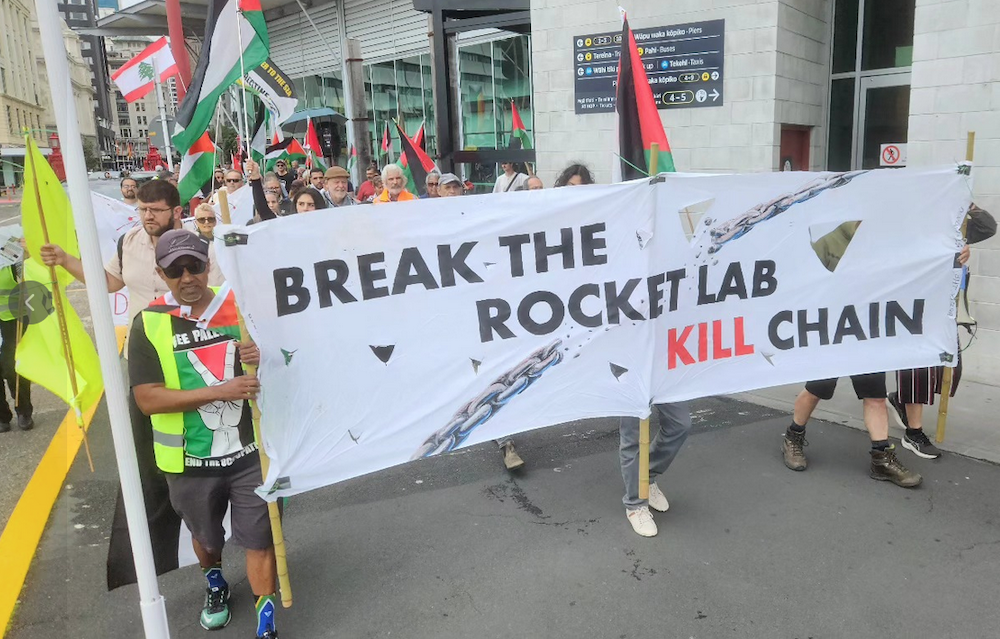
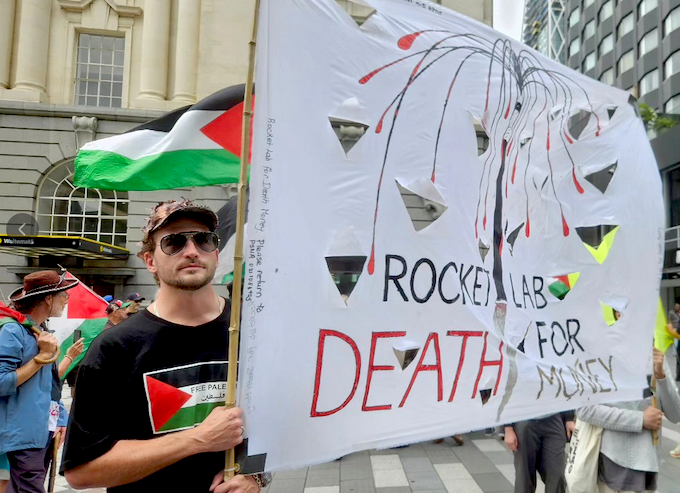
Protesters marched with banners declaring “Break the Rocket Lab kill chain” and “Rocket Lab – death for money” to Queens Wharf where a visiting Norwegian cruise ship Viking Orion (1000 passengers) was moored.