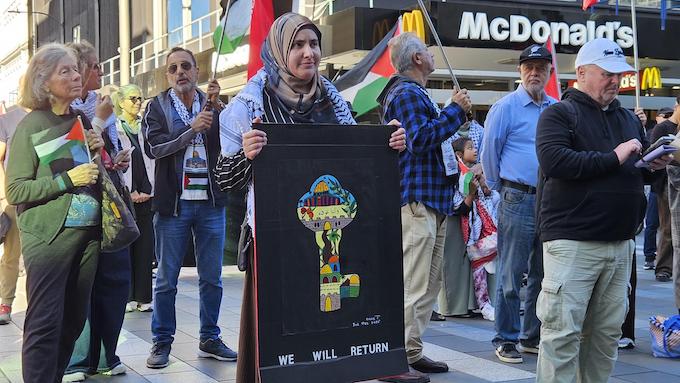

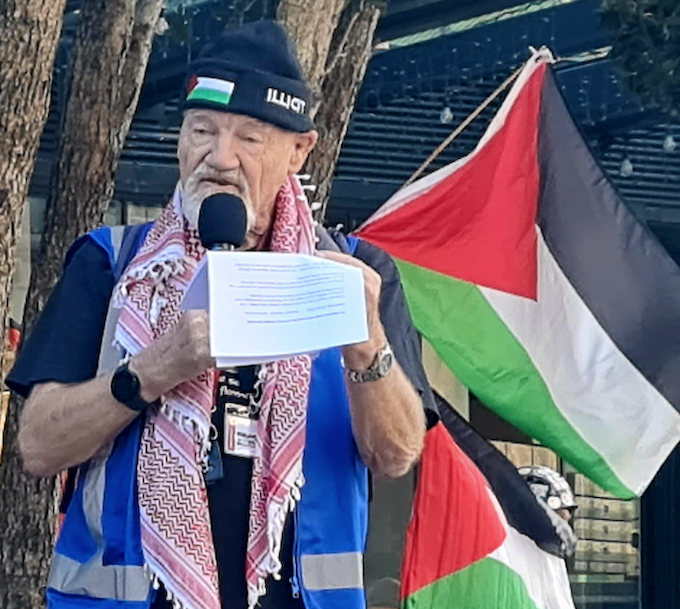
As World Press Freedom Day rapidly approaches and Reporters Without Borders has condemned the Israeli government for its massacre of journalists in Lebanon and Palestine, New Zealand journalist David Robie reflects in a speech at Auckland’s Te Komititanga Square today.
MEDIA FREEDOM: By David Robie
In a week’s time next Sunday, it is World Press Freedom Day on May 3. And already our whānau of journalists who are facing horrendous danger at the hands of the Israeli killing machine have had a shocking few days.
During our 133 weeks of protest we have become painfully accustomed to how one journalist after another has been brutally assassinated, some even alongside their family members.
Far more than 260 journalists — the actual number varies with different media freedom monitoring agencies and different methodologies — have been slaughtered in Israel’s war on Gaza since October 2023.
- READ MORE: Journalist Amal Khalil killed by Israeli airstrikes in Lebanon: RSF retraces events and denounces war crimes
- ‘We had Amal Khalil by her hand’s grip. Then Israel murdered her’
- Other Gaza and Lebanon media freedom reports
- RSF World Press Freedom Report 2026
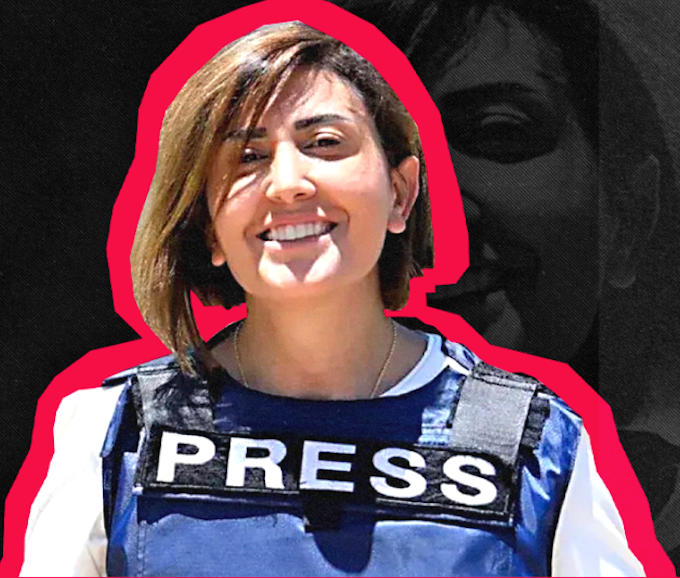
And some of you may have seen the chilling photograph circulating on some social media channels. It shows 8 Lebanese journalists – four men and four women – smiling and giving peace signs.
Eight Lebanese journalists killed in a month by Israel https://t.co/Fqeji5D3M8
— Pen MacRae (@penmacrae) April 23, 2026
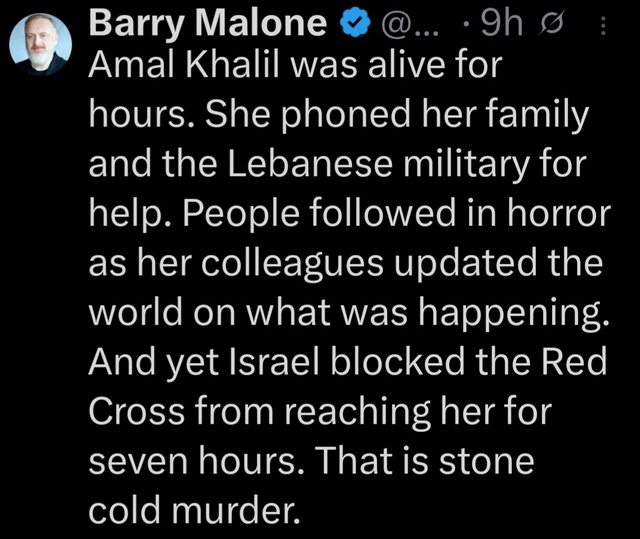
They have all been murdered in the last month, including the tragic killing of Amal Khalil, who died last Wednesday under building rubble in the town of al-Tayri, southern Lebanon, after a double tap attack and then the Israelis fired a stun grenade on the ambulance rescue workers preventing them trying to save her.
But before I talk more about her tragedy and what it means– she was just buried yesterday with thousands at her funeral — I want to show you another photo.
This is Shireen Abu Akleh, a Palestinian American journalist working for the Arabic channel Al Jazeera who was a highly popular household name right across the Middle East if not the world.
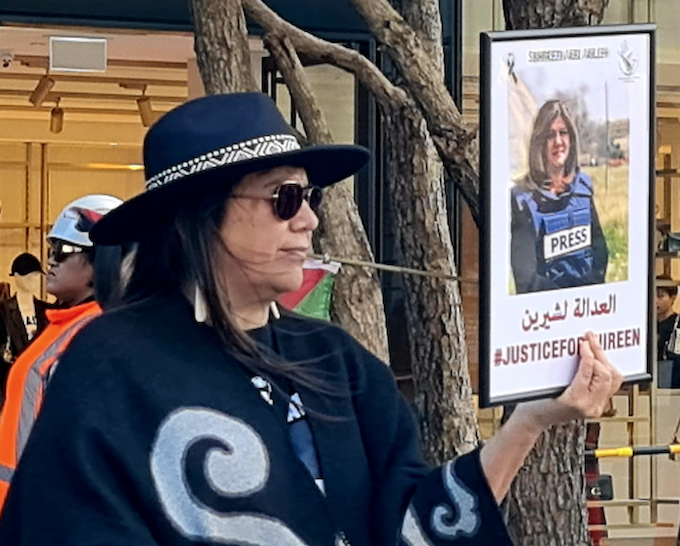
She was known as the “daughter of Palestine” and she was shot and killed by Israeli occupation forces on 11 May 2022 — just eight days after Media Freedom Day that year.
I have this photo hanging on the wall of my office, thanks to Palestine Youth of Aotearoa, to remind me daily of the brutality and global impunity of the Israelis.
With my experience as a media freedom defender for Pacific Media Watch and Reporters Without Borders since 1996, I have come to a chilling and shameful conclusion:
The fact that there was no accountability for her murder and the US authorities and Biden administration orchestrated a cover-up – even though she was American — signalled to the Netanyahu government that they could target journalists and those bearing witness with absolute impunity.
So this is where we are at now, the Israeli killing machine launched into a bloody massacre of more than 72,000 Palestinian civilians in Gaza over the past two plus years, especially targeting journalists, doctors and medical workers, teachers, and aid workers.
And the hypocritical Western countries, including Aotearoa New Zealand, have barely offered a timid bleat.
The Israeli bloodlust has now spread to Lebanon and other countries. The IDF claims that its military is the “most moral in the world”. That claim is an obscenity.
According to the New York-based Committee to Protect journalists (CPJ), Israel is by far the world’s biggest killer of media workers.
On its monitoring website it lists the following:
• 260 journalists and media workers killed by Israel, of which:
• 207 were Palestinians killed in Gaza
• 2 Palestinian killed in Gaza during the Iran war
• 2 Palestinians killed in Israeli detention centers
• 31 Yemenis – out of a total of 32 – killed in Yemen
• 6 Lebanese in Lebanon during the war on Gaza
• 9 Lebanese in Lebanon during the Iran war
• 3 Iranians in Iran during the 12-day war
To return to the targeted murder of Amal Khalil, who worked for Al-Akhbar, she was with another journalist, Zeinab Faraj, who was rescued and survived.
The Paris-based media freedom watchdog Reporters Without Borders said in a statement by its Middle East desk chief Jonathan Dagher:
“The Israeli army has very likely committed two more war crimes on 22 April, by targeting journalists who were identified as such, obstructing rescue operations and continuing strikes that killed one journalist and injured another.
“Responsibility for these crimes also lies with Israel’s allies, who continue to allow the Netanyahu government to commit them with impunity.”
RSF published a compelling and disturbing timeline of how the IDF blocked her would-be rescuers for seven hours.
CPJ’s Middle East and North Africa regional director Sara Qudah said:
“We knew [Amal] was alive beneath the rubble – a real, breathing presence. Not in the abstract, not as rumour or hope.
“The 40-year-old female journalist, Amal Khalil, whose voice had just reached her family and colleagues, her survival depended on whether the machinery of rescue would be allowed to operate as it is supposed to under international law, and the law of humanity.
“That is what made what followed so difficult to process — not only emotionally, but structurally.
“Because this was not a case of disappearance in the fog of war.
“It was a case of proximity to survival that collapsed into confirmed death while rescue was still theoretically possible.”
Qudah added that her death could not be understood only as an individual tragedy, “although it was that to everyone who knew her, every journalist in the region”.
“It must also be understood as a stress test of the systems that are supposed to prevent this outcome — early warning, protection, humanitarian access and accountability. On each of these dimensions, the case raises unresolved questions.”
Israel is not only killing journalists, it is systematically torturing them — along with hundreds of other Palestinian hostages. CPJ’s recent report, “We returned from hell”, where the watchdog published the in-depth testimonies of 59 media prisoners released from jail since October 2023 is shocking reading.
I would like to finish with a quote by Australian journalist Antony Loewenstein, who visited New Zealand in 2023 to launch his book The Palestine Laboratory about how the Israeli killing machine exports in brutal technologies — a book that has been translated into many languages and had a profound influence in the world.
“With some notable exceptions, too many in the international media, journalists, editors and owners, have refused to take appropriate action against Israel. No official sanction.
“[They are] still interviewing Israeli spokespeople and politicians as normal. Not treating this as a monumental crime and outrage. Instead, often deferring to unproven Israeli claims that every journalist murdered was a ‘terrorist’.”
This complicity by many journalists — even in our own region — must be widely condemned.
Dr David Robie is convenor of Pacific Media Watch and a media freedom defender with global groups including RSF. He gave this short address at the Palestine Solidarity Network Aotearoa (PSNA) rally in Auckland on Anzac Day.