
SPECIAL REPORT: By Tony Fala
Saturday, 18 April 2026, was a beautiful autumn day in Henderson, Tāmaki, Aotearoa, but with clouds gathering and rain promised for later in the day. I came to support my friends Simon and Mel from the Banners Crew and to perform kaimahi work for their fundraising efforts for Médecins Sans Frontières–Doctors Without Borders.
Corban Arts Estate was busy with families, workers, and visitors. As I approached Shed Two, the Te Tino Rangatiratanga and Palestine flags fluttered in the wind.
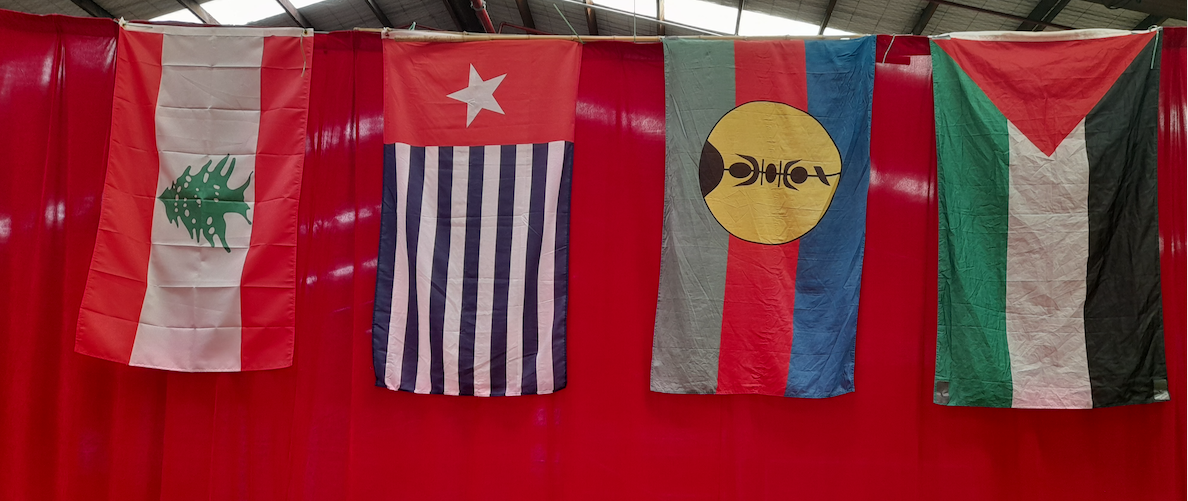
Inside, the Banners whānau were completing preparations, installing banners and flags that reflected years of artistic labour and struggle. Photographs and placards were already in place.
Banners Crew whānau Stephen, Maia, Stu, Matt, Simon, Mel, and the children, Josh, and Jim were there. Linda joined later, while John was not present as he was not well.
Simon provided important background to all Banners Crew organisation efforts for the day:
“We were planning for the event for months and compiling the speakers’ list. Planning stepped up six weeks out and went into overdrive for the last three weeks. We got the venue on Thursday before the event.
“That’s when we started loading in the banners and hung the drop sheet from the ceiling. That took a lot of effort and time…
“Another Banners member, John, helped us with the load in… Linda, another Banners soul, helped on Friday and collected some donated food from the Greek house Restaurant.”
All this extensive work laid the foundation for a formidable community event to come in the afternoon. In diverse ways, and on multiple levels, the Banners Crew had worked tirelessly to ensure all speakers, poets, singers, and manuhiri enjoyed a special community event and fundraising occasion.
The event started just after 2 pm.
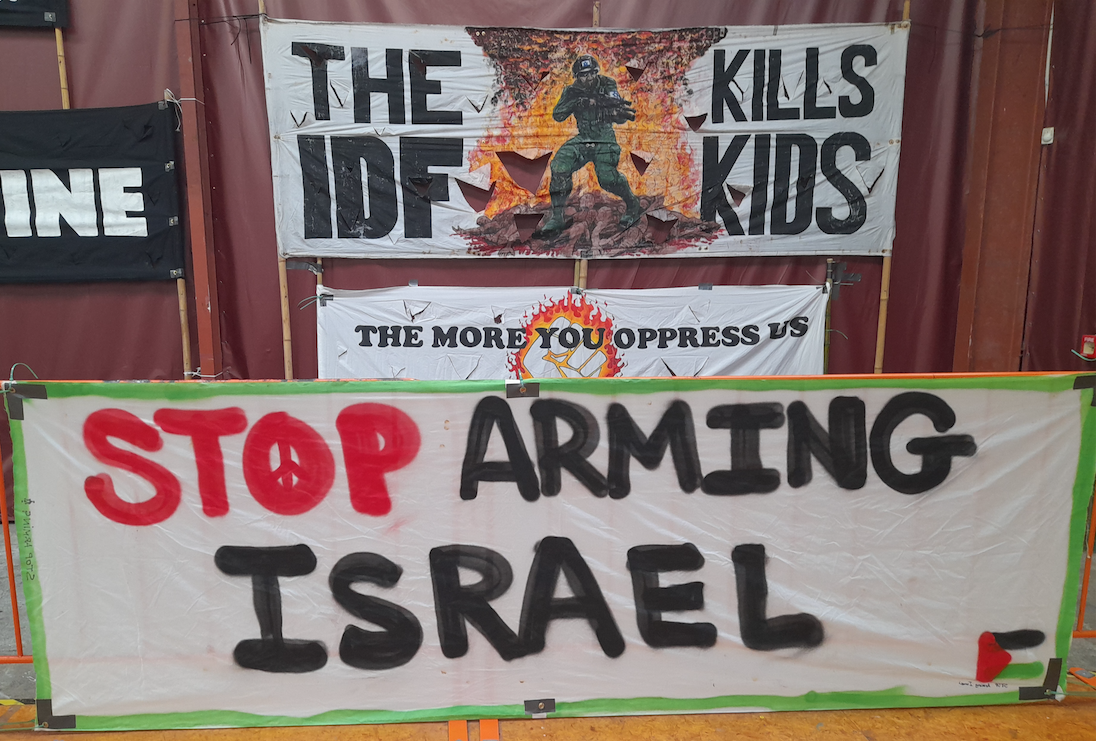
Opening the space
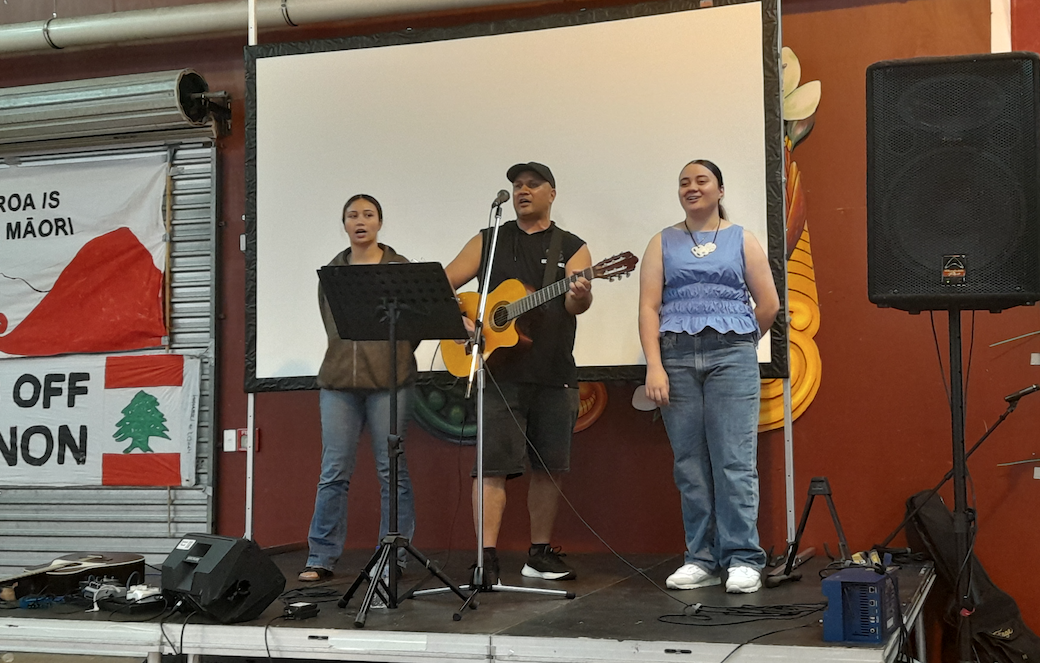
Simon opened the space just after 2 pm with songs on his guitar — “Stand Up,” “Free Palestine,” and the classic Aotearoa movement song, “Nga Iwi E.”
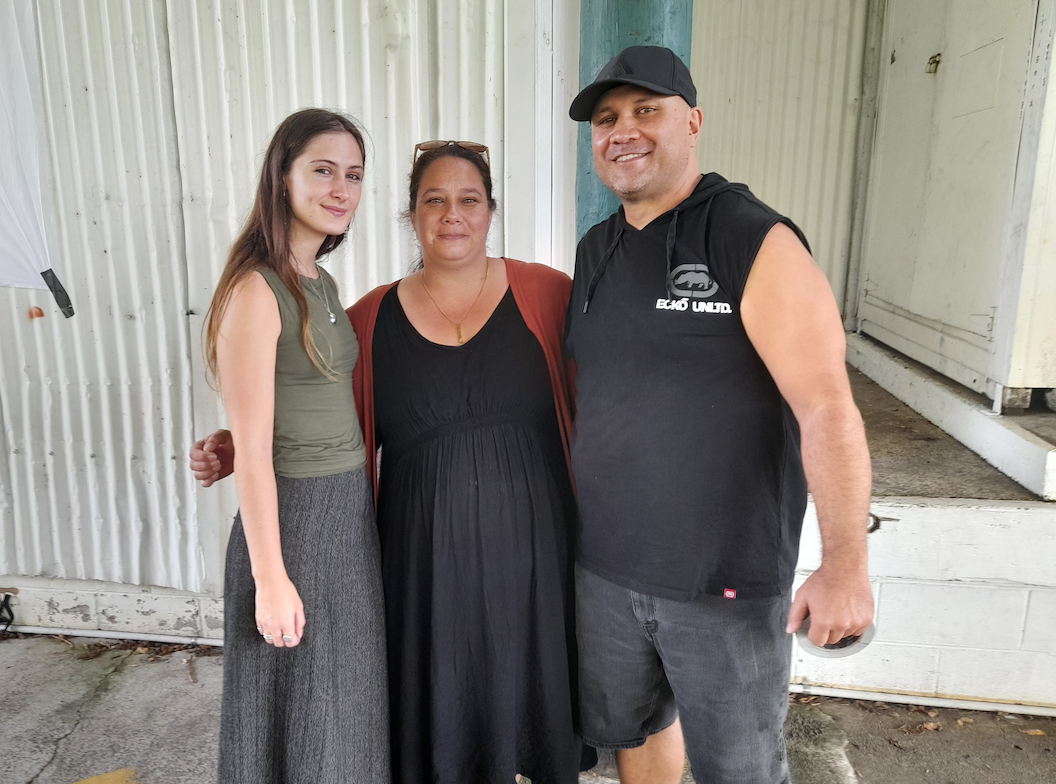
As the MC, he invited his daughters to deliver a karakia in beautiful Te Reo. He then welcomed the first speaker, Stephen Woodward of the Banners Whānau.
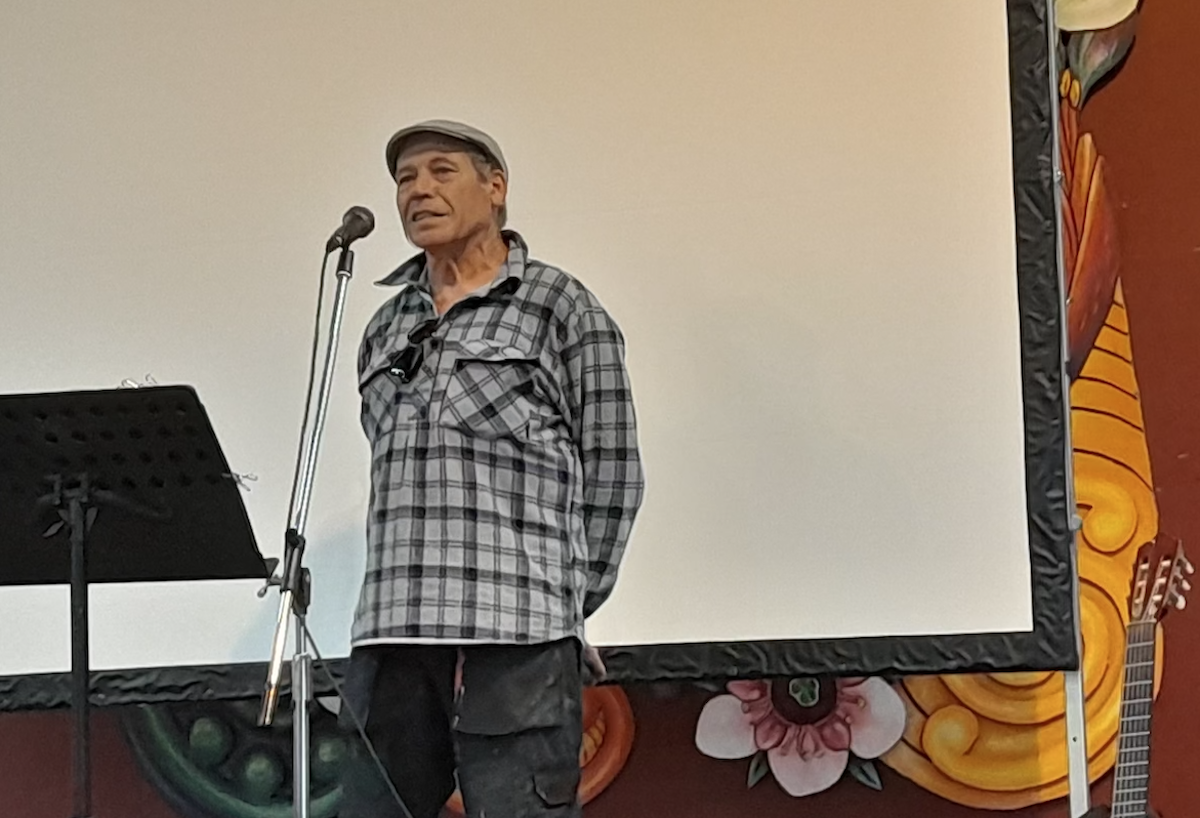
Stephen Woodward
Stephen greeted the audience warmly and explained that the group had changed its name from Banners for Palestine to Banners for Humanity. He thanked Corbans Arts for their support and acknowledged all speakers and performers who had contributed to the kaupapa.
Stephen spoke about the important work of Doctors Without Borders (MSF), and he encouraged the audience to give generously. His words were met with strong applause.
MSF video presentation
Simon reminded the audience that the day’s kaupapa was to support MSF. A video presentation followed, outlining MSF’s founding in 1971, its 1999 Nobel Peace Prize, and its mission to provide medical care without discrimination.
The video highlighted MSF’s work in war zones, disaster areas, wherever people suffered, as well as its advocacy for oppressed communities. It described how MSF intervenes in crises, how it authors reports, and how it advocates across the world in public forums.
The video centred the kaupapa and provided the audience with a deeper appreciation of this wonderful organisation and the mahi that they accomplish on behalf of others.
Josh
Simon introduced Josh, who performed a set of acoustic guitar pieces seated on the front stage floor. His music was melodious and calming. It encouraged people to pause and reflect as he performed. The audience responded with warm applause.
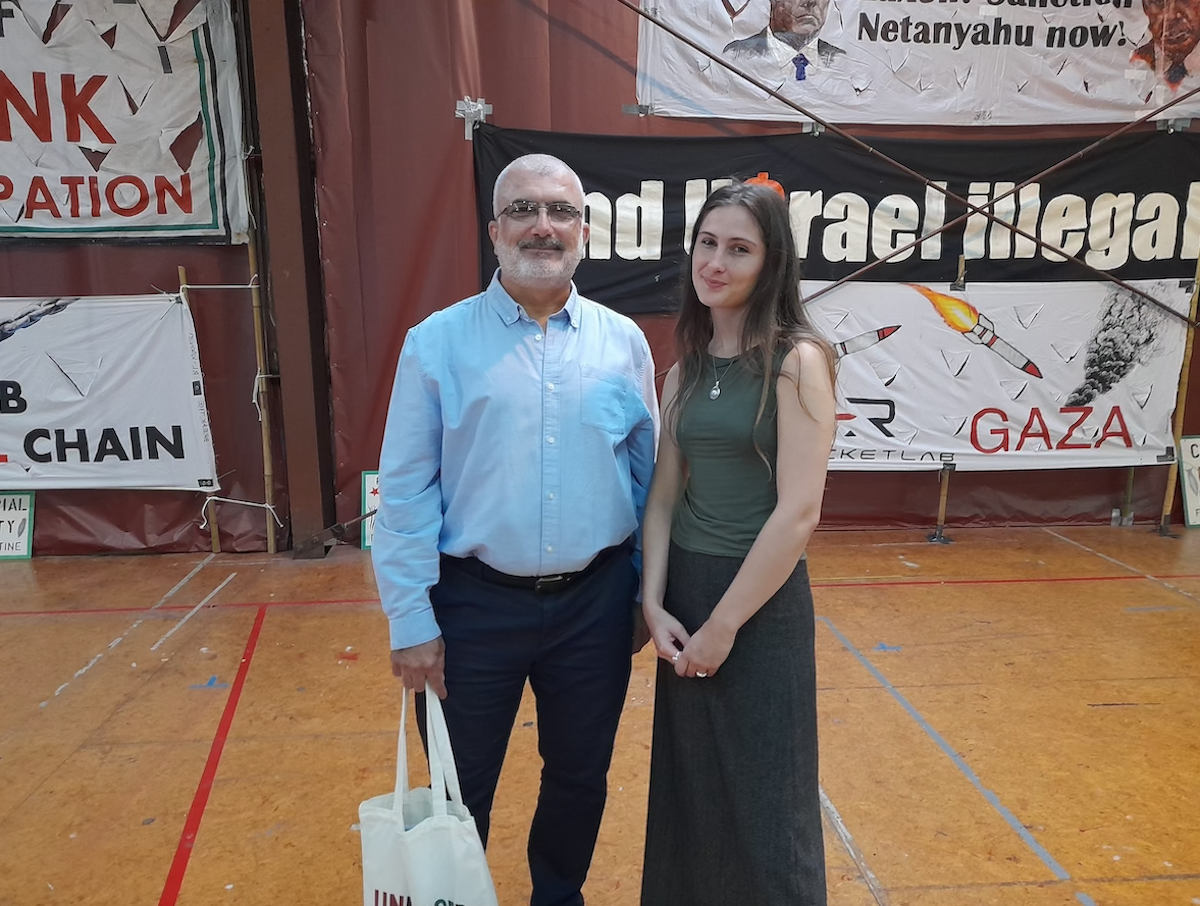
Maher Nazzal
Simon welcomed Palestinian leader Maher Nazzal. Maher thanked the Banners Crew for their tireless work across Tāmaki over the past two years and described how their mahi complemented the weekly PSNA rallies.
He spoke about Gaza’s collapsing health system in 2026, noting that only 10 hospitals remained operational and that Palestinian health professionals were being targeted and killed.
Maher emphasised the need for continued pressure on Israel and highlighted two recent victories for the Palestinian movement in Aotearoa — one at the Auckland Council and another at the High Court — with a third expected shortly. He praised MSF for delivering medical care to oppressed people and encouraged donations. Maher concluded by presenting Stephen with a trophy to honour the Banners Crew for their work for Palestine.
Maher and Stephen received generous applause.
Taipua and Delta
Two rangatahi, Taipua and Delta from Waitākere College, performed a powerful spoken word poem exploring rangatiratanga, te reo, Māori identity, and resistance. Their performance was dynamic, an interplay of two voices, multiple themes, in one performance. The audience responded with warm applause.
Leka Skipwith
Simon introduced his friend Leka Skipwith, a leader of the Rotokakahi struggle. Leka expressed solidarity with Palestine and acknowledged the work of the Banners Crew. He described himself as a “Haututu” and Protector, speaking about opposing a proposed sewerage pipe through his people’s wāhi tapu.
He recounted the 1886 Tarawera eruption, the loss of the Pink and White Terraces, and the ancestors buried there. Leka connected the oppression faced by Māori with the struggles of Palestinians and Iranians. He built unity between local and international movements. His kōrero received warm applause.
Community Fellowship Break
Simon performed a moving acoustic guitar version of Bob Marley’s acclaimed Black Liberation Struggle Anthem, “Redemption Song”, just before the event intermission. A 30 minute break allowed guests to share food and conversation.
Mel and her daughters provided a generous spread, and people from different communities — Palestinian, Tangata Whenua, Tagata o le Moana, Sudanese, West Papuan, Congolese, Lebanese, Afghani, Pākehā, and others — mingled and built intercommunal, inter-movement solidarity. The atmosphere was positive, allowing for people from different generations, communities, and struggles to meet.
Eva Maria
After the break, Eva Maria performed hauntingly beautiful Lebanese songs. She then spoke about Lebanon’s suffering during the 10 day “truce” with Israel, describing bombings of villages, bridges, churches, mosques, and synagogues. She said the 2026 invasions were worse than those of 2006, displacing 1.2 million people.
Eva shared her desire to return to Lebanon to live with her children and questioned whether calling for humanity toward the Lebanese should be considered “radical.” She described how Israeli forces warned communities to evacuate while simultaneously jamming communication networks, preventing people from sharing life saving information.
Eva urged support for Lebanon, Sudan, Congo, Palestine, West Papua, and MSF. Her speech received warm applause.
Achmat Eesau
Simon welcomed Achmat Eesau, a veteran of South Africa’s anti apartheid struggle. Achmat acknowledged Te Kawerau ā Maki and spoke about South Africa’s 2023 case against Israel at the International Court of Justice, noting the court’s 2024 interim finding that genocide charges were plausible. Israel is still on trial with the ICJ.
He explained that South Africa stands with Palestine because international solidarity — especially from Cuba, Palestine, Libya, and Iran — had supported South Africans during apartheid. He quoted lines from the Irish poet Yeats in the context of the fall of colonialism and empire, saying, “Things fall apart, the centre cannot hold,” and led the audience in the anti apartheid chant “Amandla!” with the crowd replying “Awethu!” His contribution was warmly applauded.
Chelsea
Chelsea spoke about the power of light over darkness and her commitment to Palestine and Lebanon. She performed two delicate, beautiful, and original songs. She received a generous applause.
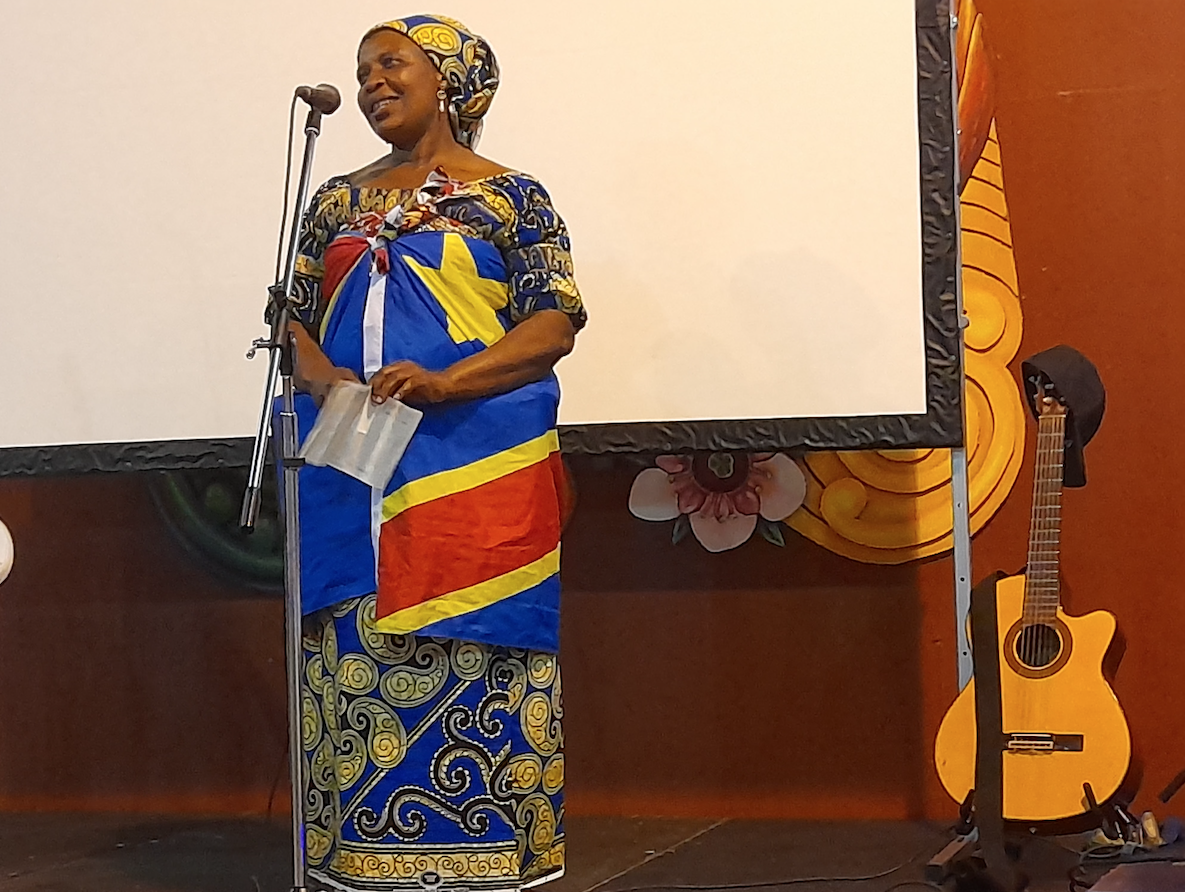
Mama Lema
Simon welcomed Mama Lema from North Kivu, Democratic Republic of the Congo. Mama came to the event with her grandson. She shared the sad news of her mother’s recent passing and described how the M23 militia forced women and children into labour to extract minerals used in cars and cell phones. She spoke of displacement, disease, and media silence concerning the killing and oppression of her people by M23.
Mama said she was not a politician but a historian for her people. She spoke of land loss, the severing of communities, and the suffering of Congolese women. She implored the audience to speak for Congo and support MSF. Her speech received strong applause.
Rahman Bashir
Rahman invited the audience to consider the interconnected struggles of Congo, Falastin, West Papua, and Lebanon alongside Sudan. He performed two spoken word pieces addressing genocide, inequality, and the need for liberation across all regions of Sudan.
He encouraged people to help however they could — even feeding five Sudanese people could assist the suffering in his land. Rahman asked people to help the people of Sudan, Beirut, Gaza, and West Papua. His words were met with generous applause.
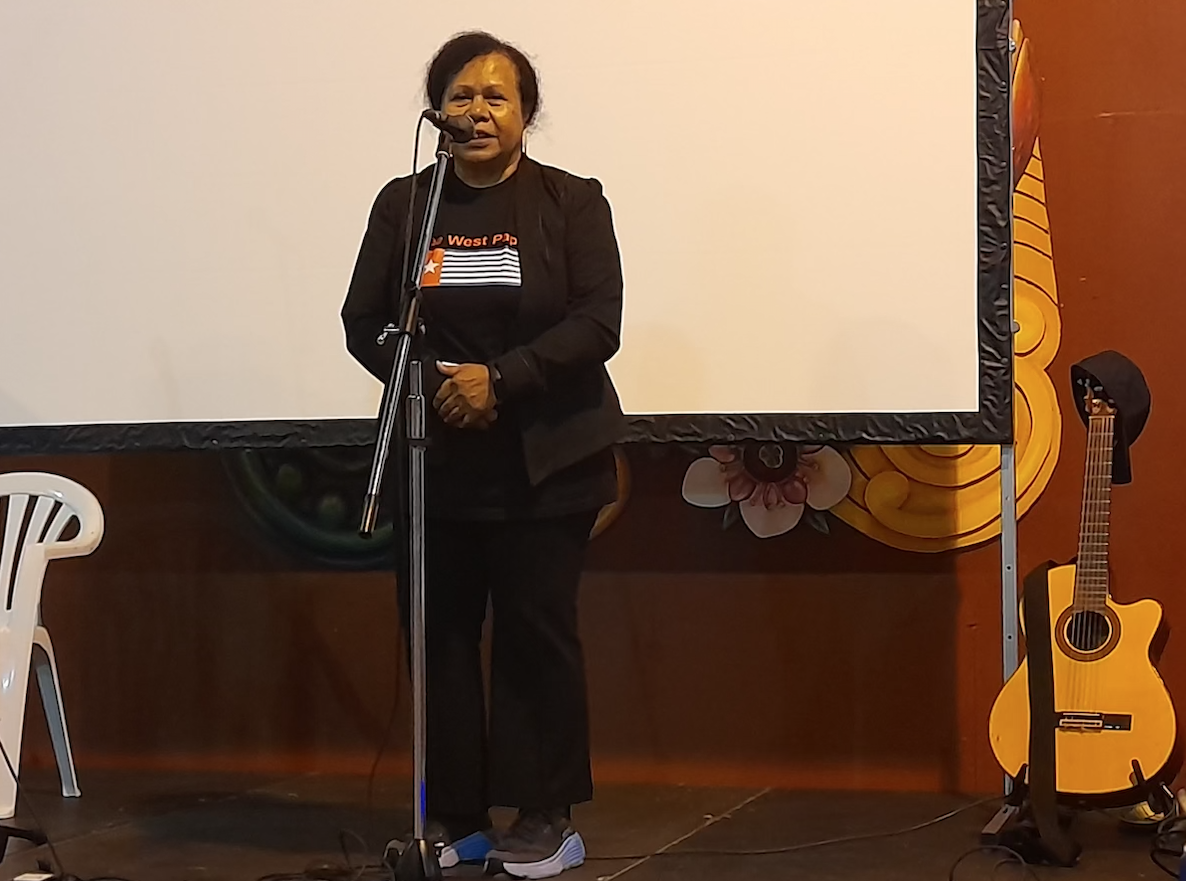
Mary Joku Ponifasio
Mary introduced herself as being from Jayapura and spoke about her father, Henk Joku, a senior OPM [Free West Papua] leader. She described West Papua’s preparations for independence in 1961 before Indonesia’s 1963 invasion. She explained the symbolism of the Morning Star flag and spoke about West Papua’s rich natural resources, including gold, copper, and oil.
Mary recounted her father’s imprisonments, her mother and siblings’ escape by canoe to Papua New Guinea, and the family’s long years of exile. She spoke of the work of her cousin, West Papua independence leader Theys Eluay, and his assassination by the Indonesians.
Mary also mentioned two people her father always spoke of with respect — David Robie and Maire Leadbeater, both long time supporters of West Papuan human rights. She spoke of how her people were dehumanised as primitive people. Mary said she felt a deep affinity for Tangata Whenua, and she acknowledged Māori women and their Moko Kauae traditions.
As Mary left the stage, I approached her and introduced her to David Robie, who was present with his wife, Del. Mary, David, and Del met and later caught up after the event ended. Mary’s talk received warm applause.
Fatima
Fatima spoke for her people of Darfur and for Sudan. She said it was never easy to speak about Sudan and that she felt the world had abandoned her people. Fatima reflected on the 2004 Darfur massacres, where 300,000 people were killed, and on global indifference to Sudan’s suffering.
She spoke about anti Blackness against African peoples, where others profited off the deaths of African peoples, the exploitation of African resources, and the ongoing violence perpetrated on Sudanese lives. She cited an MSF report documenting how women in Darfur were unsafe against sexual violence and rape, and urged people to remember Sudan. The audience applauded her talk with generosity.
Amena
Amena spoke in solidarity with Iran, recounting the nationalisation of oil under Prime Minister Mohammad Mosaddegh in 1951, the establishment of Operation AJAX and the 1953 CIA MI6 led coup, and the repression under the Shah and SAVAK.
Amena said the same CIA tactics deployed against Mosaddegh were deployed against the great African independence leader Patrice Lumumba in 1960 in the Congo. She described the achievements of the 1979 Islamic Revolution, including increased life expectancy and women’s strong representation in medicine, engineering, and parliament.
She connected Iran’s struggles with those of Congo, Palestine, Sudan, and Venezuela, concluding that Iran would continue to stand and fight for its freedom. Her talk was warmly received.
Immense success
The event was an immense success, bringing together different community voices speaking to different, yet deeply interconnected struggles in support of MSF–Doctors Without Borders. Performers, singers, poets, and speakers from Afghanistan, Aotearoa, the Democratic Republic of Congo, Lebanon, Palestine, South Africa, Sudan, Tagata O Le Moana, Tangata Whenua, and West Papua all added their mana to the event.
One of the Banners Crew organisers, Simon, reflected: “All of the speakers were grateful to participate and share their thoughts and experiences. I spoke to all speakers before and after their talks.
“They appreciated the opportunity and felt seen, heard, and respected.
“I am so proud of them all and the Banners Crew for pulling off such a special event.”
More than $4000 was raised for MSF at the event.
Dr Tony Fala is a Moana activist in Tamaki. This article is dedicated to the tireless work of the Banners Crew. Fala has seen their work in the movements, particularly for Palestine and respects their contribution to the Palestine struggle — and other struggles in Aotearoa and around the world.