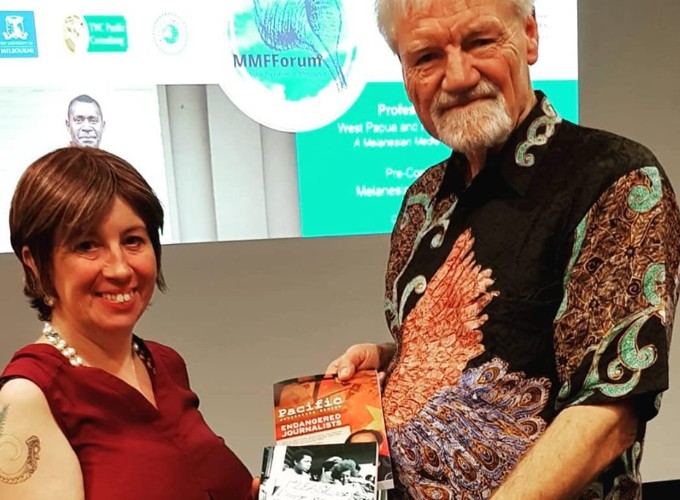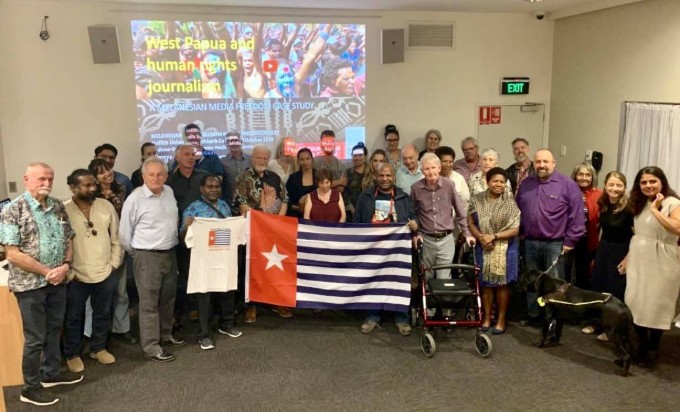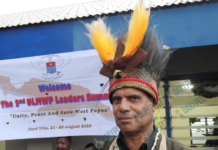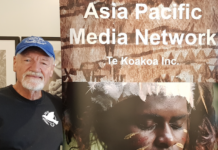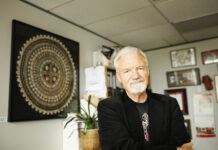

Professor David Robie has a passion for the Asia-Pacific region. A journalist for more than 40 years, David has reported on postcolonial coups, indigenous struggles for independence and environmental and developmental issues in the Asia-Pacific. He retired from AUT University in December 2020.
Pacific media should ‘bear witness’ to human rights violations, says Robie

Human Rights and Social Development
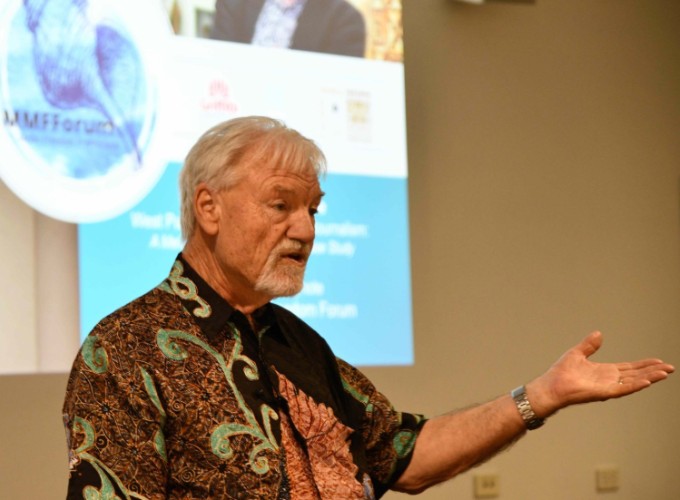
A prominent journalist and founding director of Auckland University of Technology’s Pacific Media Centre, Professor David Robie, has shared his experience of human rights coverage in the region as a media person.
He stressed the news media role as watchdogs at a Human Rights and Media Forum held in Nadi, Fiji, on 13–15 April 2016. Professor Robie was chief guest.
Senior journalists and government communication officers from 13 Pacific countries participated in the forum, which had the theme: Enhancing a human rights-based approach to news reporting.
“Human rights-oriented journalism is more focused on global rather than on selective reporting, with an emphasis on the vulnerable and empowerment for the affected and marginalised people — a voice for the voiceless,” Dr Robie said.
After the forum, he said in an interview: “Journalists ought to be human rights defenders and bear witness to Pacific human rights violations.
“This forum was remarkably successful in providing the tools for a wide range of Pacific media people to bring accountability to offenders against human rights.
“I congratulate the Pacific Community’s Regional Rights Resource Team (RRRT) on organising this important forum.”
Vital media role
The forum, which was supported by the Australian government and European Union, released an outcomes document, reaffirming the vital role the media play in recognising the importance of strengthening news reporting, using a human rights-based approach.
The outcomes document also acknowledges the importance of building a strong relationship between government communication personnel and journalists in sharing information and the roles they play in disseminating information.
This document is being formatted into a poster for newsrooms in the region.
Romulo Nayacalevu, SPC’s Human Rights Adviser, said: “The media have a powerful voice in highlighting human rights issues and concerns, and this workshop provides the opportunity for journalists to dialogue on human rights and the media.
“SPC is delighted to work closely with the Pacific media to support their work in human rights reporting and we are excited about the outcomes document, which provides them with tips on how to do that.”
Giving a Pacific journalist’s perspective, Stanley Simpson, managing director of Business Melanesia Ltd, stressed that journalists in the region were frequently victims of human rights abuses while reporting on human rights in the region.
“Pacific journalists are often young and almost always broke, some have very little life experience, they are underpaid and overworked, they get threatened and intimidated regularly, and they endure a high pressure environment.
‘Instruments of change’
“People like to see journalists as instruments of change, but sometimes journalists just feel that they are being used by different sides with different agendas.
“So often they are going through the day-to-day slog of getting a newspaper or news bulletin out — it is easy to forget that they have the potential to influence change.
“It is important that this is addressed and journalists understand their roles as agents of change,” he said.
Belinda Kora, news director of Papua New Guinea FM, agreed that journalists could influence change but their reporting must be responsible.
“I keep reminding my reporters that when it comes to reporting about human rights, if your story does not impact on the lives of victims or anyone else for that matter, you are only taking up space,” Kora said.
She added that, importantly, journalists needed to know their rights to be able to report responsibly.
“How can we journalists in the region report effectively if we don’t know our rights?” Kora asked.
Pacific aspirations
The three-day forum strengthened media capacity in rights-based reporting to reflect the aspirations of Pacific Island communities for equality, development and social justice, said RRRT team leader Nicol Cave.
Marian Kupu of Tonga’s Broadcom Broadcasting Limited said: “I found the three-day forum very encouraging because I learnt about my country’s human rights commitments and I see my role as a journalist to report on the gaps in order to encourage decision makers to prioritise and address the issues.”
“Giving voice to the voiceless” and “championing the rights of all peoples” were key messages highlighted at the forum.
The forum was organised by the Regional Rights Resource Team (RRRT) of the Pacific Community in partnership with the Pacific Media Assistance Scheme (Pacmas), the Pacific Islands News Association (PINA) and the journalism programme of the University of the South Pacific.
Republished from the RRRT website.
531pi’s Ma’a Brian Sagala talks nuclear-free Pacific with David Robie
Pacific Media Watch
Radio 531pi Breakfast Talanoa host Ma’a Brian Sagala talks about the Rarotonga Treaty with Pacific Media Centre director Professor David Robie.
The treaty ushered in the Nuclear Free Pacific Zone 33 years ago, which predated NZ’s own nuclear-free law.
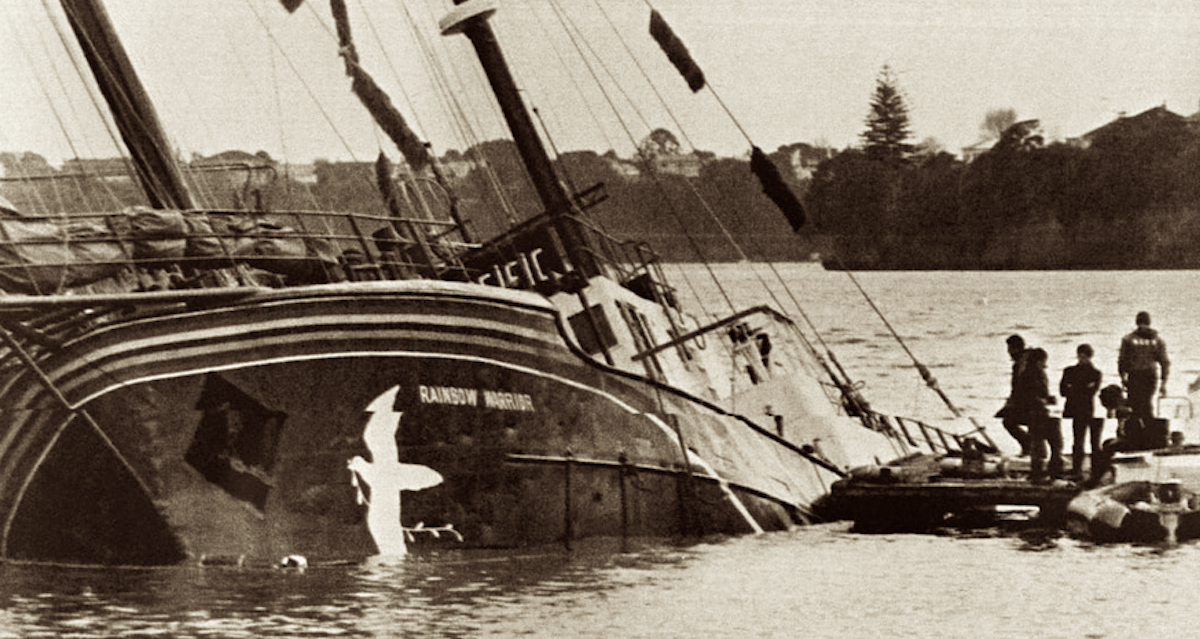
Dr Robie also talks about the Rainbow Warrior’s humanitarian voyage to Rongelap to help the islanders move to another home across the Pacific Ocean.
He is the author of the book Eyes of Fire about French and US nuclear testing in the Pacific.
More information: eyes-of-fire.littleisland.co.nz
Asia Pacific Report: A New Zealand nonprofit journalism model for campus-based social justice media

By David Robie
For 13 years (2007-2020), the Pacific Media Centre research and publication unit at Auckland University of Technology published journalism with an “activist” edge to its style of reportage raising issues of social justice in New Zealand’s regional backyard.
It achieved this through partnerships with progressive sections of news media and a non-profit model of critical and challenging assignments for postgraduate students in the context of coups, civil war, climate change, human rights, sustainable development and neo-colonialism.
An earlier Pacific Scoop venture (2009-2015) morphed into an innovative venture for the digital era, Asia Pacific Report (APR) (http://asiapacificreport.nz/), launched in January 2016. Amid the current global climate of controversy over ‘fake news’ and a ‘war on truth’ and declining credibility among some mainstream media, the APR project has demonstrated on many occasions the value of independent niche media questioning and challenging mainstream agendas.
In this article, a series of case studies examines how the collective experience of citizen journalism, digital engagement and an innovative public empowerment journalism course can develop a unique online publication. The article traverses some of the region’s thorny political and social issues — including the controversial police shootings of students in Papua New Guinea in June 2016.
- Read the full research article at Ikat: The Indonesian Journal of Southeast Asian Studies
https://doi.org/10.22146/ikat.v2i1.37395
Media freedom under attack in the Pacific

By Samisoni Pareti in Suva
With the trial of three newspaper executives underway in Fiji in May on charges of sedition, the assault of a newspaper journalist in Papua New Guinea, the removal of the general manager and her news manager at the Tonga Broadcasting Commission and the re-introduction of libel laws in Samoa, press freedom is coming under severe attacks in all regions of the Pacific.
A survey by Islands Business reveals disturbing signs to silence or control the work of independent and free media in the islands, with most of these attacks orchestrated by public agencies. Equally alarming is the absence of a public outcry or condemnation from the media and the general public alike.
Long-time Pacific media commentator and journalist, now director of the Auckland-based Pacific Media Centre and convenor of Pacific Media Watch, Professor David Robie believes media freedom in the Pacific has never been under such severe stress as it is today.
“Ironically, in this digital era of social media and with a multitude of alternative and independent information sources and platforms available, mainstream media has faced a decline in media freedom,” he says.
“Notably two of the Pacific countries with the largest and strongest media industries,Fiji and Papua New Guinea, have faced a steady ‘chilling’ in their discourse. Increasingly in PNG, for example, the public and journalists themselves are turning to independent and respected blogs for trusted and ‘real’ information.
“There is a mainstream media silence on many issues, especially the under-reporting of social justice issues, the plight of refugees after closure of the Manus detention centre, climate change, and West Papua.”
Flashback to the 1968 My Lai massacre: ‘Something dark and bloody’
By David Robie, originally published at Café Pacific blog
The Melbourne Sunday Observer — the original newspaper of that name which campaigned against Australian involvement as a US surrogate in the Vietnam War — published photographs of the My Lai massacre in December 1969.
It was prosecuted for “obscenity” for reporting the atrocity but the charge was later dropped.
Michael Cannon was editor and David Robie chief subeditor at the time (and later the editor). The photographs were published by arrangement with Life Magazine and were later shown to Federal MPs in an attempt to change Australian government support for the war.
The photographs were published during a period when newspapers in Australia rarely published pictures of bodies, and certainly not as victims of “atrocities” by “our side”. This website has a small selection of the photographs published by the Observer.
The Sunday Observer was the springboard for the launching of Nation Review in 1970:
From David Robie’s Instagram account, 16 March 2018:
One of the most horrendous acts of the Vietnam War remembered today — the My Lai massacre on 16 March 1968. US troops slaughtered 504 unarmed civilians in Son My village. Many women were gang raped and their mutilated bodies dumped on the roadside and in the ricefields. Covered up by the US authorities for a year. Charges finally laid against 26 soldiers. Only one, Lieutenant William Calley, was sentenced to life, but he only served 3 years under house arrest.
I was chief subeditor of the Melbourne Sunday Observer at the time and we published several of witness military photographer Ron Haeberle’s photos as evidence.

The War You Don’t See, a documentary by John Pilger Video:FilmIsNow
Excerpt from the Sunday Observer, 14 December 1969:
© Photographs by Ronald Haeberle
My Lai was one of nine hamlets clustered near the village of Song My, a name sometimes used also for the hamlets. GIs called the area “Pinkville” because it was coloured rose on their military maps and because the area had long been known as Viet Cong territory.

The “Bloodbath” image is the cover of the Sunday Observer
reportage of the exposé, 14 December 1969.
The action at My Lai received only a passing mention at the weekly Saigon briefing in March of 1968. Elements of an American division had made contact with the enemy near Quang Ngai city and had killed 128 Viet Cong. There were a few rumours of civilian deaths, but when the US Army looked into them — a month after the incident — it found nothing to warrant disciplinary measures.
The matter might have ended there except for a former GI, Ron Ridenhour, now a Californian university student. After hearing about My Lai from former comrades, he wrote letters to congressmen warning that “something dark and bloody” had taken place.
Now an officer, Lieutenant William Calley, has been charged with murder of “an unknown number of Oriental human beings” at My Lai, and 24 other men of C Company, First Battalion, 20th Infantry, are under investigation. The world is demanding to know what happened at My Lai, who ordered it, and whether or not US troops have committed similar acts in Vietnam.

Because of the court-martial, the Army will say little. The South Vietnamese government, which has conducted its own investigation, says that My Lai was “an act of war” and that any talk of atrocities is just Viet Cong propaganda.
This is not true.
The pictures published in this newspaper by Ronald Haeberle, an Army photographer who covered the massacre, and reports in the past three weeks confirm a story of indisputable horror — the deliberate slaughter of old men, women, children and babies.
Eyewitness reports indicate that the American troops encountered little — if any — hostile fire, found virtually no enemy soldiers in the village and suffered only one casualty — a self-inflicted wound. The people of My Lai were simply gunned down.

‘Frightful violation’
“The My Lai massacre represented a frightful violation of the principle of humaneness. To tell as much of the truth as was then available about that violation, and to make sure at the same time that the accused Lieutenant William Calley would be treated justly, required extraordinary care by a journalist. More than a mere set of court-martial papers needed to be inspected. Calley needed to be found and interviewed.
“In acting on that judgement, journalist Seymour Hersh used many standard reportorial techniques and several ingenious ones. Passive deception, allowing persons on the military base [Fort Benning] to make their own most natural inference as to his identity, could be defended so long as it did no avoidable harm — that is, so long as it did not risk injustice or unfairness to innocents caught up in Hersh’s quest for Calley.
“can be argued that Hersh allowed his key source, Jerry, to make his own decision to obtain Calley’s file. But, in fact, Hersh appears to have actively created a situation in which Jerry, already a busted private, risked further penalty to himself unless he cooperated. Having made an authoritative entrance demanding Jerry’s presence, Hersh met with Jerry outside, ‘and told him what I wanted’.”
- On the ethical dilemmas involved in Hersh’s investigation to gain access to Calley’s file and to expose the truth about the massacre, from Edmund Lambeth‘s Committed Journalism: An Ethic for the Profession, Indiana University Press, 1986, 1992.

David Blackall adds:
Helicopter pilot intervened for victims
The horror only began to die down when army helicopter pilot Hugh Thompson Jr landed between the soldiers and the villagers, threatening to fire at the troops. After taking off again, the pilot witnessed soldiers chasing civilians and landed the helicopter between them. He evacuated the villagers and returned to the scene to search for survivors. Thompson also told his superiors about the massacre, and the order was sent back to “knock off the killing”.“After the shooting was over, the soldiers went and were eating their lunch, really literally next to the ditch, next to the bodies. And that’s how disconnected you get,” Seymour Hersh, the investigative reporter who uncovered the story, said on Democracy Now.
Despite Thompson filing a report, a military investigation found there had been no massacre. Captain Ernest Medina, who had ordered the soldiers to be aggressive in their operations, told superiors the unit had killed lots of VC fighters.
- Heart of Darkness – Al Jazeera 2008
- Calley apologises for massacre – Democracy Now 2009
- My Lai massacre – the day US military slaughtered a village and tried to cover it up – RT 2018
- David Blackall talks to David Robie on Don’t Spoil My Beautiful Face, My Lai and human rights in Asia-Pacific – Asia Pacific Media Educator 2015 ( p. 334)