
Home Blog Page 112

Archive: A photographer’s date with a nuclear death

0
Greenpeace photographer Fernando Pereira and Rongelap Islander Bonemej Namwe
Greenpeace photographer Fernando Pereira and Rongelap Islander Bonemej Namwe ride ashore in the bum bum. Born on Kwajalein, Namwe, 62, had lived most of her life on Rongelap: "The United States use our people for studying as if we were chickens and pigs." Image: David Robie/© Eyes Of Fire 1985

President Jacques Chirac’s controversial final round of nuclear tests at Moruroa and Fangataufa atolls in 1995 unleashed an unprecedented storm of international protest. And dilemmas for journalists covering the riots in Pape’ete and the junkets by French authorities. The Vanuatu government banned news reports on protests. Journalist David Robie on board the original environmental campaign ship Rainbow Warrior — bombed by French secret agents a decade ago — recalls the events. He was later arrested by the French military.

By David Robie in Uni Tavur

Fernando Pereira was on board the Rainbow Warrior’s ill-fated voyage to the Pacific a
decade ago almost by chance. Campaign coordinator Steve Sawyer had been seeking a wire machine for transmitting pictures from the Marshall Islands and Moruroa Atoll.

Sawyer phoned Fiona Davies, then heading the Greenpeace photo office in Paris. But he said he wanted a machine and a photographer separately.

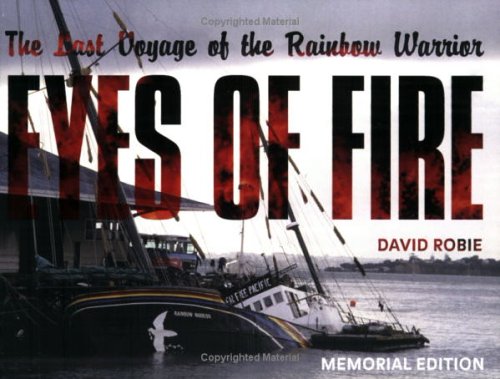
The 2005 Memorial Edition of David Robie's book Eyes of Fire: Last Voyage of the Rainbow Warrior
The 2005 Memorial Edition of David Robie’s book Eyes of Fire: Last Voyage of the Rainbow Warrior.

‘No, no … I’ll get you a wire machine,’ promised Davies. ‘But you’ll have to take my
photographer with it.’ Agreed. The deal would save Greenpeace’s campaign budget about
US$8000.

But it would also cost the Portuguese-born photojournalist Pereira his life. Less than
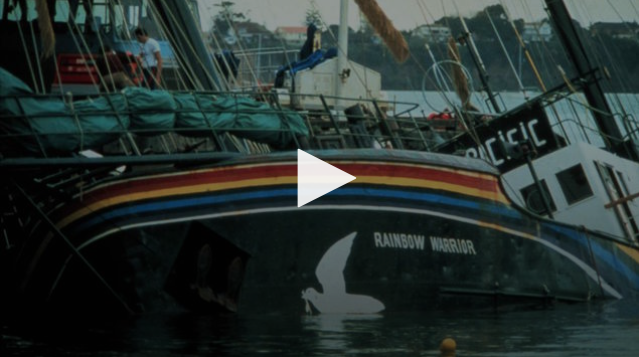
three months later he was dead — drowned as the Rainbow Warrior, bombed by French secret service agents, sank to the bottom of Auckland Harbour.

The ship’s successor, Rainbow Warrior II, returned to French Polynesian waters in 1995 for another dramatic tilt at the French over nuclear testing. Again, American Steve Sawyer was on board for the first round of protests in July.

For thousands of people in the Pacific, the French plan to resume nuclear tests this year reopened a deep and bitter wound.

New Zealand has long played a key anti-nuclear role. Twice in 1973 it dispatched frigates to the Moruroa Atoll testing zone to protest over atmospheric tests. A World Court case filed jointly with Australia forced France to switch to underground tests the following year.

Yet, in spite of persistent small boat protests over ensuing years, it was not until a decade ago that this major act of French state terrorism in New Zealand’s largest port suddenly projected nuclear tests at Moruroa firmly into the international limelight.

"A photographer's date with a nuclear death", PJR,
“A photographer’s date with a nuclear death”, PJR, November 1995.

Irony of the saboteurs
The night was chilly as the Greenpeace flagship Rainbow Warrior lay moored at Auckland’s
Marsden Wharf on Wednesday, 10 July 1985. It had arrived in New Zealand from Vanuatu three days earlier — a week after President Haruo Remeliik had been assassinated in Belau.

Greenpeace campaigners were preparing the former North Sea fishing trawler for the environmental group’s biggest-ever protest voyage to Moruroa Atoll, one which they hoped
would embarrass France over nuclear testing even more than the many brave forays of the yacht Vega. On board, supporters celebrated the 29th birthday of Steve Sawyer, the American co-ordinator of the Pacific Peace Voyage.

Unknown to the Greenpeace activists, two frogmen, French secret agents Jacques Camurier and Alain Tonel, had set off in an inflatable dinghy across the 2km stretch of the misty harbour from Mechanics Bay. It was ironic that the saboteurs were using a French-made Zodiac — the craft used by marine commandos to chase the Vega in 1973 (when they bludgeoned David McTaggart, Greenpeace founder in the Pacific), and later adopted by the Greenpeace “commandos of conservation” in dramatic campaigns against nuclear waste dumpers and whalers.

Camurier and Tonel crouched low into the icy breeze as they motored slowly across the harbour. It was bitterly cold, even in their waterproof jackets and wetsuits. Stowed on board the grey-and-black craft were two explosive packs wrapped in plastic, a clamp, rope, and the rest of their scuba gear — including two rebreather oxygen tanks, which did not release telltale bubbles underwater.

It was about 8.30 pm when they were close enough to switch off the little four horsepower Yamaha motor and paddle towards the Rainbow Warrior’s berth. They moored the
Zodiac to a sheltered wharf pile. So far, so good. It was just as they had rehearsed this phase of the so-called Operation Satanic at their Aspretto base in Corsica, France.

Donning their flippers, oxygen tanks and masks, Camurier and Tonel slipped into the inky water. Then they reached over the side of the inflatable to grab the bombs, the heavier of which weighed 15 kilos. They both swam underwater with the bombs, clamp and rope to the stern of the Rainbow Warrior.

Tonel attached the smaller, 10 kilo bomb to the propeller shaft; Camurier fixed the clamp on to the keel and ran out of rope to pinpoint a spot to attach the larger bomb next to the engineroom.

The hull explosive would sink the ship; the propeller mine would cripple it. Both bombs were timed to explode in just over three hours, at 11.50 pm. The explosives laid, the frogmen headed back to their hidden Zodiac. The hardest part of their mission was over.

The first blast ripped a hole the size of a garage door in the engineroom. The force of the
explosion was so powerful that a freighter on the other side of Marsden Wharf was thrown five metres sideways. As the Rainbow Warrior rapidly sank until the keel touched the harbour floor, the shocked crew scrambled on to the wharf.

But Fernando Pereira dashed down a narrow stairway to one of the stern cabins to rescue his expensive cameras. The second explosion probably stunned him and he drowned with his camera straps tangled around his legs.

I had been on board the Rainbow Warrior for 11 weeks, and my cabin was opposite Pereira’s. But I had left the ship three days earlier, on arriving in Auckland, to return to my Grey Lynn home. A planned visit to the ship that night with my two sons and their Scout troop had been cancelled at the last moment.

When the Rainbow Warrior was refloated and towed to the Devonport Naval Base dry dock, I discovered my old cabin had a huge bulge and hole where my bunk had been. My passport had been earlier recovered by navy divers from the bridge. It sank with the ship.

A daughter’s plea
Fernando had fled Portugal during the colonial wars in Angola, Mozambique and East Timor
while he was serving as a military pilot. He settled in Holland, the only country that would grant him citizenship. An amusing, engaging and likeable environmental photojournalist, he joined the Amsterdam daily newspaper De Waarheid.

Fernando’s daughter, Marelle, then aged eight, in June 1995 appealed in the French newspaper Libération to anybody who was involved in the bombing operation to tell her fully what had happened. “Now I am 18, I am an adult and I think by now I have the right to know exactly what events transpired surrounding the explosion which cost my father his life,” she wrote. She also travelled to New Zealand to interview former Prime Minister David Lange and Greenpeace campaigners who sailed on the Rainbow Warrior.

Fernando and I were among seven journalists accompanying the Greenpeace campaigners — he was also a crew member; the rest of us were independent reporters, filing for Australian, British, French, Japanese, New Zealand and Pacific news media. Our task was to travel to the Marshall Islands to report on the evacuation of the stricken islanders from Rongelap Atoll.

The Rongelap people had been contaminated by radioactive fallout, three decades earlier, in the most tragic disaster of American atmospheric tests of the 1950s — the 15-megaton Bravo H-bomb on Bikini Atoll, on 1 March 1954.

The 1985 'Rainbow Warrior' crew .. . and a journalist
The 1985 ‘Rainbow Warrior’ crew .. . and a journalist: Clockwise, from left: Davey Edwards, chief engineer (UK); Marshallese traveller; Nathalie Thomas Mestre, Cook (Switzerland); Martini Gotje, first mate (The Netherlands); Lloyd Anderson, radio operator (USA – in headband); Bene Hoffman, second mate (Germany); Peter Willcox, captain (USA); Bunny McDiarmid, deckhand (NZ); Hanne Sorensen, second engineer (Denmark); and David Robie, journalist (in headband – NZ). Sitting from left: Grace O’Sullivan, deckhand (Ireland); Marshallese traveller; Henk Haazen, third engineer (The Netherlands); and Marshallese traveller. (In front of Martini, partner of crew member Andy Biederman, ship’s doctor (Switzerland) – not present in the group shot). Image: Fernando Pereira.

French President Jacques Chirac’s decision to resume the tests so close to the 10th anniversary of the Rainbow Warrior bombing fuelled outrage in the South Pacific, reopened a deep wound and gave New Zealanders a feeling of déja vu. France says it needs the tests to maintain its nuclear deterrent, and will only conduct eight underground tests between this September and May 1996.

Chirac claimed the tests would have “strictly no ecological consequences”.

Since 1966, France has conducted 175 atmospheric and underground tests at Moruroa and its sister atoll of Fangataufa. The Australian Nuclear Science and Technology Organisation says the tests have left a radioactive core in the extinct undersea volcano that forms the base of the atolls.

It said that although the radioactivity was probably sealed off from the surrounding seas for the time being, there was a serious danger of leakage over the next 500-1000 years. What worries scientists is that the debris of past explosions was a half-life of at least 10,000 years. Greenpeace studies have shown radioactivity in plankton found near Moruroa, and plutonium in seawater.

But most French health tests on the residents of French Polynesia are a military secret.

A decade after the bombing, the full reasons for the French sabotage operation in New Zealand are still unclear in spite of Paris eventually admitting responsibility after the cover-up was blown. A French government-ordered official inquiry headed by leading civil servant Bernard Tricot in August 1985 was widely rejected as a whitewash. While admitting French agents were involved, it cleared the government of ordering the sabotage.

However, in September, after further revelations of French involvement, Prime Minister Laurent Fabius admitted on state television that the French secret service DGSE had indeed sunk the Rainbow Warrior, and it had been covered-up. Defence Minister Charles Hernu was forced to resign and the DGSE chief, Admiral Pierre Lacoste, was sacked.

Complicated plot
The scandal, dubbed “Underwatergate”, was a public relations disaster for France while
Greenpeace’s membership and finances soared. Thirteen secret agents — one of them infiltrating the Auckland office of Greenpeace — were used in the operation.

One DGSE agent, tough former commando Christine Cabon, alias Frederique Bonlieu, made herself at home with Greenpeace and fed information about the Moruroa plans to her Paris headquarters.

The plot by the DGSE — codenamed Operation Satanic — was complicated. A Zodiac and
Yamaha outboard motor were flown from Britain to New Caledonia. The bombs and diving equipment were obtained in Noumea and hidden on board a chartered 11-metre yacht, the Ouvéa.

Four secret agents — Chief Petty Officer Roland Verge, petty officers Gerald Andries and Jean-Michel Barcelo, and “freelance physician” Dr Xavier Maniguet — posed as tourists on a mid-winter diving voyage to New Zealand. A second team of agents flew into Auckland from London posing as Swiss tourists on their honeymoon. They were Major Alain Mafart, deputy commander of France’s Aspretto combat diving base, and Captain Dominique Prieur with the “married” name of Turenge.

Eight days before the Rainbow Warrior arrived in New Zealand on 7 July 1985, Operation
Satanic’s chief, Colonel Louis-Pierre Dillais (alias Jean-Louise Dormand), flew into Auckland
from Los Angeles. He booked into a Kingsgate Hyatt hotel room with a birds’ eye view of the environmental ship’s berth.

During the next two weeks, the Ouvéa crew played out a Jacques Tati-like farce, seducing
women and leaving obvious clues to their presence from Whangarei to Auckland. But they
eventually linked up with the Turenges, and the bombs and sabotage gear were handed over.

A third team of two divers, Camurier and Tonel, flew into Auckland a few hours before the
Rainbow Warrior arrived in Auckland from Vanuatu. Both men had false passports and claimed to be physical education instructors at Paofai Girls’ College in Pape’ete. Their task was to mine the ship.

After planting the bombs, Camurier was spotted by yachtsmen vigilantes on the lookout
for petty thieves. He was loading bags into the Turenges’ rented campervan. The car number plate, LB8945, was jotted down and two days after the Rainbow Warrior was sabotaged the fake honeymooners were detained by police on false passport charges.

Evidence points to France
Evidence quickly pointed to French responsibility for the sabotage. Police flew to Norfolk Island to question the Ouvéa crew on their return voyage to Noumea. Although they had strong suspicions, the police did not have enough evidence for arrests. By the time the police got their act together, the Ouvéa had vanished. It had apparently been scuttled in the Coral Sea and the crew (apart from Dr Maniguet, who had earlier flown through Sydney) were picked up by the nuclear-powered submarine Rubis which took them to Tahiti.

Dillais, Camurier and Tonel posed as tourists in the South Island before quietly slipping out of New Zealand two weeks later.

Meanwhile, the French government “denounced” the sabotage and strongly denied any
involvement. French press reports claimed the saboteurs were South African mercenaries, white New Caledonian anti-independence extremists or British agents — anything to divert attention away from French involvement.

 About WordPress Café Pacific | David Robie 22 updates available 00 Comments in moderation New View Post SEO Enter a focus keyphrase to calculate the SEO score Theme support Delete Cache Howdy, David Robie Log Out Bespoke Web Development & Design Services Take your website to the next level with web solutions designed for you! Get free quote Edit Post Add New Post draft updated. Preview post Add title Permalink: https://davidrobie.nz/1995/07/a-photographers-…-a-nuclear-death/ ‎ p Word count: 2693 Draft saved at 8:08:05 pm. Last edited by David Robie on June 5, 2023 at 8:05 pm Enable: The cache will be created automatically after the contents are saved. More Info Preview (opens in a new tab) Status: Draft Edit Edit status Visibility: Public Edit Edit visibility Revisions: 9 Browse Browse revisions Publish on: Jul 21, 1995 at 18:36 Edit Edit date and time SEO: Not available Readability: OK Move to Trash Post Formats Standard Video Audio All Categories Most Used Articles Books (Primary Category) Primary Featured Media News Politics Analysis Climate Justice Marketing Opinion Projects Research Resources Reviews Videos Interviews Tech + Add New Category Add New Tag Separate tags with commas Paste a video link from Youtube, Vimeo, Dailymotion or Twitter it will be embedded in the post and the thumb used as the featured image of this post. You need to choose Video Format from above to use Featured Video. Paste an audio link from SoundCloud it will be embedded in the post and the thumb used as the featured image of this post. You need to choose Audio Format from above to use Featured Audio. Greenpeace photographer Fernando Pereira and Rongelap Islander Bonemej Namwe Click the image to edit or update Remove featured image General Smart List Reviews Locker Post template: ? Single Template – Publication PRO - New Primary category: ? If the posts has multiple categories, the one selected here will be used for settings and it appears in the category labels. Subtitle: This text will appear under the title Quote on blocks: Show a quote (only when this article shows up in blocks that support quote and only on blocks that are on one column) Source name: This name will appear at the end of the article in the "source" spot on single posts Source url: Full url to the source Via name: Via (your source) name, this will appear at the end of the article in the "via" spot Via url: Full url for via Custom Label: Custom Category Label name, this will appear on flex modules/blocks like a category tag Custom Label url: Full url for Custom Label Author SEO Readability Schema Social Focus keyphraseHelp on choosing the perfect focus keyphrase(Opens in a new browser tab) Get related keyphrases(Opens in a new browser window) Preview as: Mobile resultDesktop result Url preview: Café Pacific | David Robie davidrobie.nz › 1995 › 07 › a-photographers-date-with-a-nuclear-death SEO title preview: A photographer's date with a nuclear death - Café Pacific | David Robie Meta description preview: Jul 21, 1995 - Please provide a meta description by editing the snippet below. If you don’t, Google will try to find a relevant part of your post to show in the search results. SEO title Title Page Separator Site title Slug Meta description Thank you for creating with WordPress. Version 6.2.2 A photographer's date with a nuclear death - Café Pacific | David Robie Add media
French secret service . . . a “poke in the eye”. Cartoon: © Malcolm Walker/Eyes of Fire 1986

The dead photographer, Pereira, was claimed to be a KGB agent and the ship was said to be carrying secret espionage equipment — claims which I found laughable after having lived on board for so long. The Turenges were charged with murder and arson but they eventually pleaded guilty to manslaughter and wilful damage.

On 22 November 1985, Chief Justice Sir Ronald Davison sentenced them to 10 years’ imprisonment.

Faced with steadily deteriorating relations with France after the Rainbow Warrior bombing and threats to the country’s trade future, the New Zealand Government sought international mediation. Then United Nations Secretary-General Javier Perez de Cuellar ruled in June 1986 that France must make a formal apology for the attack and pay $13 million in compensation in return for a three-year deportation of Mafart and Prieur to Hao Atoll, a military base in French Polynesia.

Greenpeace was warded $8 million compensation from France by the International
Arbitration Tribunal. The environmental movement finally towed the Rainbow Warrior to New Zealand’s Matauri Bay and “buried” it off Motutapere in the Cavalli Islands on 12 December 1987.

But the affair did not end there. The same day the French government told New Zealand that Mafart had a serious “stomach complaint” and repatriated him to Paris in defiance of the terms of the United Nations agreement and protests from Prime Minister Lange’s government.

Mafart was smuggled out of Tahiti as a carpenter called Serge Quillan on a fake passport on 12 December 1987 — hours before New Zealand was told he was being repatriated. Prieur was repatriated in May 1988 because she was pregnant. France ignored New Zealand’s protests over the blatant breach of the agreement.

In January 1987, I was detained at gunpoint by French troops near a military outpost, while on assignment in New Caledonia. After veiled accusations of my being a “spy” and being held for several hours along with a Kanak pro-independence local government official without charge at Canala gendarmerie, we were finally released. News media reports at the time linked my arrest with intimidation over my Rainbow Warrior book Eyes of Fire and my coverage of the Kanak struggle against French rule.

The Rainbow Warrior saga still leaves a bitter taste with most New Zealanders. Although
Lange’s Labour government was revered for standing firm on its nuclear-free policy, many New Zealanders have felt disillusioned with it for backing down under trade pressure and handing over the two jailed agents to French jurisdiction.

“You cannot sink a rainbow”, claimed a slogan peddled by nuclear-free campaigners in the months after the bombing. A cliche, but it’s true.

Bibliography:
David Robie, Eyes of Fire: The Last Voyage of the Rainbow Warrior. Auckland: Lindon, 1986.
Blood on their Banner: Nationalist Struggles in the South Pacific. London: Zed Books, 1989.
— (ed), Tu Galala: Social Change in the Pacific. Wellington, Bridget Williams Books, 1992.

Dr David Robie lectures in journalism with UPNG’s South Pacific Centre for Communication and Information in Development. He was one of several journalists initially on board the Rainbow Warrior, remaining with it for 11 weeks until it arrived in New Zealand. His book Eyes of Fire was the only eyewitness account. This article was adapted from Robie’s report in Uni Tavur’s Insight Report, 21 July 1995.

The author, David Robie, with Rainbow Warrior crew members Henk Haazen and Davey Edward
The author, David Robie, with Rainbow Warrior crew members Henk Haazen and Davey Edward in 1986. Image: © John Miller

Archive: Scrutiny of the Pacific mass media

0
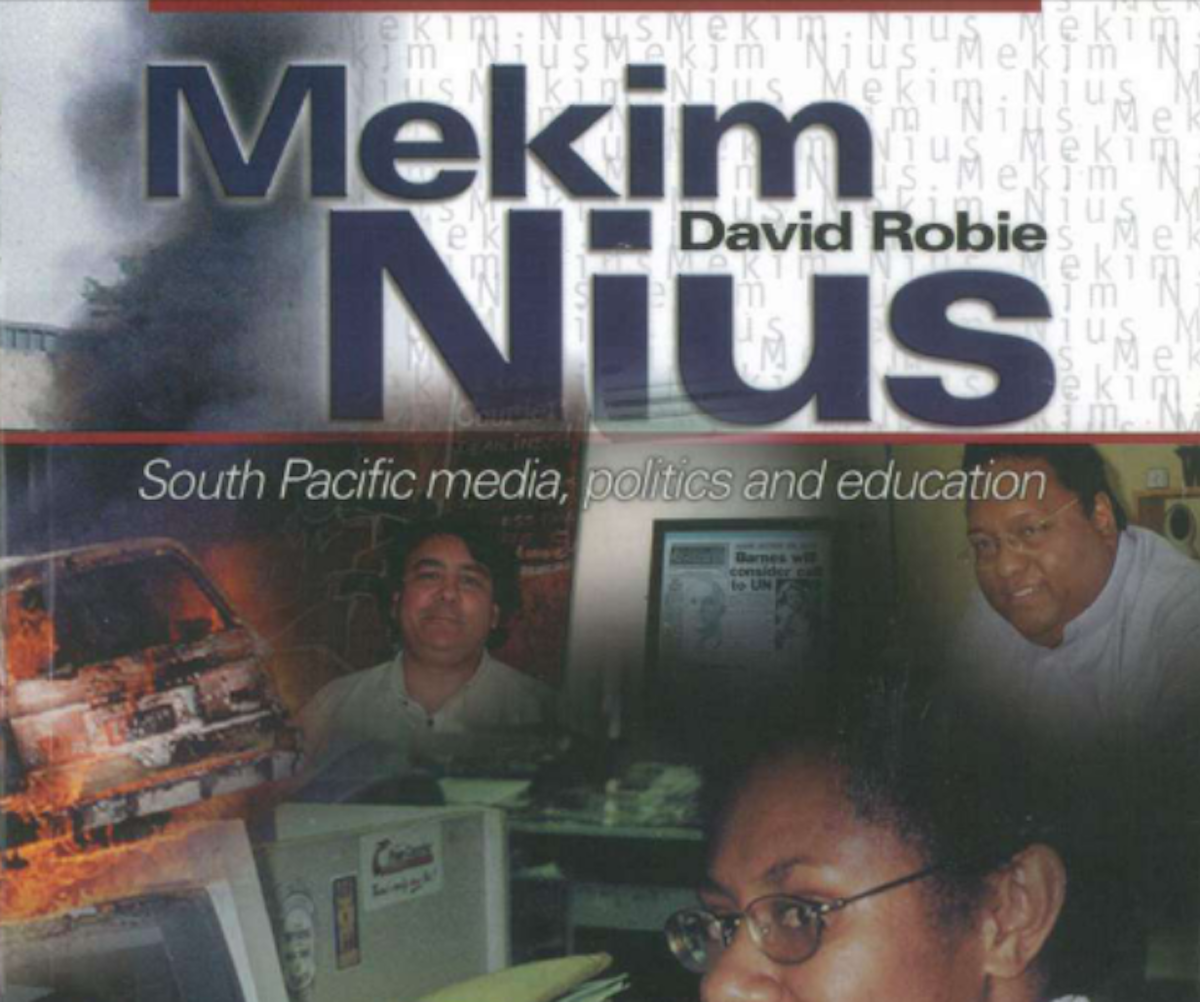
Part of the cover of Nius Bilong Pasifik, 1995
Part of the cover of Nius Bilong Pasifik, 1995. Image: Screenshot UPNG Press

REVIEW: By Damon Salesa

This ocean of ours is many things, but it is rarely “pacific”. The passage of contact, colonialism and supposed independence has not been without extreme moments.

The problems of living on the margins of a global society which both ignores and exploits the “sea of islands” are multiple, and as complex as the ocean itself. It is within such a precarious context that this feisty book examines the mass media in the Pacific.

Nius Bilong Pasifik is as urgent as it is unpretentious. Written entirely by people involved in Pasific mass media, it draws on the authors’ experiences and provides lucid illustration. It is gutsy but unassuming.

The task of the Pacific media, if it was not already clear, is onerous and treacherous. Foreign ownership, the swamping by foreign media, the constraints and trust of your own and others’ cultures, inhibited freedom if not outright danger, and the conundrum of “development” are just a few of the problems facing the Pacific media, and which they have to deal with in a language not their own, and often with inferior technology.

The Bougainville crisis, television, libraries, and the pro-democracy movement in Tonga are just a few of the issues to which Nius turns itself. While focusing largely on the Western Pacific, particularly Papua New Guinea, there are broader ramifications for throughout the Pacific, and even beyond.

Tackling the subject through themes affecting the whole region, such as types of media, and then though a series of case studies, involves too much overlapping, but more than enough of fascination.

The naivety in some places (“environmental journalists . . . are not made — they are born . . .”) is compensated for by the sophistication, knowledge and insight that is more general.

There are a few notable omissions, one being the situation in Kanaka Maoli (in Hawai’i) and the Māori people of our own country; people overwhelmed by media, and subject to much degradation, negativity and marginalisation because of this. Omissions and other “hiccups” indicate a need for further work, rather than any irretrievable problems.

Nius is a place to start, not to finish. The Pacific and its media still await an Indigenous counterpart with the weight of a Noam Chomsky or Marshall McLuhan, but David Robie and his fellows make this arrival imminent.

  • Nius Bilong Pasifik: Mass Media in the Pacific, edited by David Robie. Foreword by ‘I. Futa Helu. Port Moresby: University of Papua New Guinea Press. 1995. ISBN 9980840528. Reviewer Dr Damon Salesa is an Auckland author and academic.

Archive: Pacific media benchmark

0
Part of the cover of Nius Bilong Pasifik, 1995
Part of the cover of Nius Bilong Pasifik, 1995. Image: Screenshot UPNG Press

REVIEW: By Murray Horton

It is a graphic illustration of corporate New Zealand’s colonial mentality that our Eurocentric news media tell us all about the bludgers of Buckingham Palace and nothing about the brutalised people of Bougainville. It is our loss and Papua New Guinea’s gain that David Robie, this country’s foremost freelancer specialising in the Pacific, could no longer make a living here and now lectures in journalism at the University of Papua New Guinea.

Robie gets through a formidable work rate. As well as being a fulltime lecturer, he has revitalised the University of Papua New Guinea (UPNG) student newspaper Uni Tavur and continues to write as a freelancer. His latest project is editing this book, featuring 18 leading Pacific journalists, academics and media commentators (including himself). It is primarily written as a textbook for the emerging media workers of these scattered nations.

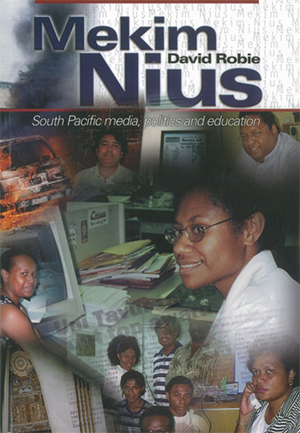
Nius Blong Pasifik cover, 1995.

In the context of national development, authorities see journalism as having a role different to that in the totally commercial-driven variety of New Zealand. Those selfsame authorities have had no hesitation trying to suppress journalism that doesn’t merely parrot the official version of the truth.

This has happened most notably against journalists trying trying to get inside PNG’s genocidal blockade of Bougainville; and against ‘Akikisi Pohiva who singlehandedly campaigns for democracy and honest politics in the feudal monarchy of Tonga.

There are other features of Pacific journalism that are peculiar to the region. For example, the fact that the owners of Papua New Guinea’s most influential newspaper, the Times of Papua New Guinea, are the mainstream churches reflects the powerful historic role played by missionaries. Other newcomers are now muscling into media ownership. PNG’s newest newspaper, The National, is owned by the Malaysian transnational that is the biggest player in that country’s logging industry, Rimbunan Hijau.

Pacific media has to be mindful of the social conservatism that is common throughout the region. The positive side of that is the determination to preserve indigenous cultures that risk being swamped by a barrage of “global culture” sweeping in by satellite dish.

David Robie has done it again. This book, from his exile in PNG, makes us keenly aware that there is now practically nobody in this country to report on the region in which we live.

Any book featuring 18 contributors will be uneven and one or two of the theoretical essays I frankly thought were a wank. But the highpoints make it well worthwhile.

David Robie is well known to Monthly Review readers. His chapter on media ownership in the Pacific is the definitive work on the subject. His other essay is on press freedom, which definitely means different things to different people in the Pacific.

For me, the most interesting parts of the book are the case studies, particularly the detailing of the shameful suppression of any Bougainville news by the Australian (and New Zealand) media. There is a fascinating account of a suppressed sex scandal involving Fijian coupster Sitiveni Rabuka.

The book also features a 40-page appendix of Pacific country profiles. As most New Zealanders (let alone our news media) couldn’t name most of the countries in the region, let alone anything else about them, this particularly welcome.

Nius Bilong Pasifik is a textbook and one which will set the benchmark for other texts in the field. But it is also accessible enough for the general reader and as such, is long overdue.

David Robie has done it again. This book, from his exile in PNG, makes us keenly aware that there is now practically nobody in this country to report on the region in which we live.

  • Nius Bilong Pasifik: Mass Media in the Pacific, Edited by David Robie. Foreword by ‘I. Futa Helu. Port Moresby: University of Papua New Guinea Press, 1995. 274 pages. ISBN 9980840528. Reviewer Murray Horton is Murray Horton is national organiser of the Campaign Against Foreign Control of Aotearoa (CAFCA) and an advocate of a range of progressive causes for the past four decades.

Nius Bilong Pasifik: Mass Media in the Pacific (1995)

0
Nius Bilong Pasifik 1995.
Nius Bilong Pasifik: Mass Media in the Pacific 1995.

Edited by David Robie | Foreword by ‘I. Futa Helu

“The news media in the South Pacific may be small — but the region has a diverse and vibrant mass communications industry.

Nius Blong Pasifik cover, 1995.

“Ranging from the PNG Post-Courier (circulation 41,000) and The Fiji Times to the fortnightly Tuvalu Echoes and monthly Madang Watcher, from EMTV’s nationwide broadcasts via the Indonesian Palapa satellite to Niue’s tiny television unit; or the PNG National Broadcasting Commission’s Kalang and Karai services to Tokelau’s traffic-and-weather broadcasts; the media caters for an audience and readership scattered over many islands and atolls.

“In French Polynesia, for example, the radio and television stations broadcast to 160,000 people spread over an ocean territory as large as Europe.

“Niue has a population of barely 2000; Papua New Guinea has more than  four million.

“In Nius Bilong Pasifik, 18 leading Pacific journalists, academics and media commentators explore the nature and problems of the contemporary Pacific mass communications industry.

“Edited by University of Papua New Guinea journalism lecturer and author David Robie, this is a unique book for Pacific journalism educators, students, sociology and political science scholars, media watchers and professional journalists.” – Back cover

Archive: Uni Tavur: A frog’s head, old ashtrays and student politics

0
The Uni Tavur team c. 1997 at the time of the Sandline mercenary crisis
The Uni Tavur team c. 1997 at the time of the Sandline mercenary crisis. Image: Pacific Journalism Review

Uni Tavur, the journalism training newspaper produced by the University of Papua New Guinea reporters and editors, celebrated its second decade of publishing in July 1994. The newspaper marked the occasion with a 20-page souvenir issue and made a television documentary.

By Jessie Waibauru in Port Moresby

It has been 20 good years since Uni Tavur was first launched. Today the journalism students are proud to be celebrating the newspaper’s twentieth birthday.

UPNG student journalist Jessie Waibauru . . . recording Uni Tavur's history
UPNG student journalist Jessie Waibauru . . . recording Uni Tavur’s history. Image: Pacific Journalism Review

Uni Tavur is the University of Papua New Guinea’s journalism training newspaper, produced by the journalism students doing practical reporting and print production. The students  cover stories about life on campus, community news and national affairs.

The journalism course began originally in New Zealand in 1974 — the year before Independence. The first issue of Uni Tavur came out on 24 July 1975. But a mix-up over volume numbers means this is the twentieth year.

Tavur means “conch shell” in the Tolai language of the Gazelle Peninsula. The shell is the paper’s logo and the original version was designed by journalism student Robert Elowo, who died in a car accident in 1976 while working for NBC’s Radio Kundiawa. Uni is derived from the university.

The first edition of Uni Tavur carried news items, including social and sports events. It consisted of four pages and had a circulation of 200 copies.

The university took over from the New Zealand government in funding and running the course in 1978. A two-year Diploma in Media Studies course started in 1985, replacing the one-year diploma course which had run for 10 years. The Bachelor of Journalism degree course started a year later.

Uni Tavur has seen a lot of changes through the years. The student reporters assigned to rounds had to cover anything of news value for their readers. Whether it was life on campus, life on the borderline, the political scene or anything of national interest, the students sweated to get the paper going.

Uni Tavur's editorial team in the second semester, 1994
From top: Uni Tavur’s editorial team in the second semester, 1994: Sports editor Isaac Nicholas (from left), chief-of-staff Tande Temane, pictures editor/cartoonist Campion Ohasio, features editor Rex Matthews (hard at work behind the computer), subeditors Koreken Levi and Theresa Bossin, production editor Kairu Laho and editor Kevin Pamba. Above left: An April 1981 issue. Above right: The 20th anniversary issue. Image: Uni Tavur/Pacific Journalism Review

Twenty years have gone by. We now look back at some of the hundreds of journalism students who have written for Uni Tavur over the years.

In 1975, the reports were on Sir Michael Somare leading the country into independence on September l6 and the voting of the first PNG Governor-General into office.

Letters to the editor caused some laughs. According to one correspondent in 1975: “I’ve followed the progress of Uni Tavur since its establishment with a great deal of interest. However … my criticism is directed at the use of phrases such as ‘other sources’, ‘one informant’, ‘unknown sources’, ‘it is believed’, ‘a source close to Uni Tavur‘ etc …

“Your anonymous source is like a man whose wife has run away from him, and who then asks someone else to go and beat up his wife because he’s afraid she might bite. He’s a ‘rubbish man’, and you’ll find his opinions or statements — even if they sound important — are worthless, and of lesser news value too.'”

In an item headlined NEW IRISH WANTOKS the following year, it was reported: ‘A Papua New Guinean studying in London gets a faster bar service in a hotel with an Irishman behind the bar — because he comes from New Ireland Province. He is Norlie Miskaram, attending the School of Oriental Studies in London.’

In 1978, there was talk of Papua New Guinea supporting the Kanak Liberation Movement fighting for independence for New Caledonia. During the same year an arts student said that marijuana should be legalised in PNG because it was “not as bad as beer”.

In 1979, a second-year student in social work said he found a frog’s head in his plate of food. When the mess manager was asked about it, he said it was “an oyster”.

In 1981, Students Representative Council president Gabriel Ramoi criticised the lecturers’ manner of dressing, while a commerce student said the government wasted millions of kina by recruiting overseas specialists to improve accounting systems.

The following year the library display on smoking caused a smoky nightmare for smokers. The headlines read: YOU CANT SCRUB THE SMOKERS . . . TRY SOME, SMOKERS TAKE IT REGULARLY . . . HAPPY BIRTHDAY SMOKERS and, to top it off, KISSING A SMOKER IS LIKE KISSING AN OLD ASHTRAY.

During the same year, in March 1982, UPNG students paid tribute to the late Gabriel Gris, the first Papua New Guinean Vice-Chancellor, who died suddenly.

In 1984, Uni Tavur celebrated its tenth birthday and a preliminary year student from North Solomons was in darkness after losing his spectacles up the mango tree next to the bookshop.

In 1985, Uni Tavur celebrated Papua New Guinea’s Independence anniversary by reporting the changes on campus and around the city over the previous decade.

Two years later, 50 university staff were retrenched at the end of the year when the government imposed a five percent budget cut, and a security guard was removed from the mess after giving away fruit to the students.

In 1989, there were reports of the university’s original bush material chapel built in 1971 — and it was burnt down the same year. The new chapel opened in 1989.

The same year, during rehearsal of a play, The Ungrateful Daughter, one of the students, instead of saying, “Darling, your steak is delicious,” said, “Darling, your stick is delicious.”

Now we are in the 1990s.

Looking back over the years the newspaper used to be more of a newsletter format.

Today the journalism students, with the help of lecturer David Robie, are producing a professional newspaper.

Twenty years this week sees a different Uni Tavur with modern equipment to facilitate the production. The newspaper has improved not only in size but also in the quality of news reports.

There has been a significant change because of desktop publishing. The content has also changed dramatically. It now has advertisements.

Uni Tavur is certainly a newspaper in its own right. It has between 12 to 20 pages and a circulation of 1700.

It has a wide readership at UPNG and among subscribers in Papua New Guinea — and from Japan to Tahiti.

Jessie Waibauru is a first-year journalism student at the University of Papua New Guinea. Republished from the 20th birthday issue of Uni Tavur, 22 July 1994 via Pacific Journalism Review.

READ MORE:

The Uni Tavur team at the time of the coverage of the Sandline mercenary crisis in 1997
The Uni Tavur team at the time of the coverage of the Sandline mercenary crisis in 1997. The previous year, Uni Tavur won the Ossie Award for best student newspaper in Australasia and the Pacific. Image: Pacific Journalism Review

Pacific Journalism Review – a research and publication archive

0

Pacific Journalism Review

The Pacific Journalism Review: Te Koakoa is a peer-reviewed journal examining media issues and communication in the South Pacific, Asia-Pacific, Australia and New Zealand.

Founded by Professor David Robie in 1994 at the University of Papua New Guinea, it was later published at the University of the South Pacific.

PJR was published between 2007 and 2020 by the Pacific Media Centre in the School of Communication Studies, Auckland University of Technology. From 2021 it has been published by Asia Pacific Media Network in association with Tuwhera Publishing at AUT and the University of the South Pacific Journalism Programme.

PJR is a ranked journal indexed with DOAJ, SCOPUS metrics and Web of Science.


The Life of Pacific Journalism Review. Compiled by AUT student Sasya Wreksono

Archive: Pacifications: The erosion of press freedom in Oceania

0
Pacifications: The erosion of press freedom in Oceania

By David Robie in Arena Magazine

Abstract: Article 19 of the Universal Declaration of Human Rights says, “Everyone has the right to freedom of opinion and expression; this right includes freedom to hold opinions without interference and to seek, receive and impart information and ideas through any media and regardless of frontiers.”

Freedom of the press is the guarantor of these rights. Although the practice of independent journalism is, internationally, frequently under attack, vigorous and courageous reporting of events by reporters in Eastern Europe, the former Soviet Union and South Africa over the past few years has reminded the world that openness and freedom of expression are cornerstones of democracy.

It is ironic, then, that several nations in the South Pacific should be heading in the other direction, imposing draconian restrictions on the news media, sufficient to constitute a threat to democracy in the region.

Archive: Crusading journalism in the blood from Edinburgh to Aotearoa [Profile]

0
Independent journalist David Robie
Independent journalist David Robie in Auckland in 1992 . . . "It's ironic that my work is published more outside New Zealand than here." Image: Kevin Lanwer/Harbour News

“It’s ironic that my work is published more outside New Zealand than it is here.” (Article first published in 1992).

PROFILE: By Murray Horton

“My conception of reporting may seem somewhat unorthodox — perhaps some would say heretical. As members of human society, I believe reporters should regard their responsibilities as being contractual obligations to editors, and their own personal interests. A simple illustration: a child being beaten to a pulp by a bully. A reporter who rushes to record the scene with a camera and tape recorder might succeed as a journalist, but [they] fail as a human being. [Their] first responsibility is to rescue the child. A reporter is not an electronic computer digesting dispassionately the facts with which [they] are confronted. [They are] endowed with reason and conscience bequeathed by many centuries of human experience. [They] cannot remain coldly aloof and objective when basic human issues are involved. My concept of reporting is not just to record history, but to help shape it in the right direction.”

— Wilfred Burchett in his 1969 book Passport.

“Watch out for a fiction writer named David Robie masquerading as a journalist and an instant expert on the Philippines . . . It’s really amazing why many foreign newspapers send idiots to this country when they could have told them instead to stay in their cells in the insane asylum back home where they can merrily manufacture mad stories. . . . And to think that many of us seem to have more faith in these parasites who just fly in, eat and drink on some local sucker, bat off an analysis, then fly out.”

Philippine Daily Inquirer column, “Idiots sent to smear us”.

“[It] was written by David Robie, a New Zealand freelance journalist who has earned himself the rare distinction among French and Tahitian government and French military officials as being one of the most unpopular Anglo-Saxon journalists working in the South Pacific.”

Tahiti Sun Press

“Ah, David Robie. The closest thing we’ve got to a war correspondent.”

— A Christchurch Press journalist

“Who knows, Robie and Rabuka may both go down in history as putting the Pacific Islands on the political map!”

— A Massey University professor

Objectivity in journalism is a myth. Most journalists are subjective, whether they admit it or not. And most media institutions are extremely subjective. Their inherent bias is cloaked in so-called “news judgment”. In fact, objectivity is merely a euphemism for reporting from a position that reflects the status quo, and the values reported by the establishment. Any reporter who deviates from that narrow position, or is perceived as a Leftist, is branded “biased”.

“I see my role as a journalist to be even-handed, to report on issues that need to be debated as well. If there’s a can of worms within a progressive movement, then that needs to be exposed. You shouldn’t hide things under the carpet just because it happens to be Leftwing.”

David Robie is that great rarity among the dwindling and dispirited band of gutless New Zealand journalists. He travels his beat (Asia/Pacific) regularly to see for himself; he freelances (albeit, even more tenuously); he is a progressive, whose scrupulously researched articles appear in both the mainstream media and NZ Monthly Review; and he is constantly the subject of personal controversy.

In the course of his work, Robie has been arrested at gunpoint by the French military in Kanaky New Caledonia. He was on board the Rainbow Warrior as a journalist for more than 10 weeks leading up to when it was bombed in July 1985. He hasn’t been allowed into Fiji since the 1987 coups, a fact which hampers his defamation suit against the Suva-based Islands Business magazine (for which he wrote as a chief correspondent for eight years).

His 1989 book, Blood on their Banner, had to be published in Swedish first because the prospective New Zealand publisher wanted to cut out [a chapter], specifically on East Timor, West Papua and Indonesian colonialism. He has regularly been the subject of smear campaigns and he was vilified by one section of the Māori nationalist movement and their Pākehā supporters because of his Monthly Review exposé of a clique running the Nuclear-Free and Independent Pacific (NFIP) movement (“Anatomy of a hijack”, NZ Monthly Review, No 328, December 1990, pp.16-21).

“There was a feeling among a number of so-called progressive activists that I should not have written about the internal workings of an indigenous group. I regard that as a very fascist approach. Rather than discuss the issue openly, they want to shoot the messenger.”

News clippings about David Robie's Asia-Pacific work
News clippings about David Robie’s Asia-Pacific work in 1992 . . . breaking the stereotypes. Image: NZ Monthly Review

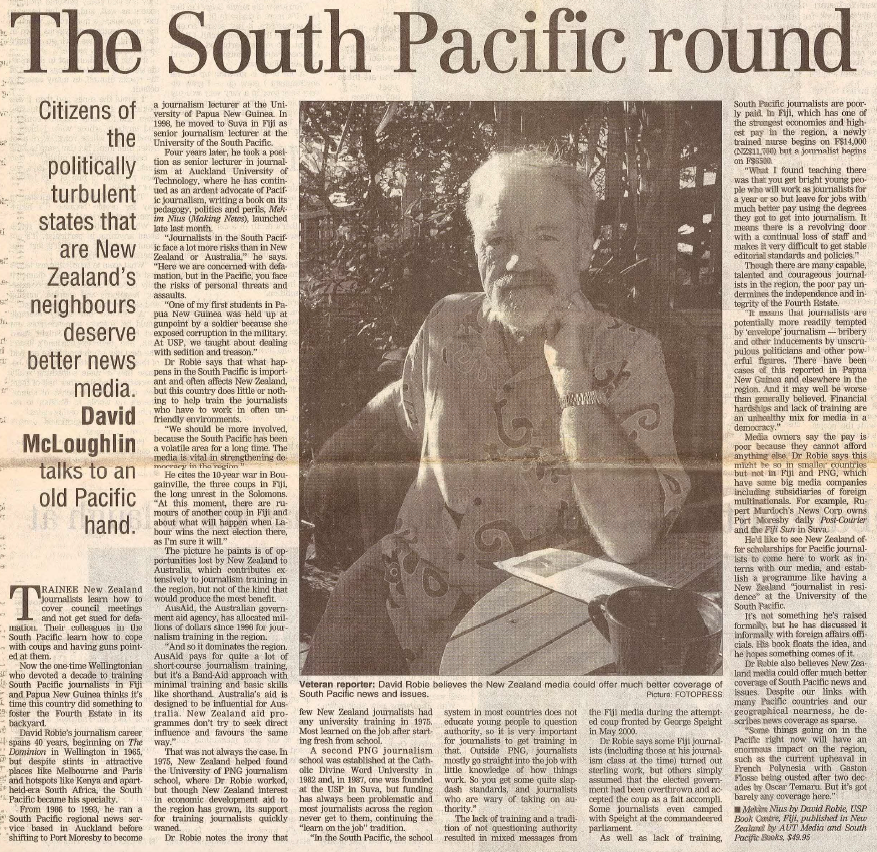
Robie, who describes himself as “independent”, has certainly paid a high price for being the closest New Zealand journalist to John Pilger (or one of his mentors, the late great Wilfred Burchett). He lives in Auckland, working from his Grey Lynn home, which is the office for [Café Pacific media]. Launched in 1991, it operates from his converted garage. But his work rarely appears in the Auckland press. He is better known to Christchurch readers of The Press, and even there his features appear a lot less frequently than they used to. He was also for several years a regular contributor to The Listener and The Dominion.

“It’s ironic that my work is published more outside New Zealand than it is here.” Robie writes for several overseas publications, including the Pacific Islands Monthly, and his articles are syndicated to 250 newspapers worldwide by a London-based agency, Gemini News Service.

Robie is regarded as anathema by the media establishment. More than once he has been interviewed for commissioned profiles for major magazines. Not one has actually been published — “not sexy” enough was the reason one writer was given by his editor. [Later, in 2002, The Listener published a profile by Mark Revington — “Guns and money”.]

The 1990 launch of Blood on their Banner was ignored by the New Zealand media and courtesy of yours truly, the [now closed] Christchurch Star saw fit to make a major feature out of the launch speech by Race Relations Conciliator Chris Laidlaw. For the 1992 Tu Galala: Social Change in the Pacific book launch, Robie secured the telegenic former Prime Minister David Lange to make the speech. That, and not the book per se, drew the coverage.

Blood on their Banner
Blood on their Banner, 1989 . . . controversial criticisms of some sections of the Pacific media. Image: Zed Books

Since the advent of the Employment Contracts Act, Robie has found freelancing the toughest it has ever been, and has been considering other challenges. He was recently shortlisted For Amnesty International’s director of media relations job in London. [Robie was later appointed head of journalism at the University of Papua New Guinea in Port Moresby.]

Even getting around his usual traps is no longer straightforward. For the most recent Pacific trip, to Papua New Guinea, he travelled as a business “consultant”, not a journalist. This is due to PNG’s official sensitivity to journalists on the Bougainville issue, one which Robie has covered firsthand.

There was nothing in Robie’s perfectly ordinary Kiwi upbringing to suggest that he would become a controversial Asia-Pacific writer. It was only as an adult that he discovered his great-great grandfather, James Robie, was a crusading journalist in Edinburgh. He edited and published the Caledonian Mercury (1860-1866), campaigning for the abolition of slavery in the United States, and against social injustice in his own country.

“It dawned on me that it was in the blood, that he wrote these 40 or 50-page political tracts.”

Robie is 47 and the oldest of three siblings. His father was a factory manager and is now retired in Pauanui. He grew up in Eastbourne, going to Wellington Boys College. He was a carnivorous youth, trapping possums for pocket money — he had to deliver sackloads of ears to the NZ Forest Service to prove his tally. He also hunted deer and goats with a bow and arrow — archery was his school sport.

He was a Queen’s Scout, representing New Zealand at a World Jamboree at Marathon Bay, Greece, when he was almost 18, and while he was abroad he spent time in France, which gave him the urge to travel.

A love of tramping compelled him to enrol in forestry at Victoria University and he spent his first year living in Kaingaroa Forest, in the central North Island. While there he rethought his direction in life, realising that he had enjoyed writing at school — “and was very good at it”.

During his second year at Victoria, he also worked for the Forest Service publications division. After leaving university, he started as a trainee journalist on The Dominion.

It was strictly a job at that stage. “I had a very apolitical background, my political awakening came later.” Motivated by a personal friendship with the son of NZ’s then military chief-of-staff, whose father was later ambassador to South Vietnam, Robie later volunteered for the Army with the view of going to Vietnam for adventure. “I came to my senses” before signing up.

In 1966, he left The Dominion as a subeditor and moved to Auckland as assistant editor of the AA magazine, Auto Age, and then moved on to become a subeditor on The New Zealand Herald. “I worked there for eight months, and it was the worst paper I’ve ever worked for. It was, and is, so incredibly conservative.”

In 1968, he married his first wife, Penelope. That year they moved  to Australia for the big OE and ended up staying overseas for 10 years. He started as a sub/reporter on the Melbourne Herald. “I was there at the end of its increasing circulation period, then it started to lose to TV, as virtually all afternoon paper have.”

He saw an advert for “crusading and fearless journos” to join a new newspaper, and moved to the Melbourne Sunday Observer as chief subeditor. Published by the transport magnate Gordon Barton, this was the first major newspaper in Australia to use colour, and the first to be strong on social justice issues.

In 1970, at 24, he became the youngest metropolitan editor in Australia. However, like NZ and the US, that country was being torn apart by the Vietnam War and conscription. He wrote editorials urging liable Australian young men to burn their draft cards. He was prosecuted for publishing the internationally infamous and gut-wrenching series of photos of the My Lai massacre. The actual charge was astonishing: “Obscenity.” It never came to anything, nor did any of the various libel claims.

One of the Sunday Observer’s principal foreign correspondents was Wilfred Burchett, the Australian journalist who beat the US blockade and travelled to Hiroshima to reveal the horror of the nuclear devastation to the world. Because the 1949-72 Liberal/Country government deemed Burchett a communist, his Australian passport was stolen from him, reputedly by the CIA. When his father died, the Australian government still refused him a passport.

The Observer flew Burchett in to Brisbane from Noumea on a chartered plane. Once in the country of his citizenship, the authorities were powerless, as Burchett had committed no crime — literally, the first act of the Whitlam Labor government was to issue him a passport.

Managerial gutlessness soon got rid of editor David Robie. Several editorial staff were dismissed (mainly photographers for “using too much film”), and he was fired by the managing director for allowing the use of the word “frigging” in the regular political carton strip. He secured an out of court settlement to ensure his contract was paid in full. That was the end of Australia for him — today there are no crusading newspapers there, the last being The National Times; no Western country has a more vertically integrated media ownership structure.

He and Penelope moved to South Africa where he became the chief subeditor and night editor at Johannesburg’s Rand Daily Mail: “My approach to journalism was very much shaped by editors like Laurence Gandar, Raymond Louw and Alister Sparks.”

In contrast to NZ media, both the Sunday Observer and the Mail were non-establishment newspapers. The latter was an outspoken anti-apartheid paper. It was the conscience of the white community and some of its senior journalists had been jailed for simply doing their job. It has since gone out of business [1985] because it was perceived to be increasingly read by blacks and then its advertising revenue collapsed.

Robie could only take two years of apartheid South Africa and had to leave for the “sake of his sanity”. “It’s an utterly abhorrent system.” They refused to have servants: “I was known among the more reactionary journalists as the ‘pinko from New Zealand’.” He tackled the notorious apartheid laws on quoting “banned” people, and publishing “banned” photos, such as ones of racially mixed couples.

South African government letter
Part of the South African apartheid government letter in January 1975 declaring journalist David Robie barred at the border. Image: APR screenshot

“I won’t go back to South Africa until there is majority rule.” After he left, he was declared persona non grata in early 1975 — curiously enough the papers, from Interior Minister Theo Gerdener, were delivered addressed to him “c/o The ‘Paris Match'” magazine via the British diplomatic bag in Nairobi, Kenya, when he was living there. Just to prove that he was as unwelcome in black dictatorships, he was also declared persona non grata in Zaire.

After six months travelling overland in Africa, they ended up in Ethiopia where he spent a year as group features editor on the Nairobi Daily Nation, the Aga Khan’s anti-colonial newspaper. “I had the shock of coming from South Africa, where some media tackled the government, to an independent country where the media basically did not buck the system.”

A senior journalist was abducted and detained by the GSU special police for being about to expose a pharmaceutical scandal. The paper did not campaign for his release, but went cap in hand to the government.

Travelling in their Kombi van through the rainforests of Zaire as part of the transAfrican freelance trek in 1976
Travelling in their Kombi van through the rainforests of Zaire as part of the transAfrican freelance trek in 1974. Image: David Robie/Café Pacific

After Kenya, they spent a further six months travelling in Africa. Robie bought a rubber stamp kit, issuing his own vehicle registration papers and his own visa for Zaire. [This was necessary to remove any evidence of them having been in South Africa]. They travelled through Idi Amin’s Uganda, central and western Africa, across the Sahara Desert to Algeria, then through Spain to France, freelancing as they went.

From 1975-77, Robie was a desk editor and foreign correspondent for Agence France-Presse news agency, based in Paris. He covered the African boycott of the 1976 Olympic Games in Montreal, Canada, and had a brief career as a sports writer, including covering rugby internationals at the Parc des Princes in Paris, and in Toulouse.

“In many respects I found working in Paris enormously stimulating. I started becoming intensely interested in French neocolonialism in the Pacific.”

Previously Robie had been a typical Eurocentric Kiwi. The Kirk Labour government taking French nuclear testing to the World Court was a big story, and Robie covered Greenpeace founder David McTaggart’s “piracy” case against the French military. Robie was also writing for the now defunct Nation Review, in Australia — and he wants it known that he has occasionally written for rightwing magazines, including To The Point, published in Brussels and later exposed as being financed by the South African Muldergate slush fund.

“New Zealand international coverage generally, not just the Pacific, is abysmal. No daily newspaper has a proper foreign editor with any proper resources.”

In 1978, he and his former wife returned to Auckland for family reasons. “I hated coming back, it took about two years to adjust to the parochial mentality.” He was foreign news editor of the Auckland Star until 1981.

“At the time it was probably New Zealand’s best newspaper, certainly the most liberal. I had a personal frustration, I wanted more Pacific and international coverage of our own. I was writing on the Pacific; I found myself in the ridiculous situation of using my holidays to travel the Pacific and sell the stories to the Star. I decided to leave and work freelance.”

Robie covered the 1981 Springbok rugby tour protests for the London Sunday Times. He was on the ground at Hamilton, where invading protesters forced the cancellation of the game, with the crowd baying: “Let’s get the journalists — they started it all.”

He freelanced on Pacific and development issues until 1983. Indeed, his first book had the unexciting title “United Nations Development Programme in the South Pacific”. Then he edited Insight, the magazine for American Express cardholders. It rapidly became the same old story — management didn’t like its punchy style, the Bob Jones columns, or the Brockie cartoons.

“They were just gutless, the general managers were abysmal.” The publishing company lost the contract, so he became redundant as editor and his final cover story on the “owners of New Zealand” was censored because it was too “controversial”. [The cover story was later published in another magazine, New Outlook]. It was the last time he worked for a boss.

Since 1985, David Robie has been an Asia-Pacific affairs independent journalist, and for a time he was associate editor of New Outlook magazine. “I write a diverse range of artices, depending on the publications. You wouldn’t condemn a rugby writer for not writing about golf.”

He spent almost 11 weeks on the Rainbow Warrior’s final voyage in 1985. He was the only journalist out of six on board. His 1986 book, Eyes Of Fire: The Last Voyage of the Rainbow Warrior concentrates on the actual voyage and the evacuation of the Rongelap nuclear test victims, rather than the bombing of the Warrior in Auckland harbour on July 10. [Although that is covered strongly too – the book was reviewed by CAFCA Watchdog’s reviewer, the late Jeremy Agar here].

Eyes Of Fire,by David Robie, the Rainbow Warrior book
Eyes Of Fire,by David Robie, the Rainbow Warrior book, 1986. Image: APR screenshot

“It wasn’t a Greenpeace manifesto; indeed Greenpeace would be quite embarrassed by some of its contents. It’s typical of the shallowness of the NZ media that they weren’t interested in the Rongelap evacuation. Any suggestion that Fernando Pereira’s death was a tragic accident is an obscene lie — it was a miracle that at least people weren’t killed.” An American environmental film, based partly on the book, is still in the offing.

“New Zealand international coverage generally, not just the Pacific, is abysmal. No daily newspaper has a proper foreign editor with any proper resources. It’s almost impossible to get a New Zealand perspective on events happening outside NZ. This is in contrast to Australia. It’s partly to do with the lack of competition, but it also reflects the traditional parochialism of NZ society. For the NZ media, the Pacific begins and ends with the Cook islands, Fiji, Samoa, Tokelau and Tonga — and even then the coverage is spasmodic and reacts to things like cyclones.

“The political and economic powerhouse is Papua New Guinea, but there is no coverage. Even the Bougainville struggle  gets only spasmodic coverage. New Caledonia, Solomon islands and Vanuatu get only spasmodic and distorted coverage, for example the Matignon Accords (in New Caledonia), are being perceived as being highly successful and there is no coverage of the enormous opposition to them.

“There was a recent delegation of NZ journalists there, with no previous experience of the country. They believed what they were fed by French officials and leaders of the Kanak independence movement, who were alleged to have been collaborators.

“The NZ media will only cover events outside NZ if there is a junket provided.”

Blood on their Banner . . . the Philippines edition
Blood on their Banner . . . the Philippines edition published by Malaya Books, 1991. Image: APR screenshot

As a journalist, Robie accompanied the New Zealand delegation to the 1988/89 Asia/Pacific People’s Conference on Peace and Development in the Philippines. Here he ended up marrying his Mindanao facilitator, Del Abcede, to the strains of the “Internationale”. Del was a teacher union leader and organiser at home. She was a driving force in the politicised section of NZ’s Filipino diaspora population, secretary of the Philippine migrant centre in Auckland, and is actively involved in the broader progressive movement.

Since then, Robie has been to the Philippines several times, including being the only New Zealander on a study tour by Australian journalists — he was guest editor of a special issue of Diarista, the journal of the host National Union of Journalists of the Philippines (NUJP).

He has had more than one series of articles on the Philippines published in New Zealand’s dailies, and he specialised in analysing NZ’s forestry aid project in Bukidnon, Mindanao. Both of his two most recent books have included Filipino content. Indeed, Blood on their Banner is the only book by a NZ writer to be published in the Philippines. Leading Filipina activist Rita Baua is one of the contributors to Tu Galala: Social Change in the Pacific.

It was Blood on their Banner’s Asia content that led to its prospective publisher wanting unacceptable cuts.

Robie’s writing on the Philippines has trodden on some very sensitive local toes. A 1989 Philippine Daily Inquirer column, entitled “Idiots sent to smear us” was written by former editor-in-chief Federico Pascual. He attacked Robie for accusing the newspaper of suppressing human rights stories — one of the Inquirer’s reporters had handed him a file of affidavits  about such stories that had been censored. Robie wrote a letter to the newsaper for publication, challenging Pascual. It was never published. Neither was a further letter sent to the paper’s ombudsman (internal investigator).

Tu Galala: Social Change in the Pacific, 1992 - David Robie (Ed)
Tu Galala: Social Change in the Pacific, 1992. Image: APR screenshot

A year later, Robie met Pascual by chance at the University of the Philippines when gthey were panellists together on the issue of press freedom. When Robie approached Pascual and mentioned the column, the former editor denied having written anything and then scurried away in embarrassment.

It was Blood on their Banner’s Asian content that led to the prospective NZ publisher wanting unacceptable cuts, and to the ludicrous spectacle of a book on the Pacific, by a New Zealand writer, being published first in Swedish.

Not that Robie has abandoned the Pacific. It is still his bread and butter. Although he is a freelancer, he is not a glory seeking individualist, but an active unionist. He is JAGPRO’s representative in the Pacific Journalists’ Association, and is involved in a lot of press freedom issues in the region. He was instrumental in securing industry and progressive movement opposition to the 1991 Auckland visit by Fiji’s coup leader Sitiveni Rabuka to address the conference of the Pacific Islands News Association (PINA), a conservative organisation of Pacific media bosses, journalists and officials.

Above all else, David Robie is an extremely good writer and he has the bits of paper and trophies to prove it — ranging from the NZ Media Peace Prize in 1985 to the Qantas Best Feature Writer Award in 1989. His articles cover our own backyard, an area shamefully neglected by the media here. His stories are rooted in his own first hand observations.

He has chosen the financially precarious path of freelancing, and he has never shied from controversy, whether with reactionary authorities and their media mouthpieces, or with apologists hiding behind “indigenousness”. As far as New Zealand journalists and writers go, he is virtually one of a kind.

One recent event illustrates my point. After attending the Auckland launch of Tu Galala with my wife, all four of us later went to Kelly Tarlton’s Underwater World. It affected us in different ways. I was a rubber-necking tourist; the Filipinas decided to cook fish; and David drew our attention to the shark turds in the tank.

Always the journalist, always in duty. And that’s what this country and region are sorely lacking — journalists who are not merely gushing admiration for the killer efficiency of the sharks in our midst, but point out that they are showering us with shit.

Murray Horton is secretary and organiser of the Campaign Against Foreign Control of Aotearoa (CAFCA) and an advocate of a range of progressive causes for more than the past five decades. This article was first published in 1992 under the title “David Robie: One of a kind” in the NZ Monthly Review which has now ceased publication. (The author’s original title was “Foreign Correspondent”). A sequel to David Robie’s Blood on their Banner book mentioned in this article was published in 2014, Don’t Spoil My Beautiful Face : Media, Mayhem and Human Rights in the Pacific (reviewed by Murray Horton here). It was endorsed by investigative journalist John Pilger.

Tu Galala: Social Change in the Pacific (1992)

0
Tu Galala: Social Change in the Pacific, 1992

Edited by David Robie

“The Pacific is in upheaval — growing poverty, nuclear testing, independence struggles, militarisation and massive social dislocation are pressing, often intractable issues.

Tu Galala: Social Change in the Pacific, 1992 - David Robie (Ed)
Tu Galala: Social Change in the Pacific, 1992.

“In Tu Galala (Fijian meaning ‘freedom’), indigenous and palagi writers describe the impact of these influences on their people.

Topics covered include the Bougainville crisis and the environmental impact of mining on indigenous communities in Australia, Aotearoa New Zealand and Papua New Guinea; hazardous waste dumping and the Johnston Atoll chemical weapons burn-off controversy; human rights violations in Fiji, Papua New Guinea, the Philippines and East Timor; ‘development’ in Kanaky/New Caledonia, and tino rangatiratanga in Aotearoa/New Zealand.” — Back cover

Preparation for Tu Galala was assisted by the Pacific Development and Conservation Trust, a fund set up in New Zealand with compensation money from the French government for the bombing of the Rainbow Warrior in Auckland’s Waitemata Harbour on 10 July 1985.

Contents:
Introduction: Poverty and privilege — David Robie and Delia Abcede

Part One: The Region

  1. Pacific Overview: Not So New World Order — Robert T. Robertson with Akosita Tamanisau
  2. People’s Movements in the Pacific — Rita Baua
  3. Militarism in the Pacific and the Case of Fiji — Owen Wilkes and Sitiveni Ratuva
  4. Chiefs and Commoners: The Indigenous Dilemma — Jone Dakuvula
  5. The Environment: ‘Who Gives a Damn?’ — Bunny McDiarmid
  6. Bougainville and Mining: ‘Breaking All Five Fingers’ — Roger Moody
  7. Indonesian Colonialism in the Pacific — Liem Soei Liong
  8. Human Rights: Abductions and Torture — David Robie

Part Two: Case Studies

  1. Aotearoa: Tino Rangatiratanga — Pauline E. Tangiora
  2. Belau: Nuclear-Free Isles Under Siege — Ed Rampell
  3. Fiji: Women, Poverty and Post-Coup Pressure — ‘Atu Emberson-Bain
  4. Kanaky: The ‘Peace’ Signed with our Blood — Susanna Ounei-Small
  5. Tahiti: In Bondage to the Bomb — Marie-Thérèse Danielsson
  6. Tonga: The Day of Redckoning — S. ‘Akilisi Pohiva
  7. Samoa: Reclaiming Our Cultural Memory — Tialetagi Poumau

Afterward: Looking for Leadership — Richard Naidu

Archive: Rabuka stirs bitter media freedom row

0
Major-General Sitiveni Rabuka . . . from military coup leader to civilian politician. An
Major-General Sitiveni Rabuka . . . from military coup leader to civilian politician. An "ulterior motive" media invitation to New Zealand? Image: Matthew McKee/The Word

Former Fiji military strongman Major-General Sitiveni Rabuka is now deputy Prime Minister in the civilian interim government. As leader of the 1987 coups d’état, Rabuka closed newspapers and jailed journalists. Now an invitation for him to address a media convention in New Zealand has stirred a bitter controversy. Accusing the conference organisers of “abysmal judgment”, one newspaper contrasted their attitude towards Rabuka with the fate of the recent coup plotters in the Soviet Union who now face charges of treason.  

By David Robie in The Word

An invitation to Fiji coup leader Major-General Sitiveni Rabuka to be keynote speaker at a media convention in New Zealand next month [October, 1991] has plunged South Pacific newspapers and journalists into a bitter row over ethics and press freedoms.

Rabuka, who deposed the elected government of the late Prime Minister Dr Timoci Bavadra at gunpoint in 1987 and abrogated Fiji’s constitution, recently quit the military and was appointed to the interim government as co-deputy Prime Minister and Minister of Home Affairs.

The Pacific Islands News Association — a regional organisation of media publishers, editors and broadcasters — invited the general to speak at its annual conference in Auckland on October 7-11.

Although the previous Labour government twice blocked attempts by Rabuka to visit New Zealand, the present National government has signalled warmer relations between New Zealand and Fiji. It declared there would be no opposition to a formal visa application by the general.

Foreign Minister Don McKinnon said that if Rabuka visited New Zealand he would be offered “the courtesies normally extended to a deputy prime minister”. New Zealand officials now regard the coup leader as a civilian politician. Fiji is due early next year to have a general election under a new republican constitution which is condemned by opponents as “racist and unjust”.

Pro-democracy expatriates living in New Zealand, and the anti-apartheid group Hart, are among movements that have protested against the planned visit. They threaten to mount demonstrations against Rabuka.

Several newspapers and journalists’ organisations have also harshly criticised the invitation. The Dominion published a scathing editorial, accusing PINA of “abysmal judgment” and “ignorance” and a New Zealand Herald report questioned what it called a possible “ulterior motive”.

Journalists jailed, harassed
The NZ Journalists and Graphic Press Union (Jagpro) said it was ironic that PINA had invited Rabuka when he represented a regime that had jailed, intimidated and harassed journalists in Fiji and arbitrarily restricted the entry of foreign journalists — including New Zealanders.

Fiji Prime Minister Sitiveni Rabuka
Fiji Prime Minister Sitiveni Rabuka in 2023 . . . Now a champion of free media and free speech. Image: Fijivillage

National secretary Tony Wilton said New Zealand journalists were effectively barred from Fiji and last year the independent radio news service Pacnews had been expelled from the country. Pacnews now operates from Honiara, Solomon Islands.

Wilton noted that “PINA is neither a New Zealand news organisation, as has been reported, nor is it affiliated with the International Federation of Journalists”.

Frank Senge, a leading Papua New Guinea journalist and president of the Pacific Journalists’ Association — representing working journalists throughout the region — said the the invitation showed “remarkable naivety”. He added that it would inevitably give credibility to the coup leader.

The PJA, founded two years ago, is supported by the Brussels-based International Federation of Journalists (IFJ), which represents 150,000 journalists internationally, and its affiliates, Jagpro and the Australian Journalists’ Association.

Suva-based PINA defended its move, saying it was “ludicrous” to infer that it was in any way expressing approval of Rabuka’s role in the 1987 coups. Newspapers in Fiji also rallied to the defence of PINA. The Daily Post said that if Rabuka formally accepted the invitation, “it will be a coup in itself for PINA. It will also demonstrate his courage in standing up [for] what he believes in.”

Among PINA’s founders is former Fiji Times publisher Sir Leonard Usher, who was for many years a publicist for the establishment Alliance Party. Many members of the Alliance government defeated in the April 1987 general election — including present interim Prime Minister Ratu Sir Kamisese Mara — regained power throughout Rabuka’s coups.

House arrest
After Rabuka seized power on 14 May 1987, troops were ordered into the offices of Fiji’s two daily newspapers and their journalists were put under house arrest. Foreign journalists were harassed and detained their hotel rooms raided, tapes and notes seized. Radio broadcasts were censored.

The papers were shut again after the second coup four months later. One of the papers, the Hong Kong and New Zealand-owned  Fiji Sun, refused to publish again under censorship and closed. Since then Fiji journalists have faced being jailed without charge, threatened with government licensing of newspapers, and harassed by a zealous Minister of Information, Ratu Inoke Kubuabola.

Reports by the Pacific Journalists’ Association, Amnesty International and other organisations have cited examples of the harassment and intimidation. PINA has also played a role in defending press freedoms and in recent times the harassment has been less marked.

On one occasion, in 1988, the now retired editor of The Fiji Times, Vijendra Kumar, was arrested by soldiers and detained over a typographical error which upset Rabuka. A reporter of the paper was also jailed without charge.

Last month [August 1991], charges of “malicious fabrication” against the publisher of the Daily Post, Taniela Bolea and two staff journalists, were dropped. The journalists had been charged last October [1990] for publishing a news report about plans by students to burn copies of the republican constitution following the kidnapping and torture of Suva academic Dr Anirudh Singh by Fijian soldiers.

In July, a leading Tongan journalist, Matangi Tonga editor Pesi Fonua, was briefly detained in Fiji while travelling to Tonga from Vanuatu. This followed the two-day detention of an Australian Broadcasting Corporation television crew invited by the Fiji Rugby Union to broadcast an international match between the touring England team and Fiji.

The Dominion which has often published outspoken editorials condemning the regime in Fiji was the target of a $1 million libel lawsuit following an article harshly critical of Rabuka written by Wellington businessman Sir Robert Jones. In its recent editorial, the paper mocked a PINA spokesperson for defending the Rabuka invitation by saying that the association had a tradition of asking “outstanding” Pacific leaders to address it.

Government frogmarched
“Rabuka is outstanding first and foremost in being the first Pacific Islander to have overthrown a democratically elected government,” the paper said. “Perhaps PINA believes it is time to acknowledge the achievement of the man who led his guntoting, gasmasked soldiers into Fiji’s Parliament in May 1987 and frogmarched the the lawful government off into custody.”

“Likeminded spirits tried something similar in Moscow last month [August 1991] and all around the world the consensus was that it was the people who opposed them who were outstanding. The perpetrators face charges of treason. Rabuka is lucky, not outstanding.”

The Dominion said that perhaps PINA thought it was time to recognise Rabuka’s “brilliant” military career. In the first coup he sidelined two superior officers and then promoted himself from lieutenant-colonel to colonel. Then he rose to brigadier-general, a year later to major-general.”

The paper noted that Rabuka did not discriminate between the rights of Parliament and those of the Fourth Estate — “he savaged both”. It said it was not clear which of the outstanding achievements commended Rabuka most to PINA, but the organisation’s “abysmal judgment is”.

PINA’s president, Patteson Mae, replied in a statement that Rabuka had been invited because he “obviously is a controversial person whose actions had a profound lasting impact on modern Pacific Island affairs. Only blinkered people could fail to see that.”

The statement also attacked the New Zealand media, saying Rabuka’s attendance would give many New Zealand journalists an opportunity of interviewing him — an opportunity denied to them by restrictions placed by the Fiji government on the admission of foreign journalists, but also by the long and unfortunate marked reluctance of New Zealand media proprietors (with the praiseworthy exception of Television New Zealand and Radio New Zealand) to spend the money it would cost to enable their journalists to develop any serious consistent first-hand cover of Pacific Island affairs.

“Basically, it needs a hurricane or a coup of a free trip to draw the New Zealand journalists to the islands; a pathetic commentary on the media of the country that claims to know the Pacific Islands best.”

NZ media ‘ignorance’
Turning its attack to Jagpro, the statement said the union’s comments were “more evidence of the general Pacific Islands ignorance of a large part of the New Zealand media. Jagpro could easily correct that deficiency by joining or supporting PINA, as some other NZ media organisations have done, notably the Community Newspapers’ Association and the Commonwealth Press Union’s NZ section.”

Fiji Times acting editor Mosese Velia said PINA’s stand was based on the “classic Voltaire defence of freedom of speech . . . I may not agree with what you say, but I’ll defend to the death your right to say it.” He added in an editorial that the unfortunate thing about the condemnation was that it came from “so-called democratic forces — people you’d think would be the first to man the barricades against the enemies of free speech”.

A letter in the next day’s Times from Islands Business Pacific publisher Robert Keith-Reid and editor Peter Lomas praised the paper for its “excellent editorial”, adding,”you probably put it even better than [PINA] did”. Keith-Reid and Lomas also launched into a bitter personal attack on Times news editor Yashwant Gaunder, who is also secretary of the Pacific Journalists’ Association.

Accusing Gaunder of bias and lack of balance in a frontpage story about the controversy, the PINA pair said he should have declared his link with the PJA. “The so-called PJA purports to represent the ‘working’ journalists of the region and has given PINA executives the strong impression that it regards PINA people as opposition and not colleagues. Gaunder . . . has expressed less than complimentary views of PINA and some PINA members.”

The letter added:”We are so far compelled to regard the so-called PJA as being the naive and wistful product of outmoded Australian and New Zealand leftwing thinking.” An editor’s footnote rejected the bias allegations by Keith-Reid and Lomas. But the paper did not point out the undeclared vested interest of the two writers — Lomas has held executive office in PINA and is believed to have “ghosted” the statement replying to NZ media criticisms; both men are key PINA publicists.

Ironically, the following week, on September 13, a meeting of Fiji journalists unanimously approved the formation of the Fiji Journalists’ Association. Representatives from the Daily Post, Radio FM96, Radio Fiji, Fiji Times, Pacific Islands Monthly and freelance writers and photograhers attended the meeting — but nobody from Islands Business magazine. Th inaugural national executive was given a mandate to affiliate to the PJA and IFJ. Said secretary Asaeli Lave, who attended the recent Port Vila conference if the PJA: “We aim to look after the interests of working journalists in Fiji.”

Disagree with editorials
Many Fiji journalists disagree with the editorial view of both Suva newspapers defending the Rabuka invitation — the letters were written by indigenous Fijian editors, one of them widely regarded as an apologist for the regime.

Richard Naidu, a former senior Fiji Times journalist and winner of Fiji’s inaugural journalist of the year award in 1984, believes the controversy should never have arisen. He also says the Fiji papers have missed the point of New Zealand critics and PINA has reacted “defensively and unprofessionally” to the criticism.

“The issue is not about freedom of speech; the major-general appears able to exercise free speech in Fiji and could certainly do so in New Zealand. The issue is why New Zealand journalists should be content to see the major-general on their home turf when the major-general’s government is not content to see them in Fiji,” he said.

“There is one other basic matter here, which professional journalists have regard to in the debate between working journalists in New Zealand and a bosses’ organisation like PINA. In the dark days of 1987, when Fiji journalists were unable to to publish, their New Zealand colleagues, for all their flaws and faults, continued to do what every journalist is charged to do — that is, they got the story out.”

This article was first published in The Word, the official publication of the New Zealand Journalists and Graphic Process Union, September 1991, pp. 2 & 3. The Jagpro conference passed a resolution condemning the invitation to Major-General Sitiveni Rabuka to speak in New Zealand, and declared on the front page of paper: “Rabuka isn’t welcome here, says Jagpro”.