
KEYNOTE ADDRESS 2018: By David Robie
Kia Ora Tatou and Ni Sa Bula,
For many of you millennials, you’re graduating and entering a Brave New World of Journalism . . .
Embarking on a professional journalism career that is changing technologies at the speed of light, and facing a future full of treacherous quicksands like never before.
When I started in journalism, as a fresh 18-year-old in 1964 it was the year after President Kennedy was assassinated and I naively thought my hopeful world had ended, Beatlemania was in overdrive and New Zealand had been sucked into the Vietnam War.
And my journalism career actually started four years before the University of the South Pacific was founded in 1968.
Being a journalist was much simpler back then — as a young cadet on the capital city Wellington’s Dominion daily newspaper, I found the choices were straight forward.
Did we want to be a print, radio or television journalist? The internet was unheard of then – it took a further 15 years before the rudimentary “network of networks” emerged, and then another seven before computer scientist Tim Berners-Lee invented the World Wide Web and complicated journalism.
The first rule for interviewing, aspiring journalists were told in newsrooms — and also in a 1965 book called The Journalist’s Craft that I rediscovered on my bookshelves the other day — was to pick the right source. Rely on sources who were trustworthy and well-informed.
Second rule: ‘Get the truth’
This was long before Robert Woodward and Carl Bernstein of The Washington Post made “deep throat’ famous in their Watergate investigation in 1972.
The second rule was: make sure you get the truth, the whole truth and nothing but…
We were told that we really needed to get a sense of when a woman or a man is telling the truth.
This, of course, fed into the third rule, which was: talk to the interviewee face to face.
Drummed into us was accuracy, speed, fairness and balance. Many of my days were spent on the wharves of Wellington Harbour painstakingly taking the details of the shipping news, or reporting accidents.
The whole idea was accuracy, accuracy, accuracy. And what a drumming we experienced from a crusty news editor calling us out when we made the slightest mistake.
If we survived this grueling baptism of fire, then we were bumped up from a cadet to a real journalist.
Fewer risks to journalists
There were fewer risks to journalists in those days – a few nasty complaints here and there, lack of cooperation from the public, and a possible defamation case if we didn’t know our media law.
It wasn’t until I went to South Africa in 1970 — the then white-minority ruled country that jailed one of the great leaders of our times, Nelson Mandela — that I personally learned how risky it could be being a journalist.
Jailings, assaults and banning orders were commonplace. One of my colleagues, banned then exiled Peter Magubane, a brilliant photographer, was one of my earlier influences with his courage and dedication.
However, today the world is a very different place. It is basically really hostile against journalists in many countries and it continues to get worse.
Today assassinations, murders — especially the killing of those involved in investigating corruption — kidnappings, hostage taking are increasingly the norm.
And being targeted by vicious trolls, often with death threats, is a media fact of life these days.
In its 2018 World Press Freedom Index annual report, the Paris-based media watchdog Reporters Without borders (RSF), declared that journalists faced more hatred this year than last year, not only in authoritarian countries but also increasingly in countries with democratically elected leaders.
Unleashing of hatred
RSF Secretary-General Christophe Deloire said in a statement:
“The unleashing of hatred towards journalists is one of the worst threats to democracies.
“Political leaders who fuel loathing for reporters bear heavy responsibility because they undermine the concept of public debate based on facts instead of propaganda.
“To dispute the legitimacy of journalism today is to play with extremely dangerous political fire.”
Fifty seven journalists have been killed so far in 2018, plus 10 citizen journalists for a total of 67; 155 journalists have been imprisoned, with a further 142 citizen journalists jailed — a total of 297.
In July, it was my privilege to be in Paris for a strategic consultation of Asia-Pacific media freedom advocates in my capacity as Pacific Media Centre director and Pacific Media Watch freedom project convenor. Much of the blame for this “press hatred” was heaped at that summit on some of today’s political leaders.
We all know about US President Trump’s “media-phobia” and how he has graduated from branding mainstream media and much of what they publish or broadcast as “fake news” to declaring them “enemies of the people” — a term once used by Joseph Stalin.
#FIGHTFAKENEWS Video: Reporters Without Borders
Toying with ‘press hatred’
However, there are many leaders in so-called democracies with an even worse record of toying with “press hatred”.
Take for example, President Rodrigo Duterte of the Philippines, who is merely two years into his five-year term of office and he has unleashed a “war on drugs” killing machine that is alleged to have murdered between some 7,000 and 12,000 suspects — most of them extrajudicial killings.
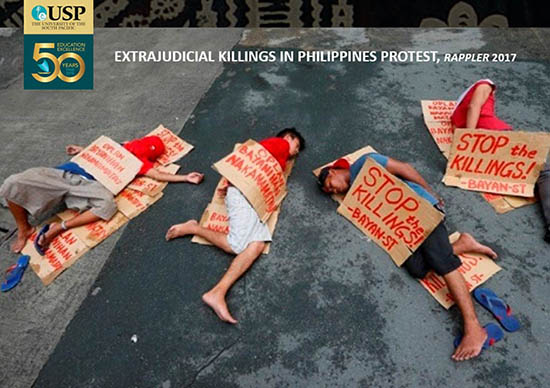
He was pictured in the media cradling a high-powered rifle and he admits that he started carrying a gun recently — not to protect himself because he has plenty of security guards, but to challenge a critical senator to a draw “Wild West” style.
Instead, he simply had the senator arrested on trumped up charges.
Duterte has frequently berated the media and spiced up his attacks with threats such as this chilling message he gave casually at a press conference:
“Just because you’re a journalist, you’re not exempted from assassination, if you are a son of a bitch. Free speech won’t save you.”
High Filipino death rate
The death rate among radio journalists, in particular those investigating corruption and human rights violations, has traditionally been high in the Philippines.
In the Czech Republic late last year, President Miloš Zeman staged a macabre media conference stunt. He angered the press when he brandished a dummy Kalashnikov AK47 with the words “for journalists” carved into the woodstock at the October press conference in Prague, and with a bottle of alcohol attached instead of an ammunition clip.
In Slovakia, then Prime Minister Robert Fico called journalists “filthy anti-Slovak prostitutes” and “idiotic hyenas”.
A Slovak reporter, Ján Kuciak, was shot dead in his home in February, just four months after another European journalist, Daphne Caruana Galizia of Malta who was investigating corruption, was killed by a targeted car-bombing.
Last week, a 30-year-old Bulgarian investigative journalist, Viktoria Marinova, was murdered. Police said the television current affairs host investigating corruption had been raped, beaten and then strangled.
Most of the media killings are done with impunity.
Outrage over Jamal Khashoggi
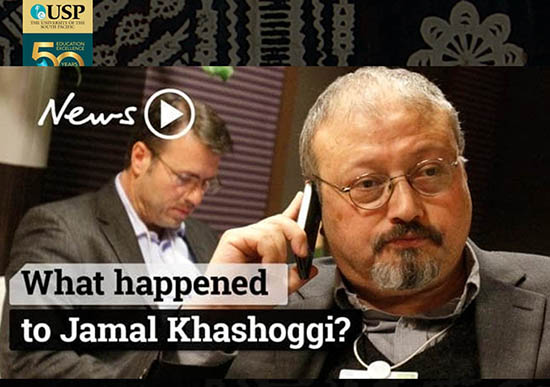
And then the world has been outraged by the disappearance and shocking murder of respected Saudi Arabian journalist and editor Jamal Khashoggi by a state “hit squad” of 15 men inside his own country’s consulate in Istanbul. He went into the consulate on October 2 and never came out.
The exact circumstances of what happened are still unravelling daily, but a Turkish newspaper reports that the journalist’s smartwatch captured audio of his gruesome killing.
Covering the disappearance of Jamal Khashoggi. Video: Al Jazeera’s Listening Post
Condemning the brutal act, United Nations Secretary-General, António Guterres, expressed fears that enforced media disappearances are set to become the “new normal”.
While such ghastly fates for journalists may seem remote here in the Pacific, we have plenty of attacks on media freedom to contend with in our own backyard. And trolls in the Pacific and state threats to internet freedom are rife.
The detention of Television New Zealand’s Pacific correspondent Barbara Dreaver for four hours by police in Nauru at last month’s Pacific Islands Forum Leaders Summit while attempting to interview refugees is just one example of such attempts to shut down truth-seeking.
Among the many protests, Amnesty International said:
“Whether it happens in Myanmar, Iran or right here in the Pacific, detaining journalists for doing their jobs is wrong. Freedom of the press is fundamental to a just society. Barbara Dreaver is a respected journalist with a long history of covering important stories across the Pacific.
“Amnesty International’s research on Nauru showed that the conditions for people who have been banished there by Australia amount to torture under international law. Children are self-harming and Googling how to kill themselves. That cannot be swept under the carpet and it won’t go away by enforcing draconian limits to media freedom.”
Pacific journalists persecuted
Journalists in the Pacific have frequently been persecuted by smallminded politicians with scant regard for the role of the media, such as led to the failed sedition case against The Fiji Times.
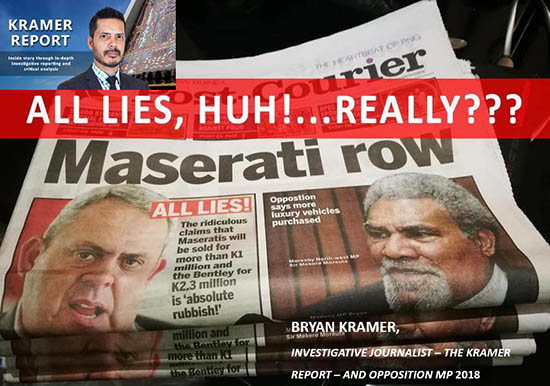
The media play a critical role in exposing abuses of power, such as Bryan Kramer’s The Kramer Report in exposing the 40 Maserati luxury car APEC scandal in Papua New Guinea last week.
In this year’s World Media Freedom Day speech warning about the “creeping criminalisation” of journalism, the new UNESCO chair of journalism Professor Peter Greste at the University of Queensland, asked:
“If we appear to be heading into journalism’s long, dark night, when did the sun start to disappear? Although the statistics jump around a little, there appears to be a clear turning point: in 2003, when the numbers of journalists killed and imprisoned started to climb from the historic lows of the late ’90s, to the record levels of the present.
“Although coincidence is not the same as causation, it seems hard to escape the notion that the War on Terror that President George W. Bush launched after 9/11 had something to do with it.”
‘Journalism is not a crime’
Peter Greste himself, and his two colleagues paid a heavy price for their truth-seeking during the post Arab Spring upheaval in Egypt — being jailed for 400 days on trumped up terrorism charges for doing their job. His media organisation, Al Jazeera, and rival media groups teamed up to wage their global “Journalism is not a crime” campaign.
Now that I have done my best to talk you out of journalism by stressing the growing global dangers, I want to draw attention to some of the many reasons why journalism is critically important and why you should be congratulated for taking up this career.
Next month, Fiji is facing a critically important general election, the second since the return of democracy in your country in 2014. And many of you graduating journalists will be involved.
Governments in Fiji and the Pacific should remember journalists are guardians of democracy and they have an important role to play in ensuring the legitimacy of both the vote and the result, especially in a country such as this which has been emerging from many years of political crisis.
But it is important that journalists play their part too with responsibilities as well as rights. Along with the right to provide information without fear or favour, and free from pressure or threats, you have a duty to provide voters with accurate, objective and constructive information.
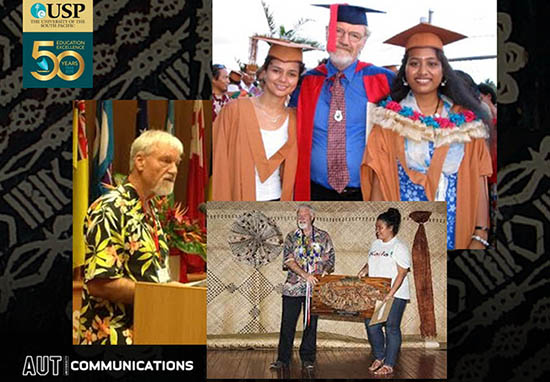
The University of the South Pacific has a proud record of journalism education in the region stretching back ironically to the year of the inaugural coups, in 1987. First there was a Certificate programme, founded by Dr Murray Masterton (who has sadly passed away) and later Diploma and Degree qualifications followed with a programme founded by François Turmel and Dr Philip Cass with French Embassy aid.
Looking back with pride
It is with pride that I can look back at my five years with USP bridging the start of the Millennium. Among high points were gaining my doctorate in history/politics at USP — the first journalism educator to do so in the Pacific — and launching these very Annual Journalism Awards, initially with the Storyboard and Tanoa awards and a host of sponsors.
When I look at the outstanding achievements in the years since then with current Journalism Coordinator Dr Shailendra Singh and his colleagues Eliki Drugunalevu and Geraldine Panapasa, it is with some pleasure.
And USP should be rightly delighted with one of the major success journalism programmes of the Asia-Pacific region.
Wansolwara newspaper, which celebrated two decades of publishing in 2016, has been a tremendous success. Not many journalism school publications have such sustained longevity and have won so many international awards.
Innovation has been the name of the game, such as this climate change joint digital storytelling project with E-Pop and France 24 media. At AUT we have been proud to be partners with USP with our own Bearing Witness and other projects stretching back for two decades.
Pacific whistleblowers
Finally, I would like pay tribute to two of the whistleblowers and journalists in the Pacific and who should inspire you in your journalism career.
Firstly, Iranian-born Behrouz Boochani, the refugee journalist, documentary maker and poet who pricked the Australian conscience about the terrible human rights violations against asylum seekers on Manus Island and Nauru.
He has reminded Canberra that Australia needs to regain a moral compass.
And activist lawyer communicator Joe Moses, who campaigned tirelessly for the rights of the villagers of Paga Hill in Port Moresby. These people were forced out of their homes in defiance of a Supreme Court order to make way for the luxury development for next month’s APEC summit.
Be inspired by them and the foundations of human rights journalism and contribute to your communities and countries. Don’t be seduced by a fast foods diet of distortion and propaganda.
Be courageous and committed, be true to your quest for the truth.
Keynote address by Pacific Media Centre director Professor David Robie at The University of the South Pacific Journalism Awards,19 October 2018, celebrating 50 years of the university’s existence. First published by the PMC here.
References
Cooke, H. (2018, September 4). TVNZ reporter Barbara Dreaver released after being detained in Nauru. Stuff. Retrieved from https://www.stuff.co.nz/national/politics/106822330/tvnz-reporter-barbara-dreaver-reportedly-detained-in-nauru
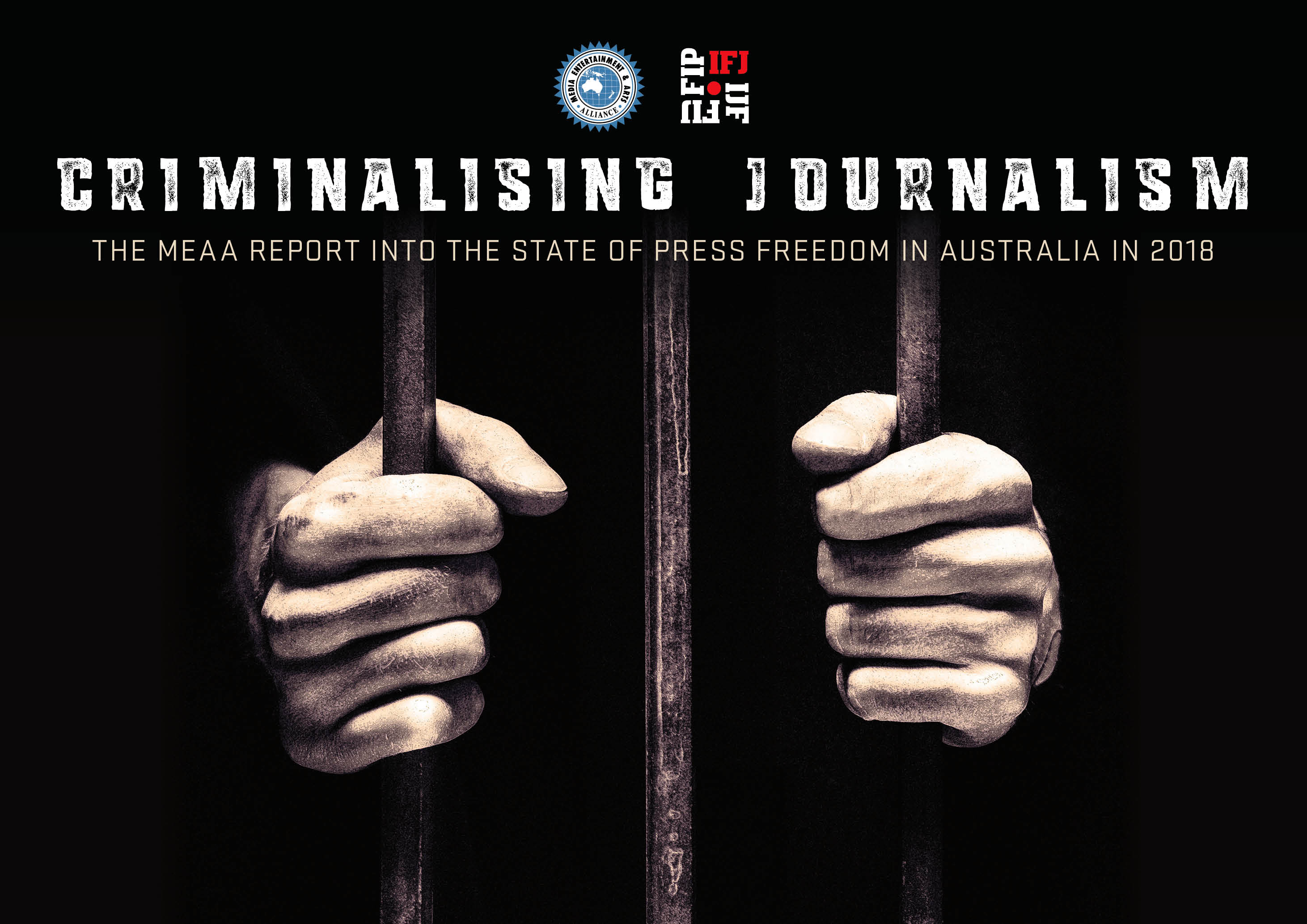
Greste, P. (2018). The creeping criminalization of journalism. MEAA World Press Freedom Day address. Retrieved from https://pressfreedom.org.au/the-creeping-criminalisation-of-journalism-53d1639c3ecb
International Federation of Journalists (2018, May). Criminalising journalism: The MEAA report into the state of press freedom in Australia. Retrieved from https://www.meaa.org/wp-content/uploads/2018/05/PF_report_2018_cover_FINAL2.jpg
Inquirer Mindanao (2017, September 8). Why Duterte carries a gun these days. Philippine Daily Inquirer. Retrieved from https://newsinfo.inquirer.net/929029/philippine-news-updates-president-duterte-antonio-trillanes-iv-angelo-reyes
Peacock, C. (2018, May 6). Peter Greste: Solidarity and standards. Retrieved from https://www.radionz.co.nz/national/programmes/mediawatch/audio/2018643318/peter-greste-solidarity-and-standards
Reporters Without Borders (2017, October 26). Czech President threatens journalists with mock Kalashnikov. Retrieved from https://rsf.org/en/news/czech-republic-czech-president-threatens-journalists-mock-kalashnikov
Reporters Without Borders (2018, May 1). RSF Index 2018: Hatred of journalism threatens democracies. Retrieved from https://rsf.org/en/rsf-index-2018-hatred-journalism-threatens-democracies
Revill, L., & Roderick, C. (Eds.) (1965). The journalist’s craft. The Australian Journalists’ Association. Sydney, NSW: Angus & Robertson.
Robie, D. (2018, July 10). ‘Sick joke’, threats cited in Asia-Pacific declining media freedom summit. Asia Pacific Report. Retrieved from https://asiapacificreport.nz/2018/07/10/sick-joke-threats-cited-in-asia-pacific-declining-media-freedom-summit/
Robie, D. (2004). Mekim Nius: South Pacific media, politics and education. Suva, Fiji: University of the South Pacific Book Centre.
Toboni, G. (2017, June 6). It’s super dangerous to be a journalist in the Philippines. Vice Magazine. Retrieved from https://www.vice.com/en_nz/article/mbqkmb/its-super-dangerous-to-be-a-journalist-in-the-philippines-v24n5