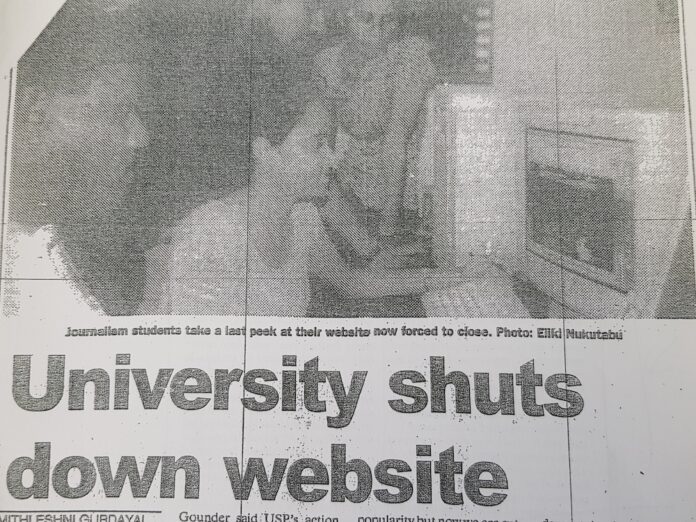
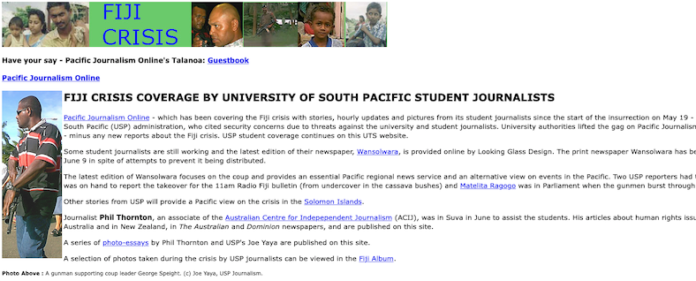
USP shuts down student journalism website, Fiji Daily Post, 21 June 2000. Image: Screenshot Daily Post
By Mithleshni Gurdayal
Journalism students at the University of the South Pacific have expressed dismay over the forced shutdown of their website, Pacific Journalism Online (PJO), by the university vice-chancellor Esekia Solofa.
Vice-chancellor Solofa instructed the website to be shut following the attack on Fiji Television by a mob on May 22.
The website is used by second year students for practical assignments and internet classes. The website also hosted Wansolwara, the newspaper put together by journalism students.
Online editor Christine Gounder said: “USP’s action was unacceptable and poses a serious threat to media and academic freedom.
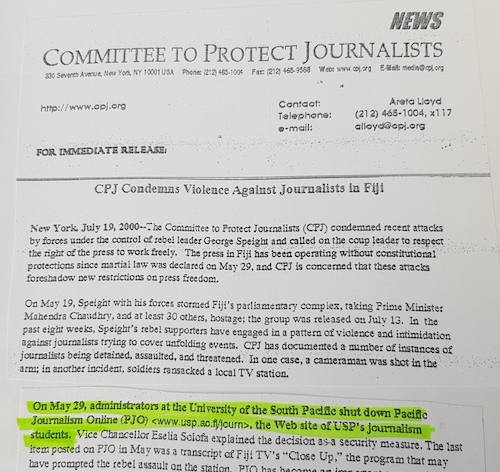
The New York-based Committee to Protect Journalists media watchdog’s protest over the violations of media freedom in Fiji during George Speight’s attempted coup in 2000. Image: CPJ/19 July 2000.
“It is disappointing and disturbing. It was a sudden decision made by the university and we, the journalism students, were not consulted on the matter,” she said.
Wansolwara editor Reggie Dutt also slammed the university’s decision, saying that the vice-chancellor had acted in haste.
“USP’s action is in violation of media freedom and portrays hypocrisy. It would have been better if the students and the lecturer were consulted before shutting us off.
“We were just gaining popularity but now we are cut off,” he said.
“The sad thing is that we are not even being given a formal explanation on the matter.”
International press agencies and journalism schools have also criticised the university’s decision to shut the website and most have described this action as “gagging media”.
Professor John Henningham, head of the University of Queensland journalism department, said such an act was a strike at the heart of press and media freedom.
“Suspension of a news and information-based website is equivalent to closing down a newspaper or TV station and clearly breaks the most fundamental principles of press freedom to which all journalists are pledged.”
David Venables, president of the Journalism Education Association of New Zealand, said it was important that media organisations and universities everywhere did not compromise freedom of speech or press freedom and cave into threats of violence.
Meanwhile, a spokesperson for the university administration that the vice-chancellor was “only taking precautions” [in view of the attempted coup situation in Fiji].
She said the VC was mindful not to be caught up in the crossfire during the political crisis.
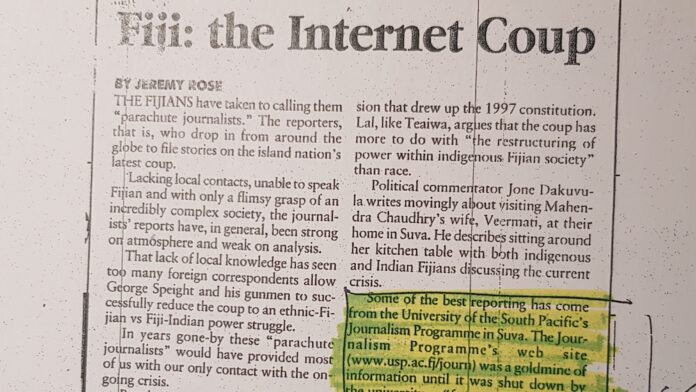
USP journalism coordinator David Robie’s account of the website shutdown on 29 May 2000 and later reopening during the crisis as published in Pacific Journalism Review.
In years gone by these "parachute journalists" would have provided most of us with our only contact with the ongoing crisis. But the internet has changed all that.
By Jeremy Rose
The Fijians have taken to calling them “parachute journalists”. The reporters, that is, who drop in from around the globe to file stories on the island nation’s latest coup.
Lacking local contacts, unable to speak Fijian and with only a flimsy grasp of an incredibly complex society, the journalists’ reports have, in general, been strong on atmosphere and weak on analysis.
That lack of local knowledge has seen too many foreign correspondents allow George Speight and his gunmen to successfully reduce the coup to an ethnic-Fijian vs Fiji-Indian power struggle.
In years gone by these “parachute journalists” would have provided most of us with our only contact with the ongoing crisis.
But the internet has changed all that. Sites such as FijiLive.com not only provide up-to-the-minute news items on the crisis, they carry in-depth pieces of analysis by people who know what they’re talking about.
People such as Victoria University’s Pacific studies lecturer Dr Teresia Teaiwa who wrote a penetrating piece towards the beginning of the crisis whuch convincingly argued that the “race card was misleading and mischievous”.
Dr Teaiwa, a former history and politics lecturer at the University of the South Pacific in Suva, also signalled the possible secession of Fiji’s western provinces as a result of the coup — something not picked up by the mainstream media for another 10 days.
Then there are pieces by people such as Professor Brij V Lal, a member of the commission that drew up the 1997 constitution. Professor Lal, Like Dr Teaiwa, argues that the coup has more to do with “the restructuring of power within indigenous Fijian society” than race.
Political commentator Jone Dakuvula writes movingly about visiting Mahendra Chaudhry’s wife, Virmati, at their home in Suva. He describes sitting around the kitchen table with both indigenous and Indian Fijians discussing the current crisis.
USP student journalism best
Some of the best reporting has come from the University of the South Pacific’s Journalism Programme in Suva. The Journalism Programme’s website (www.usp.ac.fj/journ/) was a goldmine of information until it was shut down by the university . . . “for security reasons”.
The shutting down of the website followed its publication of a transcript of a television interview which was said to have led to the ransacking of Fiji Television by Speight supporters. The transcript would have been lost to cyberspace were it not for the quick work of Wellington’s Scoop (www.scoop.co.nz) which picked it up and republished it. It’s well worth a read.
Despite protests by the journalism programme coordinator David Robie that the closure of the site amounts to censorship, the university is sticking to its decision to close it down. It’s to be hoped that the work of the students finds its way into some of the other internet sites.
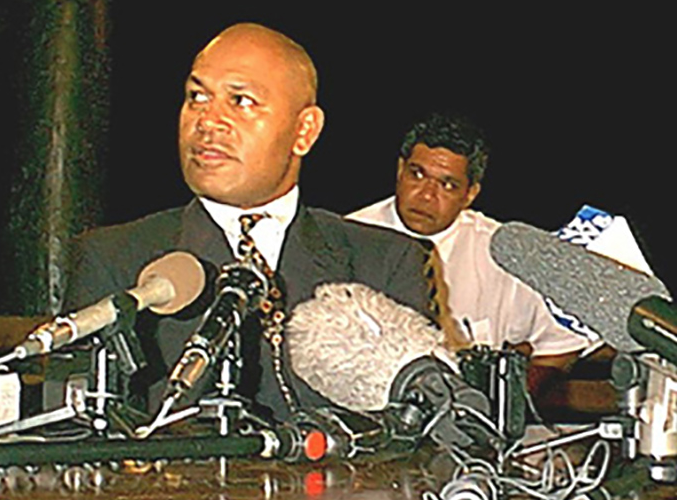
Fiji's 2000 coup frontman George Speight . . . . Image: Joe Yaya/USP Journalism
By David Robie in Suva
Fiji’s Great Council of Chiefs is meeting at a military camp near Suva to decide how to respond to the attempted coup and hostage taking at Parliament.
The Council’s deliberations will determine the fate of three men: President Ratu Sir Kamisese Mara, Prime Minister Mahendra Chaudhry who is being held captive with several of his MPs, and rebel leader George Speight.
The first two are well-known public figures and leaders. The third is a man who burst into the spotlight from out of nowhere last Friday morning.
He has been branded as a terrorist by both the country’s president and the leading daily newspaper, The Fiji Times.
But just five days ago he was a local timber industry businessman with a modest profile and reputedly an undischarged bankrupt.
Although rumours of an impending coup attempt had been rife in Fiji for weeks, few people took them seriously. And self-proclaimed rebel prime minister Speight, with shaved-head and measured voice, was not on the list of aspiring coup-makers.
Even though he regularly played golf with Sitiveni Rabuka, the man who staged Fiji’s first two coups in 1987 which ended with the country becoming a republic and ostracised by the Commonwealth, Speight’s armed takeover of Parliament was a surprise to the former military commander.
Cult figure
At first, Rabuka seemed an ideal mediator. He had been something of a cult figure among young indigenous Fijians after his early exploits and his first biography Rabuka: No Other Way. He was again a celebrity earlier this year with the publication of his life story in the book Rabuka of Fiji.
He had been the dominant political figure in Fiji for more than a decade. Ironically, he was also a key architect of the 1997 multiracial constitution, which led to his crushing defeat by Chaudhry’s Fiji Labour Party-led coalition a year ago this month.
However, after early “shuttle diplomacy” between President Ratu Mara, and Speight in several attempts to resolve the hostage crisis, Rabuka finally ran foul of the kidnappers.
Speight said he no longer trusted Rabuka.
The former coup leader was scathing about Speight and his fellow kidnappers in an exclusive interview with Fiji Television.
Rabuka scoffed at Speight’s claims to have seized Parliament on behalf of indigenous Fijians.
“I don’t know why he is claiming to be acting on behalf of indigenous rights like I did in 1987. I’m still waiting for him to say this in Fijian,” Rabuka said.
White settler descendant
Speight, a mixed-race fourth-generation descendant of a white settler in Fiji, is the son of Opposition parliamentarian Savenaca Tokainavo, who is among the hostages.
Tokainavo, a dairy farm farmer also known as Sam Speight, is reportedly depressed about his son’s actions in seizing Parliament.
George Speight’s paternal grandmother is from Naivicula village in Wainibuka, about 10km from Korovou in Tailevu, near Suva. His mother is from Ra in the western sugar cane belt of the main island of Viti Levu.
The family is popular over its local community development activities.
During last year’s election, Speight stood as a proxy candidate for his father on a ticket for Rabuka’s SVT party. Savenaca Tokainavo defeated nationalist Iliesa Duvuloco — now the “lands minister” in Speight’s rebel government — at the polls.
“Nobody thought Speight had this sort of fanatical streak,” said a colleague who declined to be named.
Last Monday, he pleaded not guilty on exchange rate and extortion charges in the High Court in Suva.
Surprised over brush with law
Rabuka said he was surprised by Speight’s earlier brush with the law.
According to The Fiji Times, Speight is also an undischarged bankrupt.
“He was director George Speight of the Wattle Group, an Australian investment company which siphoned millions of dollars from the Australian police, Fiji citizens and life savings,” alleged the newspaper.
Speight is seen by some associates as bearing a grudge against the Labour Party-led coalition and Prime Minister Chaudhry because he was dumped as chief executive from the Fiji Hardwood Corporation and also from the board of Fiji Pine Ltd.
The coalition’s Forests Minister, Poseci Bune, an indigenous Fijian, sacked him when the cabinet moved to halt privatisation policies of the Rabuka government.
Speight is understood to have earlier basked in the patronage of former Finance Minister Jim Ah Koy in Rabuka’s government.
He has no apologies for what is seen as an unashamedly racist and pro-Fijian stance.
‘Not apologising’
“We are not going to apologise to anybody and we are not going to step back, and we are not going to be daunted by accusations of racism, or one-sidedness,” Speight said early in the crisis.
“At the end of the day, it is [about] the supreme rights of our indigenous people in Fiji, the desire is that it be returned — wholesome and preserved for the future.”
Speight says people don’t need to have the “mind of an Albert Einstein” to understand the plight of indigenous Fijians. He believes expressed grievances had fallen on deaf ears.
The irony is that while many indigenous Fijians distrust the Labour-led government’s policies on land tenure for landless Indo-Fijian cane farmers, Chaudhry has initiated many far-reaching reforms for the benefit of all rural and urban poor Fiji Islanders and boosted education, health and welfare.
Asked whose coup was better planned and executed, Rabuka would not be drawn into comparisons with Speight, saying such judgements were best left to observers.
But he adds: “We went down a similar road in 1987. It led us nowhere. Speight should pull out of this treasonable act while there is still time.”
David Robie is senior lecturer and coordinator of the journalism programme at the University of the South Pacific in Suva, Fiji. This article was published in The New Zealand Herald.
Fiji's 2000 coup frontman George Speight . . . . Image: Joe Yaya/USP Journalism
By David Robie in Suva
Civilian gunmen leader George Speight today defied mounting international condemnation of the kidnapping of Fiji’s elected cabinet, claiming that his regime was now the legal government of the Pacific nation.
His self-styled interim government named a list of “advisers” last night but at least three of them denied any involvement and condemned the attempted coup.
Prime Minister Mahendra Chaudhry, the country’s first Indo-Fijian prime minister, whose Fiji Labour Party was swept to a landslide victory in last year’s general election, his cabinet, and MPs have been detained under armed guard in Parliament since yesterday morning.
While the police and military forces appeared loyal to constitutional authority, Speight, a shaved-head timber industry businessman and undischarged bankrupt, claimed that indigenous Fijians supported the illegal regime.
He said that only the President, Ratu Sir Kamisese Mara, and negotiator Sitiveni Rabuka, who led the two 1987 military coups and was ousted as prime minister by the Chaudhry coalition government, were not in support.
President Mara declared a state of emergency last night and the armed forces called up all reservists in the greater Suva area.
Speight claimed at a press conference that the 1997 constitution had been revoked: “There is now no longer the office of the president.”
Commonwealth Secretary-General Don McKinnon joined the Australian, New Zealand and United States governments in condemning the attempted coup and calling on the kidnappers to abandon their action.
McKinnon warned on BBC Television that Fiji could face the fate of Pakistan in being excluded from the Commonwealth if the coup succeeded.
He said there was total Commonwealth support for constitutional rule, adding: “The police and army must stay on side with the elected government.”
On Radio Fiji this morning, McKinnon added that he was “sad and angry” over the attempt to overthrow the elected government.
“I am very concerned and and very saddened by this,” he said. “But I am also very angry because this was not necessary and it will set Fiji back a long way. This will not help Fiji’s international reputation at all.”
McKinnon said that he had been in touch with Mara and said the Commonwealth supported the president’s attempts to reassert constitutional government.
The Fiji Citizens’ Constitutional Forum (CCF), a community-based group which played a key role in the establishment of the multiracial 1997 constitution, strongly condemned the kidnapping of the government and the looting and violence.
“We call especially on our international partners who have contributed to the long process of democratisation in Fiji which culminated in our 1997 Constitution – governments, churches, NGOs and committed individuals – to join us in this chorus of condemnation against this ‘civil coup’,” said executive director Rev Akuila Yabaki.
“The group of seven armed men who have carried out these acts of violence are made up of unpopular politicians and discredited businessmen. Anyone who thinks that the ethnic Fijian community can benefit from this coup is living in a fool’s paradise.
“The majority of Fiji’s citizens voted overwhelming in support for constitutional democracy in the last election in May 1997 – including a majority of ethnic Fijians. This violence is not about protecting Fijian rights. It is about the interests of a few at all of our expense.
“The leaders of this so-called coup have no legitimacy and do not represent the breadth of Fijian support for constitutional democracy.”
About 48 per cent of the country’s 800,000 population are indigenous Fijians; 46 per cent are Indo-Fijians, and the rest are mixed-race or ethnic minorities.
The Fiji Times, the only one of the country’s three daily newspapers to publish today, declared in an editorial that “the madness must end.”
“It is wrong and dishonourable to back protests with guns and violence. Threatening people’s lives and putting their safety at risk is inexcusable,” the paper said.
“We have again witnessed how one moment of madness will set this country back by decades. Everything we have worked hard to put right and goals we have set for the nation have been ruined.”
Police declared the central city zone of the capital Suva a “no go” zone and said they were treating the entire central business district as a crime scene after scores of looters smashed their way into stores and set one shopping block, adjoining a newspaper office, ablaze yesterday afternoon.
An unnamed police office told Radio Fiji that 167 shops had been looted and 5 shops burned.
Police barricades were thrown up on the main roads into the city.
The attempted coup leader, George Speight, is son of the Opposition MP Savenaca Tokainavo. Last Monday, he pleaded not guilty to exchange rate charges and extortion in the High Court in Suva.
He is a descendant of a fourth generation white colonist and is reputed not to be a fluent Fijian speaker.
Speight was installed by former Finance Minister Jim Ah Koy (in the Rabuka government) as head of the Fiji Hardwood Corporation, a multimillion dollar company which was been at the centre of controversy in recent months.
He said he had no apologies for what seizing control of the country.
“We are not going to apologise to anybody and we are not going to step back, and we are not going to be daunted by accusations of racism, or one-sidedness,” Speight said.
“At the end of the day, it is [about] the supreme rights of our indigenous people in Fiji, the desire is that it be returned — wholesome and preserved for the future.”
David Robie, a New Zealander, is senior lecturer and coordinator of the journalism programme at the University of the South Pacific in Suva, Fiji. This article was published by The New Zealand Herald.
The Fiji 2000 coup archive of the University of the South Pacific journalism students at the University of Technology Sydney.
Crisis coverage by University of the South Pacific journalism students
An archive of the exclusive University of the South Pacific journalism programme coverage of the Fiji coup by George Speight in May-August 2000. This was published by the Australian Centre for Independent Journalism (ACIJ) after the students’ own website was closed by the USP administration.
David Robie and journalism students at the University of the South Pacific reported the George Speight coup in Fiji on their website Pacific Journalism Online [now Wansolwara Online].
The original site was closed down by the University of the South Pacific (USP) administration on 29 May 2000 in response to threats, and new stories about the Fiji crisis were not permitted to be published on the Fiji site.
For three months, University of Technology, Sydney, journalists Fran Molloy and Kate MacDonald published stories and photographs from Fiji journalism students and USP staff on the Australian Centre for Independent Journalism (ACIJ) website — now zip file archived in the UTS Library.
Frontline Reporters: USP student reportage of the 2000 Fiji coup Video: USP Journalism 2000
The site was designed and set up within hours by Fran Molloy, and with the support of ACIJ director Chris Nash and head of the journalism department Wendy Bacon, the USP journalism students were able to have their stories published shortly after they were filed.
The USP students subsequently won several awards for their online (and print) coverage of the coup in the annual Journalism Education Association (JEA) Ossie Awards 2000, including best regular publication in the Australia/NZ and Pacific region.
Awards went to Pacific Journalism Online and the students working on Wansolwara.
David Robie is an award-winning New Zealand investigative journalist who has reported on the 1987 coups and many other issues and events in the Pacific. He was then running the USP journalism programme.
He is founding editor of Pacific Journalism Review and a graduate of the UTS Master of Arts (Journalism) programme.
Broadcaster Pat Craddock, then with the USP Media Centre, was also a key leader of efforts by the journalism team to communicate the coup to the outside world.
The Pacific Journalism Online site was restored, and remained a successful South Pacific news site until March 2007. It later became Wansolwara Online. A mirror of the Wansolwara special coup online edition of the newspaper established by former USP design lecturer Mara Fulmer in the US.
Judging by how the number of “hits” at my Café Pacific blog tripled after news emerged late in August [1998] about condemnation by some quarters in Fiji officialdom and a handful of anonymous and self-interested media people, online readers were quick to check us out for Pacific “hidden agendas”, as John Pilger would say.
This mild website barely caused a ripple with officialdom for the two years it was hosted at the University of Papua New Guinea. But a mere six weeks in Fiji has led to some local media personalities — some would describe them as hacks — and two misled ministers ducking for cover.
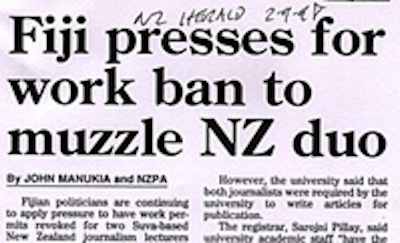
New Zealand Herald report 2 September 1998 . . . mounting international support for the lecturers. Image: NZH headline screenshot CP
Firstly, I need to clear up any misconceptions lingering after the smear campaign of the past week, which had a Kafkaesque quality — the accusations from faceless accusers kept changing ground.
Neither I nor my colleague, Ingrid Leary, a qualified lawyer and journalism academic, have been in breach of our Fiji work permits. These are trumped up claims to divert people away from the substance of my websites or her Media Watch column in Fiji’s Daily Post. Nor do I make any money from websites.
Nor do I have any business interests in Fiji. My commitment is to rebuilding the University of the South Pacific journalism programme which has awaited a much needed professional boost.
Café Pacific began life as an educational project in 1996 at the University of Technology Sydney and promptly won an award. It is now continuing as an independent cyberspace netzine, but it also has a role, along with other media websites, as a teaching tool with my senior journalism students at USP.
Actually, the website is not physically in Fiji at all. Although it has a Fiji “domain”, Café Pacific is actually set up on web servers in three other countries. Impossible to gag.
Why try to gag us?
So what is at the bottom of all this? Why should a group of journalists in Fiji want to try to gag Ingrid and me, or try to have our work permits revoked? Is it the continuation of the campaign at the start of this year against our appointments? Or is it the vendetta waged against me by some journalists at Islands Business since the military coups more than a decade ago?
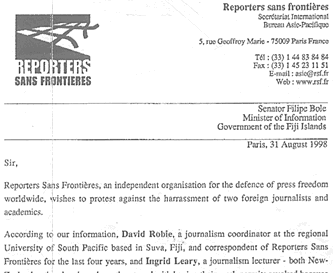
Reporters Without Borders protests against “harassment” of David Robie and Ingrid Leary on 31 August 1998. Image: RSF letter screenshot CP
Why the hypocrisy of Pacific Islands News Association president William Parkinson in not standing up for academic and media freedom in our case, and trotting out the work permit red herring? And this after an international media freedom organisation, Reporters Sans Frontières, had already protested to the Fiji Government against our harassment. (The national university staff association of New Zealand and others have also followed with protests – see Pacific Media Watch). Is it because of my formal complaint filed with the Fiji Media Council in April against some sections of the local news media and PINA individuals?
Does it have something to do with attempts to corner the lion’s share of journalism education and training funds for the South Pacific? Independent university courses don’t fit comfortably with this grand scheme because they teach critical thinking as well as vocational skills. And the fact is that in the past six months Ingrid and I have turned the USP journalism programme into the best in the region.
Or is it unashamedly resentment at two regional staff being appointed from New Zealand instead of a local candidate from Fiji? This is a regional institution, not a Fiji national university, and its policy is appointing the best people for the job.
You make up your own mind. But here is a rundown on the facts:
We reportedly became under threat of having our work permits being revoked because of sensitivity by the Fiji government over media commentaries in what has been dubbed by Pacific Media Watch as the first “freedom of the internet media” case in the South Pacific. But it quickly became apparent that the real sensitivity was from certain quarters in the media.
On Thursday, 27 August 1998, The Fiji Times carried a story reported by Margaret Wise claiming that the Fiji government was investigating complaints that Leary and I had allegedly “breached” our work permit conditions. The inquiry was said to be directed towards revoking our permits.
Focused on my report
The inquiry apparently focused on my report which criticised Fiji government plans to legislate for a Media Council to replace the independent and self-regulating council already in place.
The newspaper followed with similar claims against Ingrid and me the following day, saying the government “would withdraw [our] work permits if they were found to have breached the terms under which they were given’. After cursory attempts at getting comment on the first day, Wise failed on the second day to make any serious attempt to seek our views or balance the allegations.
Worse, the newspaper failed to report an official statement by the university’s Registrar, Sarojini Pillay, defending us and stating that our activities were within the normal roles of research and publication carried out by academics.
The university statement also quoted Professor Subramani, head of the literature and language department, saying that the pair of us had been doing “outstanding” teaching and publication for the journalism programme.
Other news media in Fiji did carry the university’s statement and cited our rejection of the claims by the Ministry of Home Affairs and Immigration.
None of the complaints were directed to either the university or us. However, The Fiji Times reported that the ministry’s permanent Secretary, Emitai Boladuadua, said some government departments and some “members of the public” — as it turned out, some media people who had been opposed to us taking up our positions earlier this year — had made complaints.
Jone Dakuvula, a former press secretary to Prime Minister Sitiveni Rabuka and a onetime investigator with New Zealand’s Human Rights Commission, was quick to point out in the Sunday Times on August 30 that under the new Fiji Constitution [Section 30 (1)]:
Every person has the right to freedom of expression, including: Freedom to seek, receive and impart information and ideas; andFreedom of the press and other media.
He added: “Reading from your report, it appears to me that some local news media employees or journalists were involved in these complaints, which seem to be based mainly on these persons’ disagreements with either the views of David Robie and Ingrid Leary, or the fact that they have been lawfully employed by USP.
“Our new Constitution has been in force for barely one month and here we have some news media people attempting to suppress two well-qualified journalists’ freedom of expression, perhaps in the hope that they could be expelled from this country for the ‘crime’ of writing, publishing and teaching journalism.
“Where is the Fiji journalists’ much vaunted Code of Ethics?”
An international pariah
Next May, Fiji faces its first general election since the new Constitution — its adoption helped regain the country’s place in the Commonwealth after being an international pariah since the 1987 coups. A media freedom issue of this kind testing the Constitution would be an embarrassment.
Fiji Assistant Minister for Information, Ratu Josefa Dimuri. 1998.
The speculation about “news media people” was quickly confirmed by an admission in a letter by the Assistant Information Minister, Ratu Josefa Dimuri, in the Fiji Times on September 1 when he said: “I would be failing my friends and former colleagues in local journalism if I did not ensure their employment opportunities are not trampled on by foreigners.”Dimuri also noted that the ministry had “received complaints from both local journalists and regional media organisations who were of the view that their interests were being jeopardised by the involvement of these two people in other areas of work not stipulated in their work permits”.
It is understood that the ministry’s concerns focused on articles appearing on Asia-Pacific Network/Café Pacific website. I teach internet journalism at USP (including having set up the regional Pacific Journalism Online website [now called Wansolwara]), have maintained the Café Pacific site for two years at universities, and it has only become an issue in Fiji.
In the case of Ingrid, the complaints concern her weekly Media Watch column in the Daily Post and her part-time teaching at the Fiji Journalism Institute – at the request of local journalists.
The president of the USP Staff Association, Dr Ganesh Chand, has defended us, saying we have “perfect freedom” to carry out research and publish in areas of our expertise. The Fiji Council of Trade Unions secretary Pratap Chand has also called on the government to “stop victimising and harassing” us.
Many organisations and individuals have strongly supported us, but few of their letters have been reported in the local press which raises serious questions about the impartiality of the Fiji news media.
However, both newspapers did support us in the editorial columns, TheFiji Times describing the response to us as “draconian”. Labelling Senator Bole’s attack as “vicious”, Fiji’s Daily Post said the government was “not fully and properly informed” on the issue.
The Post added: “The saddest thing is the deafaning silence from the Pacific Islands News Association and the Fiji Media Council. By failing to support the rights of journalists, like Mr Robie and Ms Leary, whether they be teachers, students or whatever, these organisations are helping to destroy the very freedom of expression they have so often said they protect.”
Media freedom attacks criticised
New Zealand’s national staff association representing academics at all of the nation’s universities made a strong protest to both Prime Minister Sitiveni Rabuka and Information Minister Filipe Bole in support of us. Executive director Rob Crozier, of the Association of the University Staff, said: “We view very seriously attacks on academic freedom.”
“As a member of UNESCO, Fiji will be a signatory to the Recommendation on the Status of Higher Education teaching personnel, which was adopted by UNESCO in November 1987,” he said.
“All higher-education teaching personnel should enjoy freedom of thought, conscience, religion, expression, assembly and association as well as the right to liberty and security of the person and liberty of movement.
“They should not be hindered or impeded in exercising their civil rights as citizens, including the right to contribute to social change through freely expressing their opinion of state policies and of policies affecting higher education. They should not suffer any penalties simply because of the exercise of such rights.”
One of the founders of the journalism programme at USP, Professor Andrew Horn, who is now at Harvard University in the US, also defended us. In a message, he said: “For too long the countries of the Pacific basin have relied excessively on external media sources to provide information and to set the parameters of debate, while local print and broadcast services were content to serve very restricted interest groups.”
It was precisely these sorts of problems, Horn argues, that the USP journalism programme was established to address: “Your work to help in the professionalisation of the region’s media community, to expand its scope and give greater confidence to its practitioners should be applauded by the peoples and the governments of all 12 of the university’s member states.”
Anonymous ‘sneaks’
Bill Southworth, executive director of the NZ Journalists Training Organisation, said the Pacific journalism community was “disappointed” at the continuing harassment of Leary and me: “In the latest incident, anonymous ‘sneaks’ have drawn it to the government’s attention that Robie and Leary have been writing commentaries on journalism and guest lecturing at the Fiji Journalism Institute.”
Added Southworth, a former editor of the Fiji Sun: “Perhaps those who wish to silence Robie and Leary should take time to read Fiji’s new constitution. Section 30 says every person has the right to freedom of expression, including the freedom to receive and impart ideas.
“Even Kiwi journalism lecturers.”
Many journalists have also protested. Vimal Madhavan, chairman of the Fiji Journalists Association and member of the Press Council of Fiji in 1986/87, says: “Threats to journalists, foreign or local, such as questioning their right to work, is as much an assault on our freedoms as sending in armed troops to shut down a newsroom.”
John Manukia, Pacific Affairs reporter with The New Zealand Herald, says: “Nothing less than democracy and freedom of expression is at stake. To suggest that writing columns in local newspapers and on the Internet goes against the description of work permits is ridiculous. You are doing work in your field of expertise. To suggest otherwise is nonsense and I condemn such an act.”
The events of the past two weeks are an indictment of the current standard of Fiji journalism, and the lack of fairness and balance in the media. Sadly, after my five years living in Papua New Guinea, I would have to say that the professionalism of Fiji news media does not compare favourably.
David Robie is publisher of Café Pacific and journalism coordinator at the University of the South Pacific.
Samoa Observer publisher Gatoaitele Savea Sano Malifa . . . vigorously reporting allegations of corruption, nepotism and abuse of public office, the Observer and its staff have frequently faced harassment. Image: Malifa FB
A feisty newspaper publisher’s loss to the Samoan prime minister in a hefty defamation case and manipulation by the Fiji Information Ministry in an attempt to impose legislative curbs have once again put the South Pacific media on the backfoot over freedom of information.
By David Robie in Suva
Press freedom Pacific-style is again on the rocks. A feisty newspaper publisher’s loss to the Samoan prime minister in a hefty defamation case and manipulation by the Fiji Information Ministry in an attempt to impose legislative curbs before next year’s first genuinely democratic election since the military coups have once again put the South Pacific media on the backfoot over freedom of information.
Savea Sano Malifa, editor and publisher of the Samoa Observer, believes he now may be forced to sell the daily newspaper many regard as the scourge of the Samoan chiefly establishment.
After losing in Prime Minister Tofilau Eti Alesana’s civil defamation action which has cost him a US$16,000 judgement in damages in the Supreme Court in Apia in July [1998], he also faces a criminal libel case filed by Tofilau.
He has already had crippling legal fees of US$76,000 to pay off and now the judgment is another serious blow to the viability of the paper.
Vigorously reporting allegations of corruption, nepotism and abuse of public office, the Samoa Observer and its staff have frequently faced harassment — including a suspicious fire which burned down the paper’s printing plant.
Malifa’s recent troubles as the most outspoken editor of Samoa have come amid several recent setbacks for media freedom in the region.
Media freedom developments Among the developments:
Fiji’s Assistant Minister of Information Ratu Josefa Dimuri, ironically a former journalist on the Murdoch-owned Fiji Times, is insisting on dumping the country’s well-respected independent media council and replacing it with a new government-initiated body and laws imposing “codes of conduct”.
A report by an Australian consultant that called for the early retirement of Radio Tonga’s general manager, Tavake Fusimalohi, and the abolition of his son ‘Ahongalu Fusimalohi’s position as deputy in an attempt to restructure the station for a “positive course for the future” was met with bitter attacks. Moves were reportedly made by the station’s senior executives to have the consultant blacklisted around the region. The conservative station was described as being overstaffed and lagging behind many other Pacific Island broadcasters in operational practice and performance.
Polynesian villagers blockaded the French state-run television and radio station RFO in the territory of Wallis and Futuna in May, preventing local broadcasts for a week. They were angry about the “insufficient coverage” given to a traditional dance spectacular. The chief editor, Philippe Voisin, station director Bernard Joyeux and technical director Alain Delabre were held hostage.
The same month, the editor of the Solomon Islands Voice, former Television New Zealand journalist Carole Colville, faced a weekend of harassment after her newspaper exposed allegations of a corrupt land deal. The deal involved prominent Solomon Islands businessman Rex Fera who is an associate of Prime Minister Bartholomew Ulufa’alu. Describing the actions as “persecution”, Colville said men demanding to see the paper’s publisher, John Asipara, had raided her home early on a Sunday morning. Ironically, the intimidation happened on the same weekend as the UNESCO-sponsored World Press Freedom Day was being marked globally.
World Press Freedom Day was also controversial in Vanuatu where Trading Post publisher Marc Neil-Jones reacted angrily over inaugural Media Freedom Awards presented by Vanuatu Broadcasting and Television Corporation chairman Kalvao Moli to three former prime ministers — Father Walter Lini, Maxime Carlot-Korman, and Serge Vohor — and current Prime Minister Donald Kalpokas. Neil-Jones withdrew all support from the Trading Post to the Press Klab and pulled the newspaper out of the organisation. Storming out of the awards ceremony, he said: “I’ve great respect for Father Lini but he deported Christine Coombs over her paper, Voice of Vanuatu, and banned journalists like Jemima Garrett from entering Vanuatu because his government did not like the way they reported the news.”His government rigidly controlled the press and no independent newspapers were allowed. Why on earth is he being given a media freedom award?”
Although press freedom has been supported in Papua New Guinea by Prime Minister Bill Skate after three controversial draft media laws were scrapped last year before the Sandline affair, he has been frequently quick to condemn the international media.At a National Press Club luncheon in Canberra in August, he blamed foreign journalists for a painting a negative view of his country. Papua New Guinea, he said, is the victim of sensational reporting by reporters “who have little understanding” of the country.
Radio New Zealand International was forced to end its afternoon and evening broadcasts to listeners in the Pacific region from early August, following a slashed budget. Funding cuts by New Zealand’s Foreign Ministry were decided on after considering closing the shortwave station altogether. RNZI employs a number of Pacific journalists as stringers and has a independent perspective in the region.
A US State Department report was critical of the Federated States of Micronesia government over last year’s Sherry O’Sullivan affair. It said the government took actions “aimed at stifling investigation and criticism of government activities and figures”.The report, entitled “Micronesia Country Report on Human Rights Practices for 1997,” questioned the FSM government’s support of the press, after O’Sullivan, a Canadian citizen editing the monthly newspaper FSM News, was forced to leave the island. She had been declared an “undesirable alien” because of her newspaper’s vigorous reporting.
Work permits
Assaults on media freedom have by no means been restricted to governments alone. Twice during 1997, New Zealand journalist Michael Field was turned down by the Fiji government over work permits while trying to establish a regional Pacific bureau in Suva for The New Zealand Herald.
But it is believed that the real reason he was blocked was because of intense lobbying by two prominent media personalities. Opposition also came again earlier this year from the Pacific Islands News Association to the appointment of Fiji Television journalist Ingrid Leary and myself as lecturer and journalism programme cooordinator respectively (we are both New Zealanders) at the University of the South Pacific.
Although PINA later publicly denied that it was opposed to our recruitment because we were not Pacific Islanders as had been widely reported, it was well known among Fiji journalists that a PINA official had lobbied and written in an unsuccessful bid to prevent us taking up the position.
I have filed a complaint with the Fiji Media Council over this affair. [Note: On 2 November 1998, Fiji’s Daily Post apologised for the misrepresentations following mediation by the Media Council.]
But the future of the council itself is also uncertain as the Fiji government seeks to find ways to muzzle the news media in spite of the new constitution’s guarantee of freedom of speech and information.
Although the recent Thomson Foundation report to the government strongly recommended self-regulation, Assistant Minister Dimuri seems determined to interpret the report rather differently.
While the Thomson Report generally gives the Fiji news media a supportive nod, it specifically states that the media should not be licensed and that there should be no extension of the law to deal with publication of leaked documents.
In her Media Watch column, Leary asked: “Why is Ratu Dimuri insisting on creating a government-initiated media council?
“With respect to the minister, it is charming to think that creating a new council would be in line with the Thomson Foundation recommendations and, indeed, the new constitution.
“But it is difficult to see how this is anything more than a charming bid to control the media”.
David Robie is journalism coordinator at the University of the South Pacific in Fiji and co-convenor of Pacific Media Watch.
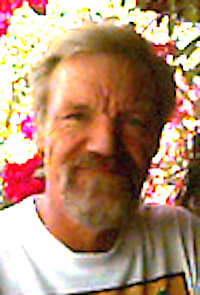
David Robie in his office at the University of the South Pacific's School of Humanities in 1988. Image: USP
Two New Zealand journalism educators are still in suspense over their positions at the University of the South Pacific amid controversy over the “politicising” of the appointments by non-academic bodies.
Two New Zealand journalists recruited to run the University of the South Pacific journalism degree programme have been told they were granted work permits by the Fiji government after weeks of controversy.
But a day later they were told Immigration officials were still considering their case — after one lecturer had turned up for work.
University authorities earlier confirmed that officials had authorised the permits after journalism students had petitioned Prime Minister Sitiveni Rabuka and a series of letters in the daily newspapers had supported the recruited lecturers.
Author and journalism academic David Robie, who currently heads the journalism programme at the University of Papua New Guinea, has been appointed senior lecturer and journalism coordinator at USP.
Ingrid Leary, who has been executive producer at Fiji One television over the past year, has been appointed television lecturer.
The Suva-based Pacific Islands News Association (PINA), comprising news organisations and senior media executives, had been pressing for the appointment of a local candidate who had no academic publishing record or experience of running a journalism programme.
Unsigned stories in the Fiji Daily Post, apparently linked to PINA officials, highlighted Robie’s past articles and books critical of the 1987 military coups.
Recent letters to the two daily newspapers in support of the recruited lecturers have highlighted the issues of academic and press freedom.
“There is the pungent scent of a personal and ideological vendetta against Robie. This is in stark contrast to PINA’s stated objective of ‘fostering professional fellowship and cooperation’,” Pacific Media Watch co-convenor Peter Cronau said in the Daily Post.
In The Fiji Times, a former USP journalism lecturer, Philip Cass, said a “petty-minded campaign” appeared to have delayed the work permits.
“Perhaps that attitude stems from the notion that PINA should be the controlling body for journalism training and education in the Pacific. This idea is, of course, nonsense,” he wrote.
Fiji Media Training Institute director Jo Nata, also writing in the Times, claimed there appeared to be a “concerted and orchestrated effort” to prevent Robie’s appointment.
He added: “I further suspect that the Daily Post and PINA have been used for the personal agenda of people who have had a long standing feud with Robie.”
This is the third incident involving New Zealand journalists and work permits in Fiji in recent months. Auckland-based Agence France-Presse correspondent Michael Field was last year twice denied a work permit application to set up a Suva bureau for a New Zealand newspaper.
Immigration officials considered the cases of Robie and Leary again yesterday after delays of more than two months.
On Monday, a Journalism Students Association deputation delivered a protest letter to Prime Minister Rabuka complaining about the “politicisation” of the work permits by “non-academic” bodies and appealed for the two lecturers to be allowed to start work.
“We feel that it is extremely unfair on us students to have to suffer because some non-academic bodies are not happy with their appointment,” the letter said.
“We understand that David Robie and Ingrid Leary were considered the best qualified and experienced to teach Pacific journalism at the present time by the USP Selection Board.
“Through our own investigations, and having looked into their accomplishments as journalists and/or lecturers, we support their appointments and have been looking forward to learning from and working with them,” the students said.
“As students we are gravely concerned that the university’s academic independence appears to be compromised by outside influences.”
Leary is taking up her position immediately and Robie is expected to arrive at USP from Papua New Guinea in mid-March.
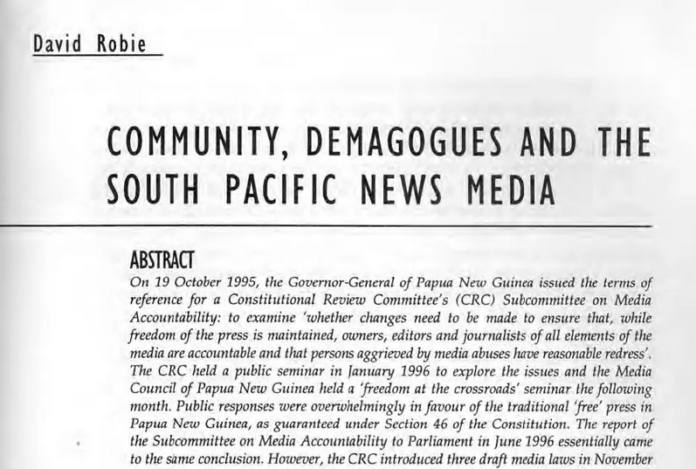
'Community, demagogues and the South Pacific news media' as published in Media International Australia, 1998. Image: MIA
By David Robie
On 19 October 1995, the Governor-General of Papua New Guinea issued the terms of reference for a Constitutional Review Committee’s (CRC) Subcommittee on Media Accountability: to examine ‘whether changes need to be made to ensure that, while freedom of the press is maintained, owners, editors and journalists of all elements of the media are accountable and that persons aggrieved by media abuses have reasonable redress’.
The CRC held a public seminar in January 1996 to explore the issues and the Media Council of Papua New Guinea held a ‘freedom at the crossroads’ seminar the following month.
Public responses were overwhelmingly in favour of the traditional ‘free’ press in Papua New Guinea, as guaranteed under Section 46 of the Constitution.
The report of the Subcommittee on Media Accountability to Parliament in June 1996 essentially came to the same conclusion.
However, the CRC introduced three draft media laws in November which introduced a controversial system involving a Media Commission, registration of journalists, licensing of media organisations and serious penalties for transgressors.
The proposed legislation was widely condemned and was eventually shelved in February 1997, A general view is that the media debate was manipulated by a small group of politicians out of self-interest.
This paper examines the developments in the context of the erosion of the news media and free expression in the South Pacific generally.
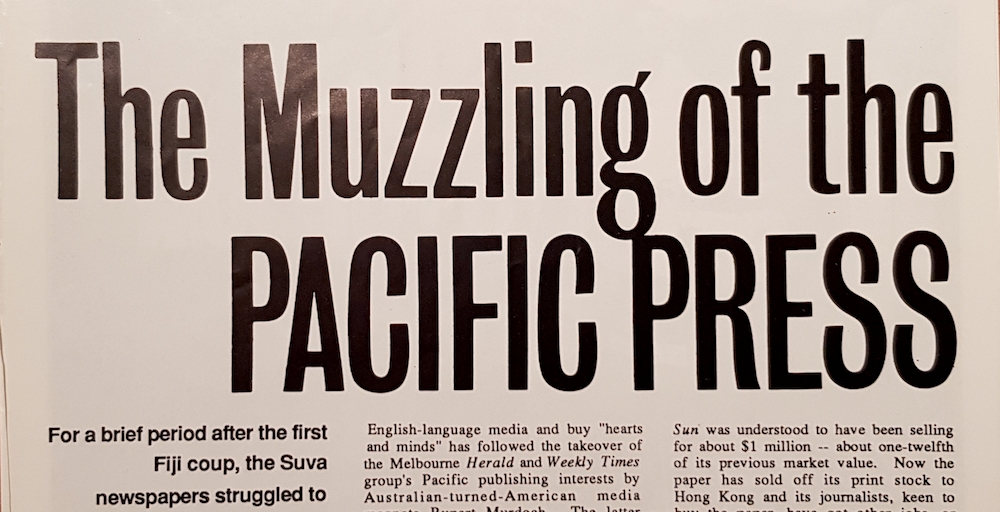
"The muzzling of the Pacific press" . . . the NZ Monthly Review article in December 1988 that sparked the furore. Image: NZMR screenshot CP
A decade-old vendetta against a New Zealand journalist by a Fiji-based media group has again resurfaced.
By Harry Stoner
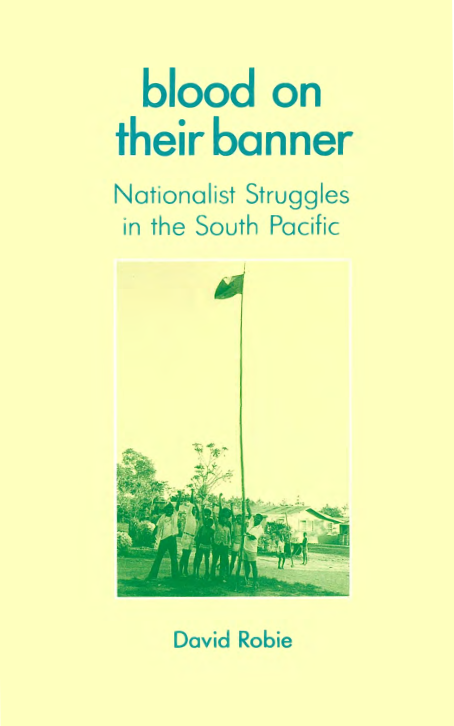
In mid-1989, the New Zealand Journalist branded as a ‘personal vendetta’ a series of attacks by a group of Fiji-based journalists against New Zealand author and journalism educator David Robie. Later that year, an internationally published book by Robie, Blood on their Banner: Nationalist Struggles in the South Pacific, raised questions in a section entitled ‘A compromised media’. Now that Robie has been appointed to head the journalism programme at the University of the South Pacific in Fiji, five unsigned attacks have been published in the Fiji Daily Post and Sunday Post. They were the subject of a formal ethics complaint filed with the Fiji News Council in April 1998. The Daily Post publicly apologised to Robie in November 1998.
ROBIE TARGET OF VENDETTA
Two Suva-based magazines are having an unseemly spat in which an entire edition of one publication, printed and bound, was recalled from the brink of distribution to avoid legal action from a rival.
At the centre of this bitter row is freelance Pacific affairs writer (and New Zealand Journalists’ Union member) David Robie, who dared to criticise a publication he once wrote for and was then the object of a lengthy personal attack in one of its following issues.
It is a story of press freedom, the tensions between journalists and publishers, and the politics of reporting a part of the world that is increasingly divided and volatile.
The March 1989 edition of the magazine Pacific Islands Monthly went to press with an unprecedented editorial directly attacking its rival Islands Business. The leader accused IB of demeaning the standard of journalism in the region and using invective and distortion in a personal vendetta against Robie.
New Zealand journalist David Robie . . . target of a Pacific vendetta. Image: CP
Robie, 43, has edited newspapers in Australia and South Africa, and wrote for Agence France-Presse in Paris. He has covered Pacific affairs for New Zealand, British and Australian publications for the last decade and has written two books on the region.
Another, Blood on their Banner, on nationalist struggles in the Pacific, is due for international publication in August.
Now writing for Pacific Islands Monthly, he was formerly a correspondent with IB for eight years and during that time covered many of the region’s big stories including the 1984 insurrection in New Caledonia and the Rainbow Warrior affair.
Parted company
IB and Robie parted company in early 1988 but relations between them hit an all-time low later in the year after he wrote a feature analysing Pacific media politics (“The muzzling of the Pacific press?” New Zealand Monthly Review, December 1988) in which he described IB as a “mouthpiece” for the Rabuka regime.
The article reported how media corporations owned by Rupert Murdoch and French mogul Robert Hersant came to dominate the Pacific press, and how the Fiji coups had radically curbed press freedom.
Robie said IB eulogised military stongman Sitiveni Rabuka (the magazine made him Pacific Man of the Year, 1987), that publisher Robert Keith-Reid wrote articles many considered pro-coup propaganda and that the magazine hired an extreme right-wing columnist to cover New Caledonian affairs.
It was the hiring of David Los, a non-journalist who runs an English-language school and has since 1984 carried out a poison pen campaign against Pacific journalists he regarded as too sympathetic to Kanak nationalism in Noumea, that precipitated Robie’s split with IB.
In December 1987, IB published a long and vitriolic letter from Los attacking Robie, then one of the magazine’s senior writers, and mysteriously omitted to offer Robie a right of reply.
An apology of sorts was inserted in the next edition at the insistence of Robie’s lawyer but the magazine then engaged Los as a New Caledonian correspondent. Known to have close links with the local anti-independence ultra-right, Los’s contributions are generally sarcastic tirades against the Kanak independence movement which he is fond of describing as “terrorist”.
Robie resigned soon after and began writing for the rival, Murdoch-owned PIM.
He alleges IB has continued to to publish his material and photographs in breach of copyright, that the magazine owes him more than F$3000, and that it has failed to return him more than 70 photographs it holds on file. These allegations were the target of IB’s successful legal threat and were subsequently removed from the PIM editorial.
Filed legal action
On the same day Robie filed legal action seeking payment and return of the photographs.
Blood on their Banner(1989) . . . controversial criticisms of some sections of the Pacific media. Image: Zed Books
But the dispute flared again when Robie’s article on the muzzling of the Pacific press was published. IB reproduced the article in its January 1989 edition, in breach of copyright, and interspersed three opinion pieces devoted to criticising Robie: by IB publisher Robert Keith-Reid, editor Peter Lomas, and columnist David Los. In all, the spread took five pages.
Keith-Reid alleged Robie was anti-American, anti-French, anti-Fiji coup, and had waged a campaign against IB. In reply to Robie’s allegation that the magazine was a mouthpiece for Rabuka, Keith-Reid wrote that “Except for four days’ imprisonment and some subsequent harassment and threats experienced by the publisher, there has been absolutely no attempt by authorities in Fiji to censor or interfere with the publication of this magazine.”
Lomas questioned Robie’s integrity, accused him of being blinkered, and insinuated he could not translate French. Robie lived and worked in France and covered French Pacific affairs for several years.
Los concluded his contribution with this extraordinary threat: “May I suggest that Robie’s little game has gone too far and that a legal process has been set in motion in Noumea that may give him a chance to see the inside of a prison if he cares to set foot in New Caledonia again.”
PIM responded to this attack on one of its writers, protesting in a full-page editorial that “the pages and editorial resources of an established production should be abused in a personal vendetta which, to be frank, fails to address (Robie’s) criticism.”
PIM called IB’s “profile” on Robie a “sad and embarrassing reflection on Pacific journalism” and said that it would continue to publish Robie’s work.
‘Best correspondent’
John Richardson, who was editor of IB from 1983 to 1987, also protested that “attack” on Robie, saying as far as he was concerned Robie was the magazine’s “best correspondent by far and the only one prepared to cover difficult and dangerous stories”.
He disagreed that Robie was a “leftist”, as had been alleged. Robie, he wrote, was in fact “a liberal with no political affiliations whatsoever. What he does possess, however, is a sharp awareness of what is unjust. This is vital to any journalist worth his salt.
Robie himself said it was scandalous that IB could “wage a malicious vendetta like this against a journalist and then gag a rival magazine from trying to expose the truth in an editorial”.
He said it was distasteful when a journalist had to resort to legal remedies but “the degree of malice shown by IB, towards me has left me no choice”. Robie is believed to be filing a defamation action against IB.
“The bizarre events of the last few months just endorse the theme of my article about the threats to press freedom in the Pacific.”
This article was first published in the New Zealand Journalist in April 1989. Harry Stoner was the alter ego of Phil Twyford, then a specialist Pacific Affairs writer for the Auckland Star and president of the Auckland metropolitan branch of the NZ Journalists Union. In May 1989, Robie filed a defamation writ before the Fiji High Court seeking damages against Islands Business, Keith-Reid, Lomas and Los. It eventually lapsed because Robie was living in NZ then Papua New Guinea at the time.