

Home Blog Page 94

2022 wrap: Pacific political upheavals eclipse fierce Tongan volcano

0
Fijians in the capital Suva celebrate the end of 16 years of authoritarian FFP rule
Fijians in the capital Suva celebrate the end of 16 years of authoritarian rule - eight years of military dictatorship followed by a rigid "democracy". Image: AJ Twitter

2022 PACIFIC REVIEW: By David Robie

The Pacific year started with a ferocious eruption and global tsunami in Tonga, but by the year’s end several political upheavals had also shaken the region with a vengeance.

A razor’s edge election in Fiji blew away a long entrenched authoritarian regime with a breath of fresh air for the Pacific, two bitterly fought polls in Papua New Guinea and Vanuatu left their mark, and growing geopolitical rivalry with the US and Australia contesting China’s security encroachment in the Solomon Islands continues to spark convulsions for years to come.

It was ironical that the two major political players in Fiji were both former coup leaders and ex-military chiefs — the 1987 double culprit Sitiveni Rabuka, a retired major-general who is credited with introducing the “coup culture” to Fiji, and Voreqe Bainimarama, a former rear admiral who staged the “coup to end all coups” in 2006.

It had been clear for some time that the 68-year-old Bainimarama’s star was waning in spite of repressive and punitive measures that had been gradually tightened to shore up control since an unconvincing return to democracy in 2014.

And pundits had been predicting that the 74-year-old Rabuka, a former prime minister in the 1990s, and his People’s Alliance-led coalition would win. However, after a week-long stand-off and uncertainty, Rabuka’s three-party coalition emerged victorious and Rabuka was elected PM by a single vote majority.

Fiji Deputy PM Professor Biman Prasad (left) and Prime Minister Sitiveni Rabuka
Fiji’s new guard leadership . . . Professor Biman Prasad (left), one of three deputy Prime Ministers, and Prime Minister Sitiveni Rabuka share a joke before the elections. Image: Jonacani Lalakobau/The Fiji Times

In Samoa the previous year, the change had been possibly even more dramatic when a former deputy prime minister in the ruling Human Rights Protection Party (HRPP), Fiamē Naomi Mata’afa, led her newly formed Fa’atuatua I le Atua Samoa ua Tasi (FAST) party to power to become the country’s first woman prime minister.

Overcoming a hung Parliament, Mata’afa ousted the incumbent Tuila’epa Sa’ilele Malielegaoi, who had been prime minister for 23 years and his party had been in power for four decades. But he refused to leave office, creating a constitutional crisis.

At one stage this desperate and humiliating cling to power by the incumbent looked set to be repeated in Fiji.

Yet this remarkable changing of the guard in Fiji got little press in New Zealand newspapers. The New Zealand Herald, for example, buried what could could have been an ominous news agency report on the military callout in Fiji in the middle-of the-paper world news section.

Buried news
“Buried” news . . . a New Zealand Herald report about a last-ditched effort by the incumbent FijiFirst government to cling to power published on page A13 on 23 December 2022. Image: APR screenshot

Fiji
Although Bainimarama at first refused to concede defeat after being in power for 16 years, half of them as a military dictator, the kingmaker opposition party Sodelpa sided — twice — with the People’s Alliance (21 seats) and National Federation Party (5 seats) coalition.

Sodelpa’s critical three seats gave the 29-seat coalition a slender cushion over the 26 seats of Bainimarama’s FijiFirst party which had failed to win a majority for the first time since 2014 in the expanded 55-seat Parliament.

But in the secret ballot, one reneged giving Rabuka a razor’s edge single vote majority.

The ousted Attorney-General and Justice Minister Aiyaz Sayed-Khaiyum – popularly branded as the “Minister of Everything” with portfolios and extraordinary power in the hands of one man – is arguably the most hated person in Fiji.

Sayed-Khaiyum’s cynical “divisive” misrepresentation of Rabuka and the alliance in his last desperate attempt to cling to power led to a complaint being filed with Fiji police, accusing him of “inciting communal antagonism”.

He reportedly left Fiji for Australia on Boxing Day and the police issued a border alert for him while the Home Affairs Minister, Pio Tikoduadua, asked Police Commissioner Sitiveni Qiliho, a former military brigadier-general to resign over allegations of bias and lack of confidence. He refused so the new government will have to use the formal legal steps to remove him.

Just days earlier, Fiji lawyer Imrana Jalal, a human rights activist and a former Human Rights Commission member, had warned the people of Fiji in a social media post not to be tempted into “victimisation or targeted prosecutions” without genuine evidence as a result of independent investigations.

“If we do otherwise, then we are no better than the corrupt regime [that has been] in power for the last 16 years,” she added.

“We need to start off the right way or we are tainted from the beginning.”

However, the change of government unleashed demonstrations of support for the new leadership and fuelled hope for more people-responsive policies, democracy and transparency.

Writing in The Sydney Morning Herald, academic Dr Sanjay Ramesh commented in an incisive analysis of Fiji politics: “With … Rabuka back at the helm, there is hope that the indigenous iTaukei population’s concerns on land and resources, including rampant poverty and unemployment, in their community will be finally addressed.”

He was also critical of the failure of the Mission Observer Group (MoG) under the co-chair of Australia to “see fundamental problems” with the electoral system and process which came close to derailing the alliance success.

“While the MoG was enjoying Fijian hospitality, opposition candidates were being threatened, intimidated, and harassed by FFP [FijiFirst Party] thugs. The counting of the votes was marred by a ‘glitch’ on 14 December 2022 . . . leaving many opposition parties questioning the integrity of the vote counting process.”

Fiji Prime Minister Sitiveni Rabuka and his wife Sulueti Rabuka with their great grandson Dallas
Fiji Prime Minister Sitiveni Rabuka and his wife Sulueti Rabuka with their great grandson, three-year-old Dallas Ligamamada Ropate Newman Wye, in front of their home at Namadi Heights in Suva. Image: Sophie Ralulu/The Fiji Times

Rabuka promised a “better and united Fiji” in his inaugural address to the nation via government social media platforms.

“Our country is experiencing a great and joyful awakening,” he said. “It gladdens my heart to be a part of it. And I am reminded of the heavy responsibilities I now bear.”

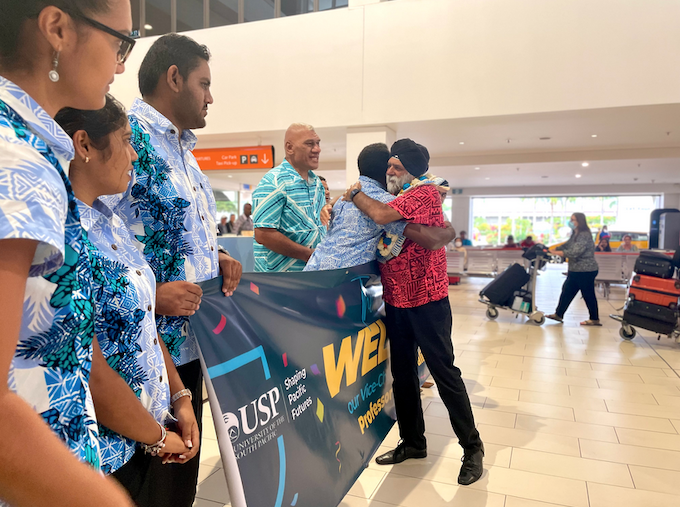
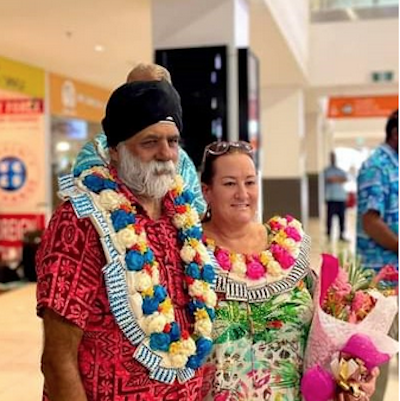
The coalition wasted no time in embarking on its initial 100-day programme and signalled the fresh new ‘open” approach by announcing that Professor Pal Ahluwalia, the Samoa-based vice-chancellor of the regional University of the South Pacific — deported unjustifiably by the Bainimarama government — and the widow of banned late leading Fiji academic Dr Brij Lal were both free to return.


Paul Barker, director of the Institute of National Affairs, discussing why the 2022 PNG elections were so bad. Video: ABC News

Papua New Guinea
Earlier in the year, in August, Prime Minister James Marape was reelected as the country’s leader after what has been branded by many critics as the “worst ever” general election — it was marred by greater than ever violence, corruption and fraud.

As the incumbent, Marape gained the vote of 97 MPs — mostly from his ruling Pangu Pati that achieved the second-best election result ever of a PNG political party — in the expanded 118-seat Parliament. With an emasculated opposition, nobody voted against him and his predecessor, Peter O’Neill, walked out of the assembly in disgust

Papua New Guinea has a remarkable number of parties elected to Parliament — 23, not the most the assembly has had — and 17 of them backed Pangu’s Marape to continue as prime minister. Only two women were elected, including Governor Rufina Peter of Central Province.

In an analysis after the dust had settled from the election, a team of commentators at the Australian National University’s Development Policy Centre concluded that the “electoral role was clearly out of date, there were bouts of violence, ballot boxes were stolen, and more than one key deadline was missed”.

However, while acknowledging the shortcomings, the analysts said that the actual results should not be “neglected”. Stressing how the PNG electoral system favours incumbents — the last four prime ministers have been reelected — they argued for change to the “incumbency bias”.

“If you can’t remove a PM through the electoral system, MPs will try all the harder to do so through a mid-term vote of no confidence,” they wrote.

“How to change this isn’t clear (Marape in his inaugural speech mooted a change to a presidential system), but something needs to be done — as it does about the meagre political representation of women.”

Julie King with Ralph Regenvanu
Gloria Julia King, first woman in the Vanuatu Parliament for a decade, with Ralph Regenvanu returning from a funeral on Ifira island in Port Vila. Image: Ralph Regenvanu/Twitter

Vanuatu
In Vanuatu in November, a surprise snap election ended the Vanua’aku Pati’s Bob Loughman prime ministership. Parliament was dissolved on the eve of a no-confidence vote called by opposition leader Ralph Regenvanu.

With no clear majority from any of the contesting parties, Loughman’s former deputy, lawyer and an ex-Attorney-General, Ishmael Kalsakau, leader of the Union of Moderate Parties, emerged as the compromise leader and was elected unopposed by the 52-seat Parliament.

A feature was the voting for Gloria Julia King, the first woman MP to be elected to Vanuatu’s Parliament in a decade. She received a “rapturous applause” when she stepped up to take the first oath of office.

RNZ Pacific staff journalist Lydia Lewis and Port Vila correspondent Hilaire Bule highlighted the huge challenges faced by polling officials and support staff in remote parts of Vanuatu, including the exploits of soldier Samuel Bani who “risked his life” wading through chest-high water carrying ballot boxes.

Tongan volcano-tsunami disaster
Tonga’s violent Hunga Ha’apai-Hunga Tonga volcano eruption on January 15 was the largest recorded globally since the eruption of Krakatoa in 1883. It triggered tsunami waves of up to 15m, blanketed ash over 5 sq km — killing at least six people and injuring 19 — and sparked a massive multinational aid relief programme.

The crisis was complicated because much of the communication with island residents was crippled for a long time.

As Dale Dominey-Howes stressed in The Conversation, “in our modern, highly-connected world, more than 95 percent of global data transfer occurs along fibre-optic cables that criss-cross through the world’s oceans.

“Breakage or interruption to this critical infrastructure can have catastrophic local, regional and even global consequences.”

“This is exactly what has happened in Tonga following the volcano-tsunami disaster. But this isn’t the first time a natural disaster has cut off critical submarine cables, and it won’t be the last.”

Covid-19 in Pacific
While the impact of the global covid-19 pandemic receded in the Pacific during the year, new research from the University of the South Pacific provided insight into the impact on women working from home. While some women found the challenge enjoyable, others “felt isolated, had overwhelming mental challenges and some experienced domestic violence”.

Rosalie Fatiaki, chair of USP’s staff union women’s wing, commented on the 14-nation research findings.

“Women with young children had a lot to juggle, and those who rely on the internet for work had particular frustrations — some had to wait until after midnight to get a strong enough signal,” she said.

Around 30 percent of respondents reported having developed covid-19 during the Work From Home periods, and 57 percent had lost a family member or close friend to covid-19 as well as co-morbidities.

She also noted the impact of the “shadow pandemic” of domestic abuse. Only two USP’s 14 campuses in 12 Pacific countries avoided any covid-19 closures between 2020 and 2022.

Pacific climate protest
Pacific Islands activists protest in a demand for climate action and loss and damage reparations at COP27 in Egypt. Image: Dominika Zarzycka/AFP/RNZ Pacific

COP27 climate progress
The results for the Pacific at the COP27 climate action deliberations at the Egyptian resort town of Sharm el-Sheikh were disappointing to say the least.

For more than three decades since Vanuatu had suggested the idea, developing nations have fought to establish an international fund to pay for the “loss and damage” they suffer as a result of climate change. Thanks partly to Pacific persistence, a breakthrough finally came — after the conference was abruptly extended by a day to thrash things out.

However, although this was clearly a historic moment, much of the critical details have yet to be finalised.

Professor Steven Ratuva, director of Canterbury University’s Macmillan Brown Pacific Studies Centre, says the increased frequency of natural disasters and land erosion, and rising ocean temperatures, means referring to “climate change” is outdated. It should be called “climate crisis”.

“Of course climate changes, it’s naturally induced seen through weather, but the situation now shows it’s not just changing, but we’re reaching a level of a crisis — the increasing number of category five cyclones, the droughts, the erosion, heating of the ocean, the coral reefs dying in the Pacific, and the impact on people’s lives,” he said.

“All these things are happening at a very fast pace.”

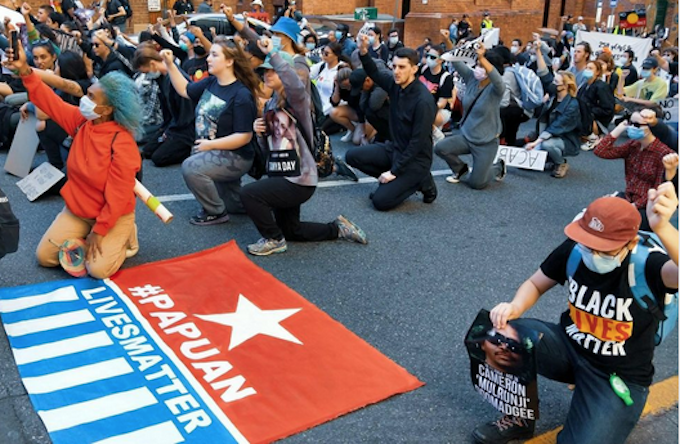
A Papuan protest
A Papuan protest . . . “there is a human rights emergency in West Papua.” Image: Tempo

Geopolitical rivalry and West Papua
The year saw intensifying rivalry between China and the US over the Pacific with ongoing regional fears about perceived ambitions of a possible Chinese base in the Solomon Islands — denied by Honiara — but the competition has fuelled a stronger interest from Washington in the Pacific.

The Biden administration released its Indo-Pacific Strategy in February, which broadly outlines policy priorities based on a “free and open” Pacific region. It cites China, covid-19 and climate change — “crisis”, rather — as core challenges for Washington.

Infrastructure is expected to be a key area of rivalry in future. Contrasting strongly with China, US policy is likely to support “soft areas” in the Pacific, such as women’s empowerment, anti-corruption, promotion of media freedom, civil society engagement and development.

The political and media scaremongering about China has prompted independent analysts such as the Development Policy Centre’s Terence Wood and Transform Aqorau to call for a “rethink” about Solomon Islands and Pacific security. Aqorau said Honiara’s leaked security agreement with China had “exacerbated existing unease” about China”.

The Pacific Catalyst founding director also noted that the “increasing engagement” with China had been defended by Honiara as an attempt by the government to diversify its engagement on security, adding that “ it is unlikely that China will build a naval base in Solomon Islands”.

However, the elephant in the room in geopolitical terms is really Indonesia and its brutal intransigency over its colonised Melanesian provinces — now expanded from two to three in a blatant militarist divide and rule ploy — and its refusal to constructively engage with Papuans or the Pacific over self-determination.

“2022 was a difficult year for West Papua. We lost great fighters and leaders like Filep Karma, Jonah Wenda, and Jacob Prai. Sixty-one years since the fraudulent Act of No Choice, our people continue to suffer under Indonesian’s colonial occupation,” reflected exiled West Papuan leader Benny Wenda in a Christmas message.

“Indonesia continues to kill West Papuans with impunity, as shown by the recent acquittal of the only suspect tried for the “Bloody Paniai’” massacre of 2014.

“Every corner of our country is now scarred by Indonesian militarisation . . . We continue to demand that Indonesia withdraw their military from West Papua in order to allow civilians to peacefully return to their homes.”

Tikoduadua asks Fiji’s police chief to resign over ‘matters of confidence’

0
Fiji Home Affairs Minister Pio Tikoduadua
Fiji Home Affairs Minister Pio Tikoduadua . . . lack of confidence in the police chief. Image: FijiOne News

Asia Pacific Report

Fiji’s Minister for Home Affairs and Immigration has invited the Commissioner of Police to resign, citing concerns on matters of confidence in him, reports RNZ Pacific.

Pio Tikoduadua said the commissioner, Sitiveni Qiliho, had, however, asked that the government follow the process of the Constitutional Offices Commission.

Minister Tikoduadua said he respected his decision, and we would let the law take its course.

Commissioner Brigadier-General Sitiveni Qiliho
Fiji Police Commissioner Brigadier-General Sitiveni Qiliho . . . asked to resign. Image: Talebula Kate/The Fiji Times

Brigadier-General Sitiveni Qiliho was formerly in the military and in July 2021 successfully completed studies at the Royal College of Defence Studies in London. He was awarded a postgraduate certificate in Security and Strategy for Global Leaders.

However, the minister added that he had no issue with the commander of the Republic of Fiji Military Forces.

Border alert
A border alert has been issued by Fiji’s Police Criminal Investigations Department (CID) for Opposition MP and former Attorney-General and Minister for Economy Aiyaz Sayed-Khaiyum.

“Mr Sayed-Khaiyum is a person of interest and is currently under investigation regarding a case of alleged inciting communal antagonism,” according to the CID.

It said it had yet to deal with Sayed-Khaiyum who was believed to be in Australia.

It said that according to his travel history, Sayed-Khaiyum had departed Fiji on 26 December 2022.

Opposition MP and former Attorney-General Aiyaz Sayed-Khaiyum
Opposition MP and former Attorney-General Aiyaz Sayed-Khaiyum . . . on border alert. Image: Fiji govt/RNZ Pacific

Meanwhile, Commissioner Qiliho said that was the normal monitoring mechanism of the CID to write to the Border Police to inform it if Aiyaz Sayed-Khaiyum returned.

Why a royal princess from the Pacific is living in Arkansas

0

Pacific Media Watch

The US tested 67 nuclear weapons on the Marshall Islands, tricking the people who lived on Bikini Atoll to leave their homeland “for the good of all mankind,” reports Al Jazeera.

But the Bikini Islanders didn’t know the US would contaminate their island and make it uninhabitable.

Now nearly 70 years later, many Marshall Islanders have moved to Springdale, Arkansas, nearly 600 miles (965 km) from the nearest ocean.

But as many Marshall Islanders build new lives there, they know Arkansas is not their permanent home, and their nuclear legacy is something both Americans and the next generation of Marshall Islanders need to remember.

The US forced the 167 islanders living on Bikini Atoll to leave in 1946 to enable American testing of nuclear weapons.

Over the next decade, the US tested 67 nuclear devices — 23 of them on Bikini.

Tabish Talib travelled to the Ozarks to learn how the Marshall Islanders are staying connected to their roots so far from their home and reports here for Al Jazeera.

“I feel like a nomad,” says a sixth generation representative of the Bikini Islanders in Arkansas, Sosylina Jibas-Maddison. “And it’s heartbreaking knowing there that we don’t have a home to go to.”

Marshall islanders mark Bikini Day on July 5, the day that is also remembered for the inaugural design of the swimsuit named by its French designer after the nuclear “bombshell”.


The AJ+ Reports documentary on the Marshall Islands in the US.

Fiji lawyer Imrana Jalal’s warning: ‘No victimisation or targeted prosecutions’

0
Fiji lawyer Imrana Jalal
Fiji lawyer Imrana Jalal . . . “Let the government slowly make its way. Give them a chance: step by step we can restore our fragile democracy.” Image: The Fiji Times

By Timoci Vula in Suva

Fiji lawyer and former human rights activist Imrana Jalal has offered a “warning” to her motherland that should people be investigated, prosecuted or dismissed, it must be done within the rule of law.

In a social media posting on her Facebook page, Jalal wrote: “A WARNING to ourselves in Fiji — it’s very important that if people are going to be investigated, dismissed, prosecuted or asked to resign voluntarily (without coercion) whether in a State-Owned Enterprise (SOE) or otherwise; or a commission of inquiry be set up, example, to look at the judiciary, that this all be done within the rule of law.

“There should be no victimisation or targeted prosecutions unless there is genuine evidence by independent investigators.

“I speak with authority on this having been targeted by the former regime personally.

“If we do otherwise, then we are no better than the corrupt regime [that has been] in power for the last 16 years.

“We need to start off the right way or we are tainted from the beginning.”

Jalal, a former Fiji human rights commissioner and previously a gender specialist with the Asia Development Bank, asked those calling for heads to roll to “be careful”.

She is the first woman to be appointed as a special project facilitator of the ADB.

‘Give our fragile democracy a chance’
“Be cautious. Refrain from this type of diatribe. No good will come of it. There can be no restoration to the rule of law like that,” she said.

“Let the government slowly make its way. Give them a chance: step by step we can restore our fragile democracy.”

Prominent Suva lawyer Graham Leung voiced similar sentiment, calling on Fijians to be patient and follow the law. He added that due process must be followed in dismissing or removing people from office.

“Arbitrary and unlawful dismissals must be avoided at all costs. There are constitutional processes for removal for some posts,” Leung said on his Facebook social media page.

“In some cases, there are legally binding contracts in place. Negotiations for early termination of contracts can take place by mutual agreement. These should be carried out professionally without malice or bad faith.

“We would be no better than the last government if we did this. Due process will take time.

“You cannot rectify and address 16 years of bad governance overnight. The change we all voted for will not happen at the press of a button.

“I urge the people of Fiji celebrating the new government’s victory and the removal of the previous authoritarian government to be patient. We will get there eventually.

“Let us not, in the excitement of the change, lose our sense of reason, fairness and logic.

“I completely accept that those [who] have broken the law must be held personally accountable, whether in the courts or according to law.”

Timoci Vula is a Fiji Times reporter. Republished with permission.

Professor thrilled over USP return – Fiji to pay $90m university debt

0
USP vice-chancellor Professor Pal Ahluwalia with USP students and staff at Suva's Laucala campus
USP vice-chancellor Professor Pal Ahluwalia with USP students and staff at Suva's Laucala campus ... exonerated by five inquiries but forced into exile in Samoa by the FijiFirst government. Image: Linked-In/Asia Pacific Report

By Felix Chaudhary in Suva

Exiled University of the South Pacific vice-chancellor Professor Pal Ahluwalia says he is thrilled at the prospect of returning to Fiji.

Speaking to The Fiji Times from Los Angeles in the United States yesterday, he said Prime Minister Sitiveni Rabuka — when he was in opposition — made a commitment to pay Fiji’s outstanding debt of $90 million to USP and to allow him to return to Fiji.

“Mr Rabuka said it, National Federation Party leader Professor Biman Prasad said it, and the Social Democratic Liberal Party leader also said it,” Professor Ahluwalia said.

“So it’s part of all three parties’ manifestos and part of their public statements, so we as a university are delighted that this amount that has been outstanding for so long will finally come to the university.

“It’s excellent news, not just for the Fijian students but for the entire region because the region has been carrying Fijian students for quite a while and there will now be a chance for us to do a lot of things that we have deferred and not been able to do, particularly issues around maintenance.

“It also means we can now aggressively look for quality academic staff.”

Rabuka issued a statement on Boxing Day saying the prohibition order against Professor Ahluwalia had been lifted and he was welcome to travel to Fiji at any time.

Professor Ahluwalia and his wife Sandra Price claimed that on Wednesday February 3, 2021, 15 people made up of immigration officials and police stormed into their USP home and forcefully removed them at about 11.30pm.

They claimed they were driven the same night to Nadi International Airport and deported on the morning of Thursday, February 4, to Australia.

The FijiFirst government on February 4, 2022 issued a statement that the Immigration Department had ordered Professor Aluwahlia and his partner Sandra Price to leave Fiji with immediate effect following alleged “continuous breaches” by both individuals of Section 13 of the Immigration Act.

Government said under Section 13 of the Immigration Act 2003, no foreigner was permitted to conduct themselves in a manner prejudicial to the peace, defence, public safety, public order, public morality, public health, security, or good government of Fiji.

Fiji now a ‘free country’
RNZ Pacific reports that Finance Minister Professor Biman Prasad said all three parties in the coalition had promised this in their election campaigns and manifestos.

The former FijiFirst government have withheld the payments since 2019 over a protracted battle with Professor Ahluwalia, now operating in exile out of Samoa.

“They didn’t like a man who was doing the right thing who exposed corruption within the university,” Professor Prasad said.

“And it has done you know, to some extent, terrible damage not only to the university, but also the unity in the whole region.”

In July, the two unions representing staff at the university said the Fiji government owes the institution F$78.4 million and the debt has increased since then.

“Well, I can’t tell you the timetable, but all I can say is…that the university will receive the appropriate funding, as well as the government will pay what is due as a result of the previous government withholding the grant to the university,” Professor Prasad said.

His revelation comes after the government statement by Prime Minister Rabuka inviting Professor Ahluwalia to return to Fiji.

Personal apology
Rabuka said he wanted to apologise to Professor Ahluwalia in person upon his arrival for the way he had been treated by Fiji.

The prime minister has also invited the widow of exiled Fijian academic, Professor Brij Lal, who passed away on Christmas Day last year to bring home his ashes for burial at Tabia near Labasa.

Professor Prasad said they look forward to welcoming home more Fijians and expatriates exiled during Voreqe Bainimarama’s 16-year-reign.

“Fiji is now a free country. We will welcome everyone who wants to come to Fiji. No one should fear about any kind of vindictiveness or harassment,” Professor Prasad said.

“That is what we promised during our campaign, and that is what this government will deliver.”

Felix Chaudhary is a Fiji Times reporter. Republished with Fiji Times permission. This article is also republished under a community partnership agreement with RNZ. 

Exiled USP chief, Dr Lal now free to enter Fiji, says Rabuka

0
Professor Pal Ahluwalia on his deportation flight in 2021
Professor Pal Ahluwalia on his deportation flight from Fiji in 2021 . . . treatment by the previous Fiji government was "unreasonable and inhumane". Image: Fiji Sun

By Josefa Babitu in Suva

The greenlight has been given to University of the South Pacific vice-chancellor, Professor Pal Ahluwalia, and Dr Padma Lal, to return to Fiji by Prime Minister Sitiveni Rabuka.

Professor Ahluwalia was deported in 2021 and Dr Lal — widow of the late leading Fiji academic Professor Brij Lal — was refused entry to Fiji along with her husband.

Exiled Professor Ahluwalia currently resides in Samoa and Dr Lal in Australia.

Rabuka has made it clear today that both of them are free to enter the country.

“I am ready to meet Dr Lal and Professor Ahluwalia personally,” he said.

“I will apologise on behalf of the people of Fiji for the way they were treated.”

Dr Lal had been prevented from coming to Fiji with her husband’s ashes for them to be taken to his birthplace at Tabia, near Labasa.

First anniversary
Today marks the first anniversary of Professor Lal’s death.

Rabuka said prohibition orders against Professor Brij Lal and Dr Lal, as well as Professor Ahluwalia, were “unreasonable and inhumane” and should never have been made.

He had promised his government would bring to an end the injustices suffered by Professor Ahluwalia, and Professor Lal.

“I received a clarification today from the Department of Immigration that neither Dr Padma Lal nor Professor Ahluwalia were the subject of written prohibition orders,” he said.

Josefa Babitu is a Fiji Sun reporter. Republished from the Fiji Sun.

Benny Wenda: A West Papuan Christmas message

0
West Papuan leader Benny Wenda speaking recently at Queen Mary University of London
West Papuan leader Benny Wenda speaking recently at Queen Mary University of London . . . "The struggle for West Papuan liberation is a struggle for humanity, dignity, and fundamental rights." Image: ULMWP/Asia Pacific Report

CHRISTMAS MESSAGE: By Benny Wenda

As 2022 draws to a close, I would like to thank everyone who has supported the West Papuan struggle this year. To our worldwide solidarity groups, including those within Indonesia, to Alex Sobel and the International Parliamentarians for West Papua (IPWP), the International Lawyers for West Papua, to our friends in the Basque Country and Catalonia, the Pacific Conference of Churches, the government of Vanuatu and all our supporters in the Pacific: my deepest thanks.  

The struggle for West Papuan liberation is a struggle for humanity, dignity, and fundamental rights. By supporting us, you are making history in the fight against modern day colonialism. 

2022 was a difficult year for West Papua. We lost great fighters and leaders like Filep Karma, Jonah Wenda, and Jacob Prai. Sixty-one years since the fraudulent Act of No Choice, our people continue to suffer under Indonesian’s colonial occupation.

Indonesia continues to kill West Papuans with impunity, as shown by the recent acquittal of the only suspect tried for the “Bloody Paniai’” massacre of 2014. 

Every corner of our country is now scarred by Indonesian militarisation. This month, nearly 100 West Papuans on Yapen Island were displaced from their villages by a sudden wave of military operations. Along with tens of thousands of West Papuans displaced since 2019, they will be forced to spend Christmas in the forest, as refugees in their own lands.

We continue to demand that Indonesia withdraw their military from West Papua in order to allow civilians to peacefully return to their homes. 

At the same time, support for the ULMWP and for West Papuan independence has continued to grow. Our voice is being heard — nearly half the world’s nations have now urged Indonesia to facilitate a UN Human Rights visit to West Papua, including the member nations of the Pacific Islands Forum, the Organisation of African, Caribbean, and Pacific States, the EU Commission, Netherlands and the UK.

In July, we signed an historic Memorandum of Understanding with our Melanesian brothers and sisters in Kanaky, strengthening the bonds of friendship and solidarity that have always connected our two movements.

In October, countries including Australia, Canada, and the US called for immediate investigation of rights abuses in West Papua at the UN, while the Marshall Islands called for West Papuan self-determination. Throughout the year, we have continued to build up our infrastructure on the ground.

We are ready to reclaim the sovereignty that was stolen from us and govern our own affairs. 

To all West Papuans, whether in exile, prison, in the bush or the refugee camps, I say your day will come. Though the road to freedom is long and hard, we are making incredible progress at all levels.

One day soon we will celebrate Christmas in an independent West Papua. Until then, we must be strong and united in our struggle. As our national motto says, we are One People with One Soul. 

To everyone around the world reading this message, I urge you to remain steadfast in your support for West Papua. Please pray for all West Papuans who cannot celebrate this Christmas, whether in Yapen Island, Nduga, Puncak Jaya, or elsewhere. Until we win our freedom, we need your solidarity.  

On behalf of the ULMWP and the people of West Papua, thank you and Merry Christmas. 

Benny Wenda
Interim President
ULMWP Provisional Government

United Liberation Movement for West Papua solidarity workers in London, United Kingdom
United Liberation Movement for West Papua (ULMWP) solidarity workers in London, United Kingdom. Image: ULMWP

A knife-edge election in Fiji sees power shift – and a chance to bring back real democracy

0
This time, Sitiveni Rabuka (pictured) and Voreqe Bainimarama — both former military leaders and coup makers — have used Fiji's democratic electoral system rather than guns and force to try to win to power
This time, Sitiveni Rabuka (pictured, blue bula shirt) and Voreqe Bainimarama — both former military leaders and coup makers — have used Fiji's democratic electoral system rather than guns and force to try to win to power. Image: TVNZ screenshot APR

ANALYSIS: By Steven Ratuva, University of Canterbury

When the final election results were announced around 4pm on Sunday, many Fijians, at home and around the world, breathed a collective sigh of relief: the government of coup-maker Voreqe Bainimarama looked like it had finally been defeated at the ballot box.

Could it be that the militarised political culture, pervasive in Fiji since the 1987 coups, was finally being effectively challenged — peacefully?

Bainimarama’s FijiFirst Party (FFP) collected 42.55 percent of votes, well short of the majority needed to return to power. The closest rival, the People’s Alliance Party (PAP), led by 1987 coup leader Sitiveni Rabuka, won 35.82 percent, followed by the National Federation Party (NFP) on 8.89 pecent and the Social Democratic Liberal Party (Sodelpa) with 5.14 percent of the votes.

Total voter turnout was 68.28 percent, less than the 71.92 percent at the 2018 election. With the Unity Fiji and Fiji Labour parties not reaching the required 5 percent threshold to gain seats under Fiji’s proportional representation system, the maths indicated a dead heat –– and some anxious coalition horsetrading.

The vote shares mean FFP will have 26 seats in the new 55-seat Parliament, the PAP 21, NFP 5 and SODELPA 3. The PAP and NFP had already signed a pre-election agreement to form a coalition, meaning they are tied with the FFP on 26 seats.

Led by Viliame Gavoka, Sodelpa was suddenly thrust into the role of kingmaker. Given its fraught history with both FFP and PAP, the stage was set for some hard bargaining on all sides this week.

Family ties
The PAP, in fact, is a breakaway faction of Sodelpa. The divorce was bitter and littered with bruised souls. A faction within Sodelpa wanted nothing to do with Rabuka and the PAP.

On the other hand, Sodelpa’s relationship with FijiFirst has been equally strained. The founding leader of Sodelpa, the late prime minister Laiseni Qarase, was deposed, arrested and jailed following Bainimarama’s 2006 coup.

But there is a personal link between Sodelpa and the FFP, whose secretary general (as well as Attorney-General and Minister for the Economy in the previous government) is Aiyaz Sayed-Khaiyum. An Indo-Fijian Muslim, Sayed-Khaiyum is the son-in-law of Sodelpa leader Viliame Gavoka, an indigenous Fijian (Taukei).

Sodelpa party leader Viliame Gavoka
Sodelpa party leader Viliame Gavoka . . . his son-in-law is the outgoing Attorney-General and Minister for the Economy  Aiyaz Sayed-Khaiyum, an Indo-Fijian Muslim. Image: RNZ Pacific

While this multiracial connection may have its political advantages, the reality is that many in Sodelpa vehemently oppose Sayed-Khaiyum for what they view as his imposing and arrogant style.

Return of Rabuka
There were early indications that Sodelpa might go with the PAP and NFP partnership to form a grand coalition, and that played out as by Friday the party’s management board had carried out two votes, both giving a very narrow margin in support of the grand coalition (16-14 then 13-12). Ideologically and politically, Sodelpa and PAP share the same basic vision and strategies regarding indigenous Fijian issues — after all, they were once the same party.

Gavoka and Rabuka are similar in various ways. They both have ethno-nationalist tendencies and embrace fundamentalist evangelical Christian doctrines. Gavoka has advocated setting up a Fijian embassy in Jerusalem, and Rabuka has been known as an admirer of Israel since he was commander of Fijian peacekeepers in the Middle East in the 1980s.

Furthermore, Sodelpa has been under pressure from its international and local branches (which fund the party) not to entertain any FFP coalition proposals. The message coming through from supporters is that their votes for Sodelpa were also votes against FFP.

There have also been fears that an alliance between Sodelpa and FFP could provoke old grievances and escalate into wider political instability.

Lastly, “non-negotiables” laid down by Sodelpa include enacting policies that promote indigenous Fijian interests (including the reinstatement of the Great Council of Chiefs (which Bainimarama abolished), forgiving scholarship debt and setting up a Fiji embassy in Jerusalem.

These are similar to the PAP policies in the party manifesto but quite different from the FFP positions.

Culture change
If the election sees FijiFirst finally leave power, there is the potential for democratic progress. One of the major challenges for an incoming new government will be reform of the country’s civil service, judiciary, education and health systems, and the economy in general.

Over the years, Fiji society has been configured in ways that suit the narrow ideological interests and centralised control of the FFP. Security, public order and media laws have been used to undermine democratic debate, free expression and public engagement.

Democratising the institutions of state and making them more relevant will be a huge task. It will require significant financial, political and intellectual resources. It also has ramifications in the wider Pacific region, given Fiji’s role as an economic, communications and political hub.

Many Pacific leaders, including in Australia and New Zealand, have been unhappy with Fiji under the Bainimarama-Kaiyum axis. Actions such as the government’s refusal to release more than FJ$80 million in funding for the University of the South Pacific — creating a major crisis at the regional institution — only reinforce such perceptions.

This time, Rabuka and Bainimarama — both former military leaders and coup makers — have used the democratic electoral system rather than guns and force to try to win to power. But behind them sits a culture of command and control that will be difficult to dislodge.

This is subtly woven into various aspects of the 2013 Constitution, such as the role of the military as the nation’s constitutional security watchdog. But there is growing confidence that the chances of another military coup following this election are virtually nil.

Fiji’s civil service and operations of state have incorporated micromanagement, authoritarianism and coercion as part of the institutional culture. The test will be to ensure that a coalition of parties can rule together in a way that expands political participation and enhances democracy.The Conversation

Dr Steven Ratuva is director of the Macmillan Brown Centre for Pacific Studies, University of Canterbury. This article is republished from The Conversation under a Creative Commons licence. Read the original article.

Tight police security for new Sodelpa party board meeting with Fiji’s political future at stake

0
Chief Sodelpa negotiator Anare Jale (middle), former MP Ro Teimumu Kepa (left) and former Sodelpa leader, Ratu Manoa Rorogaca, now party president, announce Sodelpa's choice of coalition partner in Suva on Tuesday
Chief Sodelpa negotiator Anare Jale (middle), former MP Ro Teimumu Kepa (left) and former Sodelpa leader, Ratu Manoa Rorogaca, now party president, announce Sodelpa's choice of coalition partner in Suva on Tuesday. Image: Kelvin Anthony/RNZ Pacific

By Arieta Vakasukawaqa in Suva

Tight police security will greet the Sodelpa management board meeting in Suva tomorrow when it will again decide the political party it will form a coalition with to run the Fiji government for the next four years.

The decision came after hours of deliberation today by the Sodelpa working committee — headed by party acting deputy leader Aseri Radrodro — where members discussed the “anomalies” in the previous board meeting held at the Yue Lai Hotel in Suva on Tuesday.

That meeting of the 30-member board decided by a margin of 16-14 to form a coalition with the People’s Alliance party of former prime minister Sitiveni Rabuka and the National Federation Party. This would give the coalition a slender majority of 29 in the 55-seat Parliament.

However, some issues were identified by the Registrar of Political Parties, Mohammed Saneem, after that Sodelpa board meeting.

Speaking to news media today, Radrodro said the agenda of the new meeting was to decide which party they would join.

The meeting will be held at the Southern Cross Hotel in Suva at 10am tomorrow.

Sodelpa’s negotiating team will be headed by party vice-president Anare Jale.

Arieta Vakasukawaqa is a Fiji Times journalist. Republished with permission.

Military forces deployed
Meanwhile, RNZ Pacific reports that Fiji’s military forces are being deployed to maintain security and stability in the country following reports of threats made against minority groups.

In a statement yesterday afternoon, Fiji Police Commissioner Sitiveni Qiliho announced the move, calling it a joint decision with the commander of Fiji’s military forces, Major-General Jone Kalouniwai.

Fiji Police Commissioner Sitiveni Qiliho
Fiji Police Commissioner Sitiveni Qiliho . . . reports and intelligence received of planned civil unrest and the targeting of minority groups. Image: Fiji police/RNZ Pacific

As of 3pm Fiji time, RNZ Pacific’s correspondent in Suva, Kelvin Anthony, reported there were no visible signs of increased police or military presence.

Commissioner Qiliho said the decision was based on official reports and intelligence received of planned civil unrest and the targeting of minority groups.

The military deployment comes less than 24 hours after the ruling FijiFirst party made its first public statement since the December 14 election.

Party secretary-general Aiyaz Sayed-Khaiyum said they respected the outcome of the election, but did not recognise the validity of the opposition coalition and would not concede defeat.

Sayed-Khaiyum said under the country’s constitution, the FijiFirst government remained in place and Voreqe Bainimarama was still the prime minister of Fiji.

He said this could only be changed once the vote for prime minister was held on the floor of Parliament.

Under section 131 (2) of Fiji’s constitution, the military has the “overall responsibility” to ensure the security, defence and wellbeing of Fiji and all Fijians.

This article is republished under a community partnership agreement with RNZ. 

Fiji’s kingmaker party in no rush – considering all options for new government coalition

0
Sodelpa leader Viliame Gavoka
Sodelpa leader Viliame Gavoka . . . "We are not in any hurry" to decide about the coalition partners. Image: Elena Vacukulata/ The Fiji Times

By Koroi Hawkins

The Social Democratic Liberal Party (Sodelpa) has emerged as the kingmaker in Fiji’s contentious 2022 general election and its leader Viliame Gavoka is in no rush to punch his golden ticket.

After a nightmare leadup to the election, with infighting resulting in a massive split in the party, many punters had all but written Sodelpa off ahead of last week’s polls.

The major opposition political party in the last Parliament, Sodelpa is now a shadow of its former self, just scraping through the electoral system’s 5 percent threshold by the skin of its teeth.

Its three Parliamentary seats are the lowest number of any party in the new Parliament and its leadership will be all too aware that the kingmaker position it now finds itself in — courted by parties on all sides — is probably the most leverage it will have for the coming four-year-term.

Speaking to media in the capital Suva yesterday, Gavoka said the party had 14 days to consider its options.

“We are not in any hurry, we understand the importance of this but we’re not gonna rush. We are going to do this properly but with urgency,” he said.

Gavoka said they were speaking to all parties but he was keeping his distance from the process.

“I am not part of the negotiating team. We set the parameters for negotiations, and we have redefined what is non-negotiable and what is negotiable and that is handed over to the negotiating team to talk to both parties,” he said.

“All those policies were collectively framed by the management board.”

So, what are Sodelpa’s non-negotiables?
Given that Sodelpa’s campaign slogan was “Time for change”, Gavoka is going to have to come up with something better than “we will make the best decision for Fiji” to convince his hardcore followers to swallow the pill of a partnership with FijiFirst.

Gavoka has provided assurance to Sodelpa’s supporters that whatever coalition it agrees to, its iTaukei policies will prevail:

  • Reestablishment of the Great Council of Chiefs;
  • Education policy — free tertiary and forgiveness of the student loan (TELS); and
  • Set up an embassy in Jerusalem. “Fiji being a very Christian country, we want our presence in the Holy Land.”

When Gavoka was pressed by media on his close family ties to FijiFirst’s general secretary – his son-in-law, Aiyaz Sayed-Khaiyum, his response appeared non-committal.

“You know, we’ve been political rivals in Parliament for eight years and that’s pretty clear. In the form of Parliament, there’s no family but outside Parliament you’re family.”

On the other hand, there is lingering distrust between Sodelpa and its former leader Sitiveni Rabuka, whose new People’s Alliance Party has emerged the runner-up in its election debut with 21 parliamentary seats, just behind FijiFirst’s 26.

Rabuka believes a partnership with Sodelpa is the best fit.

‘Natural for us’
“I think it’s natural for us to forge a coalition because when we look at our manifestos and policies, and vision statements, etc. they are in harmony and all of them individually and collectively are diametrically opposed to the FijiFirst policy reforms,” Rabuka said.

No agreement has yet been signed by either but talks are underway.

“We’ve taken it as far as they gave us the opportunity for yesterday, we provided our team to talk with the team, and the result of that has not come back to us,” said Rabuka.

Rabuka has confirmed that he has not spoken directly to the Sodelpa leader.

“I’m in the process of doing so.”

Gavoka, however has said he would rather not.

“You don’t want to insert yourself into the negotiations. Our people are negotiating with their people. The two leaders are best to stay apart. That’s the way I’d like to do it,” said Gavoka.

The other potential coalition partner should Sodelpa go with Rabuka over Bainimarama is the National Federation Party, led by Professor Biman Prasad.

‘A reasonable man’
Sodelpa and NFP have spent the past two parliamentary terms in the opposition.

“I’ve had a talk with the Sodelpa team, and also met the leader Bill.

“Bill and I have worked together before and he has always been a reasonable man,” Professor Prasad said.

“I think he understands the enormity of why people have voted us from the opposition and voted for a new government. And I’m sure he understands it, we understand it, and Mr Rabuka understands it and I think it looks very positive.”

The Sodelpa management board will be meeting today to consider both coalition proposals.

Meanwhile, despite RNZ Pacific attempts to get comments from FijiFirst it has not received a response.

Koroi Hawkins is a RNZ Pacific journalist. This article is republished under a community partnership agreement between Asia Pacific Report and RNZ. 

Final results of the Fiji general election
Final results of the Fiji general election showing just the four parties that met the 5 percent threshold. Image: Fijivillage